
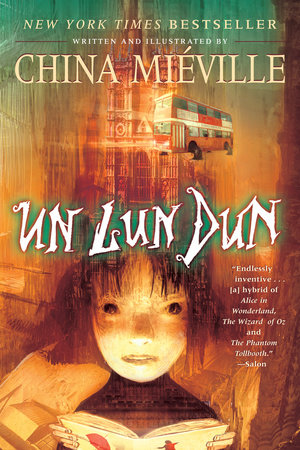
Un Lun Dun
Twelve-year-old Zanna and her friend Deeba discover a way out of London and into UnLondon, a strange parallel city where discarded things and overlooked people find their place.
About
Spoiler notice: Spoilers cover the opening discovery of UnLondon and the prophecy that appears to identify its expected hero. The account withholds the early reversal, later choices and turns, character fates, and ending.
Un Lun Dun begins with a familiar threshold: two children from London discover a route into another world. China Miéville quickly makes the other side feel less like a distant kingdom than a distorted city grown from the life of the one they know. UnLondon gathers what ordinary London loses, breaks or fails to notice, along with people who have slipped through its attention. This premise gives the book a distinctive way to make urban neglect visible. The hidden place is not an ideal alternative waiting to be admired; it is a crowded, unruly consequence of the city above it. Zanna and Deeba arrive as visitors, but the people and dangers they meet make clear that UnLondon has its own history and needs.
The city’s inventions are often built from things that would otherwise seem too small to carry a story. Words are alive; an ordinary doorway can open onto jungle; carnivorous giraffes roam the streets. Among the inhabitants are Brokkenbroll, who rules over broken umbrellas, Obaday Fing, a tailor with a pincushion for a head, and Curdle, an empty milk carton. These ideas are not just a parade of oddities. They make the book’s central transformation literal: what a city discards can return with agency, personality and danger. Miéville’s own illustrations accompany the novel, giving its invented forms a visual dimension as well as a verbal one. The result invites attention to names, objects and definitions, because even the apparently useless may have a life beyond the role assigned to it.
Zanna and Deeba are twelve-year-old friends whose entrance into UnLondon seems to match a story the city already knows. A prophecy says a hero is coming, and a talking book appears to set that expectation down in advance. The setup gives the girls a place inside a quest, but it also makes the idea of a destined saviour available for scrutiny. In a 2007 interview, Miéville described the novel as a story for younger readers about children crossing into a stranger place, and said it played with assumptions attached to Golden Child stories. That comment helps clarify the tension already present in the premise: a prophecy may shape how people interpret events, but it cannot decide what its supposed hero will actually do.
The Smog gives this playful world a danger that is both fantastical and plainly destructive. The publisher describes it as a dark cloud dreaming of burning the world; Miéville’s interview, careful not to spoil the story, likewise mentions monsters and a twisted city. Against that threat, the novel keeps asking what counts as courage when the expected pattern of adventure begins to fail. Its fantasy is not organized around a clean separation between ordinary life and a magical place. UnLondon is made from the forgotten matter of an actual city, and its fate depends on how its visitors respond to inhabitants and problems that prophecy alone cannot explain. The conflict therefore links the book’s exuberance with questions about who is seen, who is valued, and who gets named a hero.
The choice of two friends as the travellers gives the story a relationship at its centre, even as the setting threatens to overwhelm them with new sights and rules. Zanna and Deeba do not enter the city as identical figures, and the description of the novel makes their shared discovery the beginning rather than the solution. Miéville’s account of writing for younger readers points to the freedom of fairy-tale logic: transformations and impossible creatures can be accepted on their own terms, without needing the machinery of realism to justify them. That freedom lets the book move rapidly between jokes, wonder and peril. The friendship remains an anchor for readers as the city’s strange systems unfold, while each encounter tests how much a ready-made story can tell them about the people around them.
Language itself is part of UnLondon’s landscape. Living words suggest that speech and writing can act in the world instead of merely describing it; a talking book turns a familiar object of guidance into a participant in the action. Those devices suit a novel that is alert to how stories establish expectations. The prophecy supplies a script, while the city’s shifting objects continually exceed the categories placed on them. Even the title points toward a transformed version of London rather than a wholly unrelated realm. Miéville has described the book as drawing on traditions of portal fantasy, including stories of children entering stranger worlds, while bringing that structure into an urban setting. The combination makes the novel’s play with heroic convention concrete: the story’s language and objects take part in the same argument as its characters.
First published in 2007, Un Lun Dun is a young adult fantasy adventure shaped by reversal, invention and the texture of a city. The selected paperback edition is the 496-page Del Rey book published in January 2008; that edition date is later than the novel’s original publication year. Miéville wrote and illustrated the book, and his contemporary interview shows how personally he regarded the pictures, while emphasizing that the tale should work as a story in its own right. The novel’s broad appeal follows from that balance. Its bizarre creatures and comic objects give younger readers immediate pleasures, while its treatment of prophecy, waste and attention offers more to consider beneath the quest. Readers can expect an energetic journey through a London remade from its overlooked parts, with a deliberate question hanging over every promise of a chosen hero.
Book details
- Author
- China Miéville
- First published
- 2007
- Series
- No series listed
- Subgenre
- Portal fantasy, Young adult fantasy, Adventure fiction
- Tags
- No tags for this book.
Review
Editor profile
Baby Bat
Goodreads and social links will be added soon.
- Goodreads — link coming soon
- Social media — link coming soon