
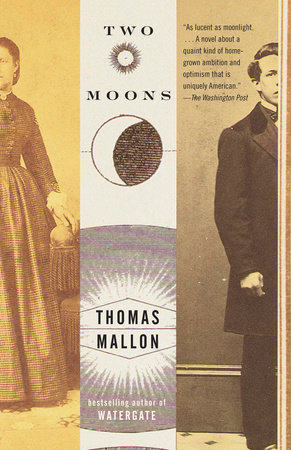
Two Moons
In 1877 Washington, Civil War widow Cynthia May takes a job as a human computer at the Naval Observatory, where she meets astronomer Hugh Allison.
About
Spoiler notice: Spoilers cover the opening setup: Cynthia May takes a position at the Naval Observatory in 1877 and becomes involved in Hugh Allison’s ambitious scheme. Later developments and the ending are withheld.
In the spring of 1877, Cynthia May arrives at Washington’s Naval Observatory looking for work. She is a Civil War widow in her thirties, and financial worry has narrowed her options. The Observatory needs people able to perform calculations by hand, a task then described as computing, and Cynthia’s mathematical skill brings her into the scientific world of astronomer Hugh Allison. From that meeting grows the novel’s central tension between practical work and extravagant ambition. Hugh has imagined a scheme that could make him live forever in the annals of science and space. Mallon builds his story from this meeting of a capable woman seeking a stable place in the world and a man whose plans reach far beyond it.
The title points toward the astronomical discovery that gives the book its historical moment: the two moons of Mars, identified in 1877. But the novel’s concerns are not confined to astronomy. At the Observatory, the heavens become an object of measurement, calculation and imagination, while the people doing that work remain subject to the ordinary pressures of money, employment and social position. Cynthia’s work as a human computer connects her mathematical ability to a larger scientific enterprise, yet it also places her among people whose ambitions do not always share her practical scale. The contrast gives Mallon room to explore how a discovery can mean different things to a scientist, a worker, a politician and an astrologer. In this story, looking upward does not free the characters from earthly interests; it makes those interests newly visible.
Mallon sets the action in Reconstruction-era Washington, a city still shaped by the Civil War and its aftermath. Government power and scientific progress occupy the same landscape, and the Observatory is exposed to both. Senator Roscoe Conkling, a real political figure, becomes one of the forces in Cynthia’s orbit as she and Hugh pursue their plans. A fraudulent astrologer also enters the story, and that figure places mystical prediction beside scientific calculation. These elements create a setting where competing ideas about evidence, influence and the future meet. The historical background gives the characters more than period clothing and landmarks: politics affects what resources can be obtained, while public ambition affects what kinds of projects attract attention. Washington becomes a place where private desires must negotiate with institutions and people who hold very different kinds of power.
Cynthia stands at the centre of these overlapping worlds. Her route to the Observatory begins in material need, and her mathematical work offers a chance to use a particular talent in a field usually associated with men. The novel presents her as intellectually alert and independent-minded, while the circumstances around her remind the reader that ability alone does not determine a woman’s choices in the nineteenth century. Hugh sees her as the partner he needs for his celestial plan; she must decide what that partnership means to her. Their relationship therefore develops alongside questions of labour, affection and self-direction. Cynthia is not simply carried into a man’s adventure. Her judgment and aims shape how she responds to the people who court her attention, and the work she performs gives her a perspective on the grand designs surrounding her.
The other major figures sharpen that tension. Hugh’s project is imaginative and audacious, but it depends on objects, money and access beyond the Observatory. Conkling represents political influence and the ability to open or close those routes. The astrologer offers another kind of authority, based on claimed knowledge of what is to come. Cynthia has to move among these claims while relying on her own reasoning and experience. Mallon’s premise lets history and invention meet: a genuine senator enters a fictional story alongside imagined characters, and a real astronomical milestone becomes part of a romantic and speculative plot. The result is a novel interested in how people use power and knowledge, and in how a person with limited means navigates plans devised by those with greater reach. Its conflict grows from differences in scale as much as from differences in belief.
Two Moons joins literary and historical fiction through a focused setting, a working woman at its centre and an idea that reaches literally toward the stars. The Naval Observatory supplies a place where calculations can be exact while human motives remain mixed. The Washington of 1877 brings political pressure and the lingering effects of war into a story also concerned with romance, scientific discovery and the wish to leave a mark on the world. Mallon’s setup invites readers to consider the distance between a grand public ambition and the quieter needs of the person asked to help achieve it. Cynthia’s perspective keeps the novel grounded in questions of livelihood, choice and companionship even as Hugh’s imagination enlarges the frame. The book’s defining combination is therefore intimate and expansive: one woman’s search for work intersects with a scheme meant to address the vastness of space.
Book details
- Author
- Thomas Mallon
- First published
- 2000
- Series
- No series listed
- Subgenre
- Literary historical fiction, Historical fiction
- Primary genre
- Historical Fiction, Literary Fiction
- Tags
- No tags for this book.
Review
Editor profile
Baby Bat
Goodreads and social links will be added soon.
- Goodreads — link coming soon
- Social media — link coming soon