
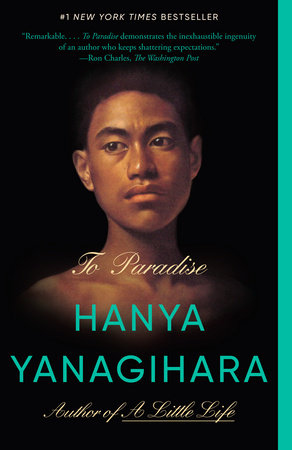
To Paradise
In three New Yorks set in 1893, 1993 and 2093, different people named David, Charles and Edward confront love, family and the limits of freedom.
About
Spoiler notice: Spoilers cover the three settings, principal characters and opening situations in 1893, 1993 and 2093. Later revelations, major turns and the ending are withheld.
To Paradise places three stories in New York, each a century apart, and lets them speak to one another without making them a single continuous family saga. The dates are 1893, 1993 and 2093. Across them, names and images return in altered forms: a Washington Square townhouse, people called David, Charles and Edward, and recurring questions about who gets to feel safe or at home. Hanya Yanagihara has described the book as her America novel. That description fits its scale: each part imagines a different country, while the characters face intimate decisions about love, kinship and what they owe one another. The city is more than a landmark shared by three plots. Its closeness, wealth and sharp disparities give the separate lives a common pressure. People arrive there to change their standing or leave something behind, yet the city also places them beside strangers whose lives follow very different rules. That proximity lets the book move between private households and larger civic questions without leaving its central streets.
The first section begins in an alternate 1893, where New York belongs to the Free States. The social order appears to permit same-sex couples to marry, yet legal possibility does not settle the private questions of desire, family and status. David Bingham, a young man from a distinguished and wealthy family, is expected to accept a suitable male suitor. He is drawn instead to a music teacher without money or standing. The familiar shape of a courtship story is present, but its terms have been rearranged. Yanagihara’s imagined republic makes room for forms of life excluded elsewhere, then asks what freedom means when class, inheritance and family expectation still determine the choices available to an individual. The future David seeks may be less simple than the promise offered by his society.
A century later, the second story moves to Manhattan in 1993. David Bingham is now a young Hawaiian man working as a paralegal, and he lives with Charles, his older and much wealthier partner. The AIDS epidemic surrounds their lives. David keeps parts of his childhood and the fate of his father from view, so intimacy has to contend with what can be said, what must be hidden and what another person can know. The distance from the first David is clear, but the repeated names invite comparison without guaranteeing that these are the same people reborn or directly descended from one another. Their echoes are part of the book’s design. The reader is asked to notice how a name or a home gathers new meanings when the social rules, dangers and available protections have changed.
In 2093, New York is shaped by successive plagues and an authoritarian government. Charlie, the granddaughter of a powerful scientist, tries to make sense of a life organized around illness, surveillance and the absence of her husband. The future is not presented as a distant landscape stripped of ordinary feeling. People continue to form attachments and seek small measures of pleasure even under political control. Yanagihara has said that she wanted this lived texture to remain visible alongside the regime’s oppression. That choice keeps the story near Charlie’s relationships and uncertainties, even as the conditions around her grow more extreme. The book’s recurring concerns—fear, dependence, illness, protection—change register here, where care can be both necessary and bound up with power.
Taken together, the three parts test the promise that a society can offer paradise to everyone. The Free States’ legal freedoms do not remove wealth and family as forces; 1993’s private household exists against a public health emergency; and the future state invokes collective safety while restricting life. Yanagihara has said that the stories are animated by uncertainty about what America was and what it might become, and by the sacrifice people justify to protect those they love. The novel does not turn those questions into a neat argument with one answer. Instead, it shifts settings and relationships, letting each section complicate what the previous one seemed to promise. Protection can be an expression of love, but the desire to protect may also narrow another person’s freedom.
The structure rewards attention to resemblance and difference. Readers encounter three versions of New York rather than one setting observed across a character’s lifetime. Repeated names, houses and kinds of relationship create links, while the altered histories keep each story distinct. Yanagihara has connected the choice of 1893 to the end of a century and to an uneasiness about what follows; the matching 1993 and 2093 dates extend that pattern into the near past and imagined future. The result moves between historical fiction, contemporary tragedy and speculative dystopia. Its scale comes from the accumulation of separate lives, not from a single explanatory timeline. To Paradise keeps returning to a difficult question: if love asks us to protect one another, how do we tell protection from control?
Book details
- Author
- Hanya Yanagihara
- First published
- 2022
- Series
- No series listed
- Subgenre
- Literary fiction, Historical fiction, Dystopian
- Primary genre
- Literary Fiction, Historical Fiction, Sci-Fi
- Tags
- No tags for this book.
Review
Editor profile
Baby Bat
Goodreads and social links will be added soon.
- Goodreads — link coming soon
- Social media — link coming soon