
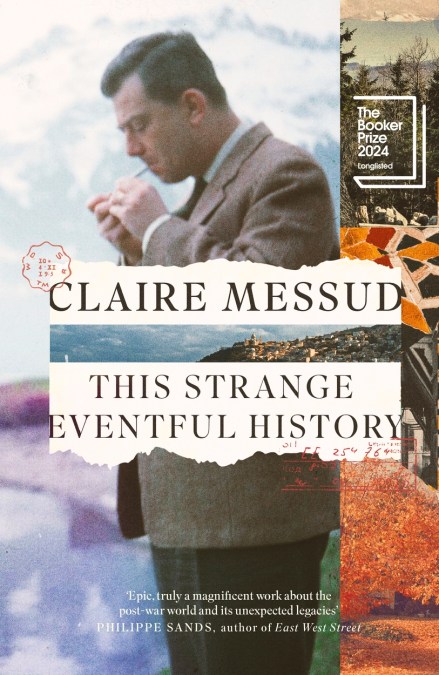
This Strange Eventful History
In June 1940, as Paris falls to the Germans, French naval attaché Gaston Cassar is separated from his wife and children.
About
Spoiler notice: Spoilers for the opening separation in June 1940 and broad family premise; later developments and the ending are not described.
Claire Messud’s This Strange Eventful History follows the Cassars, a French family whose lives are shaped by colonial Algeria, war, separation and migration. It opens in June 1940, as Paris falls to German forces. Gaston Cassar, a French naval attaché in Salonica, must part from his wife, aunt and children, trusting that they can reunite after the crisis. This separation establishes the novel’s central condition: private attachments persist while political events rearrange where people can live and what they can call home. The story moves across seven decades, from 1940 to 2010, following three generations across several countries. Large events are experienced through domestic bonds, inherited beliefs and the practical demands of making a life somewhere new.
The family’s geography is wide. The Cassars move among Salonica, Algeria, the United States, Cuba, Canada, Argentina, Australia and France. These places are more than settings; movement between them gives shape to the family’s search for continuity. The opening separation sends Gaston’s wife and children back toward Algeria while his work keeps him elsewhere, and the family story continues to cross borders. Each move places them in new social and political conditions, while the remembered idea of home travels with them. The novel joins a map of migration to an intimate study of kinship. It asks how a family maintains a sense of itself when its members are dispersed, and how attachment to a place survives when history changes it or makes it unavailable as home.
Messud has said that she wanted to explore the history of her father’s family, French colonials from Algeria who lived in many places before and after Algerian independence. She was interested in how ordinary lives intersect with larger forces in the second half of the twentieth century. The novel draws on that family history, but the Cassars are fictional characters rather than documentary portraits. Family memory supplies a starting point; fiction arranges viewpoints and events into a shaped narrative. Messud’s French grandfather wrote a personal memoir for her and her sister about the years 1928 to 1946, hoping to make his grandparents’ world understandable to them. That family record informs the book’s attention to how one generation explains its past to another.
The historical frame reaches from the Second World War through the Algerian War and into the early twenty-first century. These events are not an abstract backdrop. The family experiences history through difficult choices, distance and changing ideas of national belonging. The book connects colonial Algeria and its aftermath with a family whose loyalties and identities do not fit easily into one settled place. Messud has also identified broader changes that interested her: the rise of oil and global capitalism, the growing dominance of English, the beginnings of global warming and the fall of Communism. The publisher names politics, faith, family, industry and desire as forces shaping the Cassars’ route. Together, these elements give the saga a long view while keeping its focus on how public change enters personal life.
Faith is part of this inherited world from the opening pages. As Gaston says goodbye, he places his trust in God and in the prospect of reunion after the war. That belief offers a language for hope, but it cannot guarantee that the family will return to its former shape. The publisher describes the family as never again whole after the initial rupture. This tension between conviction and uncertainty sits alongside the novel’s interest in family loyalty: love can bind people, yet duty and expectation can constrain them. The story’s sweep lets those pressures recur across generations rather than resolve in one moment. By keeping faith, politics and intimate attachment in the same frame, Messud presents family history as something lived through everyday decisions as well as remembered through later accounts.
The book’s form matches its scale. It moves through decades and across continents, yet official descriptions stress psychological intimacy and individual lives. The Booker judges describe a three-generation Franco-Algerian family and a narrative rooted in each character’s inner landscape. This keeps history from becoming a single explanation for everything. Public events shape what is possible, but family members have distinct perceptions, beliefs and needs. Messud’s comments about the past being only partially visible also illuminate the novel’s interest in perspective: family stories are assembled from remembered scenes, inherited accounts and gaps. The narrative’s breadth makes those partial views consequential, because what one generation knows or withholds becomes part of the world the next generation receives.
This Strange Eventful History is both a migration saga and an account of family memory. The Cassars’ movements link Europe, North Africa, the Americas and Australia, while the search for wholeness gives those journeys an emotional thread. The novel examines how belonging can persist without a stable homeland, how private relationships carry the marks of political history, and how inherited stories help people understand lives they did not witness. Its attention ranges from the separation of 1940 to decades of change, but its subject remains the family: bonds that endure, the strain placed on them and efforts to make a shared past intelligible. The work was longlisted for the 2024 Booker Prize. Its selected UK hardcover edition was published by Fleet in 2024.
Book details
- Author
- Claire Messud
- First published
- 2024
- Series
- No series listed
- Subgenre
- Literary fiction, Historical fiction, Family saga
- Primary genre
- Historical Fiction, Literary Fiction
- Tags
- No tags for this book.
Review
Editor profile
Baby Bat
Goodreads and social links will be added soon.
- Goodreads — link coming soon
- Social media — link coming soon