
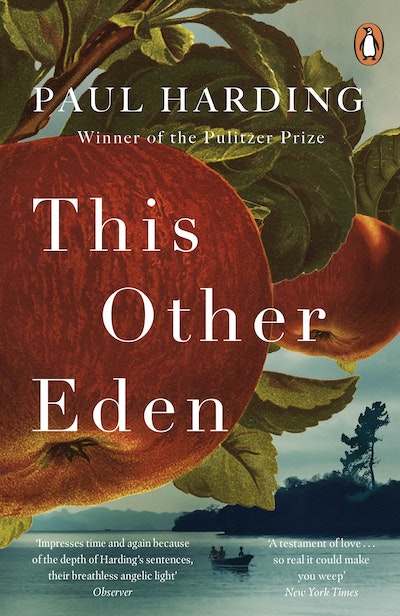
This Other Eden
In 1792, Benjamin Honey, a formerly enslaved man, and his Irish wife, Patience, settle on an island off the Maine coast.
About
Spoiler notice: Spoilers for the setup: Benjamin and Patience's arrival in 1792; their descendants' community on Apple Island in 1912; Matthew Diamond's arrival; the threat of evacuation; and the proposal that Ethan Honey leave to study art. Later events, the climax, and the ending are not described.
This Other Eden is a historical novel whose invented island community draws on the documented history of Malaga Island, off the coast of Maine. Harding calls the island Apple Island and creates a fictional lineage and cast; the book is not a literal account of the people who lived on Malaga. It begins in 1792, when Benjamin Honey, a formerly enslaved man, arrives with his Irish wife, Patience, and they make a home on the island. More than a century later, their descendants live there with neighbours whose families and histories have also brought them beyond the reach of mainland society. The novel’s central tension grows from that distance: the island offers a precarious home, while the outside world increasingly claims authority to decide which lives and communities deserve to remain.
In the novel’s 1912 frame, the community is poor and isolated, but its members have built relationships and practical ways of living together. The people Harding imagines are not presented as a single, harmonious symbol. They have distinct temperaments, needs, attachments and vulnerabilities, and the island’s cohesion does not erase hardship or conflict. Their circumstances are observed by Matthew Diamond, a retired schoolteacher who has become a missionary and has visited in summers to teach the children. He regards himself as benevolent, yet his assumptions about race and civilisation shape how he sees the islanders. His arrival brings a mainland gaze into a place that has until then been largely left to its own routines, and the novel considers how help can become a form of intrusion when it carries an expectation that people must change to be worthy of it.
Among the children, Ethan Honey is a gifted maker of images. His drawing attracts Diamond’s attention and prompts the missionary to imagine a future for the boy away from Apple Island. That possibility is entangled with the conditions that make Ethan legible to the mainland: his light skin may allow him to pass as white, while his artistic ability becomes a reason others might take an interest in his education. Harding’s plot brings care and coercion into close contact here. A chance to learn may matter to Ethan, but it is also proposed in a setting where the whole community faces an outside authority preparing to remove it. The question is not simply whether one child can be helped; it is who defines help, whose future is being planned, and what happens when an individual opportunity is offered alongside a collective threat.
The historical setting makes the island’s vulnerability more than a matter of geography. In the early twentieth century, eugenic thinking gave official and popular force to the idea that poverty, disability and racial difference could be used to classify people as unfit. In the novel, these ideas shape the mainland response to Apple Island and its inhabitants. The story does not treat the language of improvement as neutral: declarations of concern sit beside an effort to control where people may live and what will happen to them. Diamond’s moral position is complicated by this environment. His personal attention to the children exists within the same unequal framework that permits outsiders to judge and intervene in the islanders’ lives. The novel keeps those contradictions visible rather than making a single benevolent figure stand in for the larger institutions around him.
The real history behind the novel has its own distinct names, places and record. Malaga Island was home to a mixed-race community in Maine, and the state expelled its residents in 1912; official accounts document homes being removed and the cemetery exhumed. Apple Island, Benjamin and Patience Honey, Matthew Diamond and Ethan Honey belong to Harding’s fiction. This distinction matters because the novel reshapes history rather than supplying a documentary roster. Its imagined household and neighbours let the narrative explore inheritance, belonging and the unequal power to decide who counts as a member of a place. At the same time, the documented removal of Malaga residents anchors the fiction in a real history of displacement. The book invites readers to consider the people obscured when official accounts reduce a community to a problem that needs to be solved.
Across its island and mainland perspectives, This Other Eden asks what makes a home durable when its residents lack political power, and how art, family and memory might preserve lives that institutions would rather categorise or erase. Ethan’s drawings offer one way of attending to the world, but the novel does not suggest that artistic promise can repair the structural forces bearing down on the community. Nor does it turn the islanders into uncomplicated emblems of innocence: their lives are particular, difficult and bound together. The title’s Eden carries the question of who is allowed to call a place paradise, and who has the authority to remove its inhabitants in the name of progress. Harding places that question within a story about the cost of being seen by a society that mistakes difference for evidence of unfitness.
Book details
- Author
- Paul Harding
- First published
- 2023
- Series
- No series listed
- Subgenre
- Literary historical fiction
- Primary genre
- Historical Fiction, Literary Fiction
- Tags
- No tags for this book.
Review
Editor profile
Baby Bat
Goodreads and social links will be added soon.
- Goodreads — link coming soon
- Social media — link coming soon