
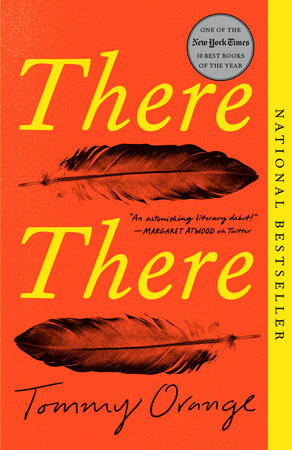
There There
Twelve Native characters travel toward the Big Oakland Powwow, each carrying a different history and reason for attending.
About
Spoiler notice: Spoilers cover the converging character setup and the Big Oakland Powwow gathering. Later events, revelations and the ending are withheld.
There There gathers twelve Native characters whose lives are moving toward the Big Oakland Powwow. The novel’s frame is collective, but its attention is individual: each person arrives with a distinct history, pressure and reason to be there. Oakland is not a backdrop that makes these characters interchangeable. It is a lived city where family ties, work, memory and questions of belonging take shape in the present. The powwow gives the book a shared destination and a public space in which separate stories can meet, while the chapters let each voice retain its own concerns. Tommy Orange has described wanting a range of modern voices rather than a single, fixed picture of Native life. That intention matters to the structure: the book asks readers to encounter a community through difference and relation, not as a symbol or a single story.
Among the people traveling toward the event is Jacquie Red Feather, newly sober and trying to find a way back to the family she left behind. Her return is not presented as a simple repair. The past remains part of the relationships she hopes to approach, and sobriety makes the work of facing them newly immediate. Another central figure, Dene Oxendene, is trying to make a life after his uncle’s death. He works at the powwow in order to honour that memory, and his interest in gathering stories connects private grief to a wider question: who gets to tell Native lives, and what forms of attention do those lives receive? These strands make kinship and storytelling practical matters, shaped by choices, responsibilities and absences rather than abstract themes.
The book also follows Orvil, a fourteen-year-old who has taught himself traditional dance and is preparing to perform in public for the first time. His curiosity places him among relatives whose own feelings about cultural inheritance are complicated. The novel allows tradition to exist in the present tense, carried through learning, uncertainty and family interaction. Orvil is not made to stand for every young Native person; his particular eagerness and his relatives’ responses belong to this family and this story. Around him, the book’s other characters bring different relationships to identity, history and community. Some are seeking connection, some are wary of it, and many hold more than one feeling at once. Their varied perspectives resist the expectation that Native identity should look only historical or only contemporary.
Orange uses a chorus of close, distinct voices to make the novel’s structure part of its subject. Chapters shift among characters, and the reader’s understanding of Oakland and the approaching gathering changes with each perspective. The movement is not a puzzle in which every life exists only to complete another. People carry their own work, losses, loyalties and private hopes; the links among them accumulate as the book proceeds. The powwow provides a point of convergence, but it does not erase the differences that brought each person there. This form also gives the city texture beyond a general label: neighbourhoods, public spaces and everyday routes matter because characters move through them with their own histories and purposes.
History is present in the novel, but it is not used to make contemporary characters seem like remnants of the past. The publisher describes the book as engaging with a complex and painful history alongside an inheritance of beauty and spirituality. Orange has spoken about the loneliness that can come from not seeing oneself represented, and about the risk of a monolithic image of Native people as only historical or only rural. The book’s contemporary Oakland setting answers that flattening through people whose lives are not interchangeable and whose circumstances are not reducible to hardship. Addiction, family rupture and grief are among the pressures represented, but they do not exhaust the characters. Humour, ambition, care, artistry and the search for connection also shape their days. The novel’s seriousness comes partly from allowing these realities to coexist without turning any one of them into a complete definition of a person.
The Big Oakland Powwow draws the novel’s paths into the same public space, giving the characters’ separate preparations a common horizon. Orange builds anticipation through what each person expects from the day and what they bring with them, while keeping the focus on the human ties and histories that precede the event. The result is a multi-voice literary novel rooted in a specific place and a varied group of contemporary Native lives. Its scope is broad, but its basic movement remains intimate: people travel toward a gathering carrying different ideas of family, memory, belonging and what might be possible. There There invites attention to those differences and to the connections that emerge when the characters’ stories are allowed to meet. A familiar place or relationship can look different as another character takes it up, and no single viewpoint claims the whole. Readers encounter a city and a community through many partial, situated accounts, with each voice adding context without closing the story around a single definition.
Book details
- Author
- Tommy Orange
- First published
- 2018
- Series
- No series listed
- Subgenre
- Literary fiction
- Primary genre
- Literary Fiction
- Tags
- No tags for this book.
Review
Editor profile
Baby Bat
Goodreads and social links will be added soon.
- Goodreads — link coming soon
- Social media — link coming soon