
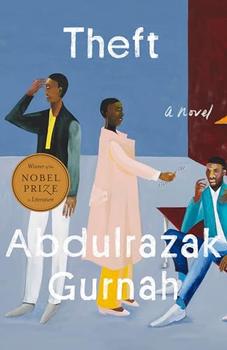
Theft
In Tanzania around the turn of the twenty-first century, Karim returns to his mother Raya’s household as a university student, where he meets Badar, a poor boy sent there to work as a servant.
About
Spoiler notice: Spoilers cover Raya leaving her marriage, Karim’s return to her household as a university student, and Badar’s arrival as a servant. Later revelations about family ties and the ending are not disclosed.
Theft follows three young people coming of age in Tanzania around the turn of the twenty-first century: Karim, Fauzia and Badar. Their lives begin from different positions. Karim grows up largely apart from his mother, Raya, after she leaves an unhappy marriage and places him with her parents. When he is older and studying at university, he returns to live with Raya and her husband in Dar es Salaam. Fauzia is still living under the limits of a smothering upbringing, while Badar is a poor boy sent from his village to work in Raya’s household. Their paths converge as the country and the expectations around them change. The publisher frames this period as one of rapid global change, which reaches even a quieter hometown and reshapes what its young residents can imagine for themselves.
Raya’s choices shape the family’s early circumstances. She is married young to an older man whose treatment makes the marriage intolerable, and she leaves with her toddler son before later building a life with Haji Othman. Karim spends much of his childhood in the care of his maternal grandparents, so his later arrival at Raya’s home does not simply restore a settled mother-and-son bond. He comes as a university student with new confidence and ambitions, while she is trying to include him in a household already formed without him. The distance between them remains part of the story even when they share a roof. This arrangement means that Raya’s attempt to bring Karim back into her life is complicated by years of separation; ordinary household routines cannot by themselves settle what they mean to one another.
Badar’s move into the Othman household is less voluntary. The people who raised him send him away from school to work as a servant, and he arrives carrying the hurt of being abandoned. He is a relative of Haji’s, but kinship does not put him on equal terms with the people he serves. He tries to adjust to a place where the rules are unfamiliar and his prospects are narrow. The book gives attention to how he observes his new surroundings and measures the small changes in his position. His quietness can be mistaken for passivity, although it does not mean that he lacks judgment or an inner life. His position also makes education and paid work feel precarious: he has lost the chance to continue school and depends on people whose home is unfamiliar to him.
An accusation of theft unsettles the household and places suspicion on Badar. The accusation is not the only source of strain: the novel also attends to the unequal obligations built into a home where one young person studies and another serves. Karim and Badar are both shaped by abandonment, but they meet it from markedly different positions. Their relationship develops through acts of help, dependence and expectation, leaving open the question of when generosity becomes a claim on another person. The title reaches beyond the question of a stolen object toward the losses and forms of taking that affect the characters’ choices. The accusation sharpens the difference between being welcomed into a household and being treated as someone who belongs there; those are not equivalent forms of security for Badar.
Fauzia’s story brings another kind of constraint into the group. She has had a difficult childhood marked by illness and grows into a young woman who wants to become a teacher. When she meets Karim, his presence seems to offer a way beyond the limits of her upbringing, and their relationship becomes one strand in the larger family story. Her ambitions do not exist separately from the pressures around her; they are shaped by what opportunities are available and by the consequences of choosing a different life. Gurnah keeps her experiences connected to those of Karim and Badar rather than presenting the three as isolated coming-of-age portraits. Her goal of teaching gives her a direction that is her own, while her relationship with Karim connects that goal to a possible change in where and how she lives.
The setting is a society changing quickly. Tourism, new technology and development work bring fresh possibilities to Tanzania, alongside new dependencies and imbalances. Karim’s path leads through university and later into development work; Badar encounters the tourist economy through service work and contact with visitors and aid workers. These settings expose differences in money, status and freedom of movement. The novel’s attention stays with what such changes mean in personal terms: who gets to make plans, whose work is valued, and what kind of gratitude is expected when one person helps another. Social change becomes part of the characters’ daily relationships. Tourism and development offer employment, but the people arriving from elsewhere do not share the same exposure to risk or the same local obligations as those who live and work there.
As the narrative moves among its characters, their accounts of family and obligation change the reader’s understanding of the same circumstances. No single person occupies the whole story from the start. Karim’s ambitions, Fauzia’s hope for a wider future and Badar’s effort to find a place of his own meet within a network of kinship and service that has already shaped them. The novel follows these connections over time, allowing misunderstandings and acts of care to acquire different meanings as people mature. Theft is therefore both a family drama and a coming-of-age story about agency: the characters must decide what they owe one another, and what they can claim for themselves. By tracing the characters over years, the book can show how early circumstances persist even when a person’s apparent status changes.
Book details
- Author
- Abdulrazak Gurnah
- First published
- 2025
- Series
- No series listed
- Subgenre
- Literary fiction, Coming-of-age, Historical fiction
- Primary genre
- Literary Fiction, Historical Fiction
- Tags
- No tags for this book.
Review
Editor profile
Baby Bat
Goodreads and social links will be added soon.
- Goodreads — link coming soon
- Social media — link coming soon