
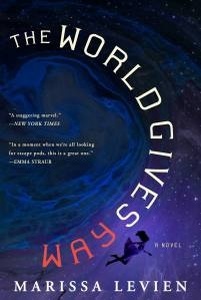
The World Gives Way
Aboard a generation ship bound for another world, Myrra expects to spend fifty more years in contract servitude.
About
Spoiler notice: Spoilers for the opening deaths, Myrra’s early freedom, and the central flight; the outcome and the nature of the Carlyles’ secret are withheld.
Marissa Levien’s The World Gives Way takes place aboard a generation ship, a constructed world carrying people toward a future beyond their present lives. That setting gives the novel’s title two related scales: the world is a home made by human beings, and it is also a place whose continuance is in doubt. Myrra, the central character, has been told that her contract will keep her bound for another fifty years. She has been a contract worker since she was five, with her labour assigned to the highest bidder. The novel opens on a life whose horizon is measured not by a chosen destination but by the distant end of an obligation. Levien has described the book as a science-fiction adventure and a classist dystopia, while also emphasising its focus on character and human connection. Those elements place an intimate struggle for agency inside a larger story about a society approaching its limit.
Myrra’s work has passed through different owners and forms: butchers, laundries and, most recently, the powerful Carlyles. The contract system makes class visible in the most direct way, by turning a person’s future labour into something controlled by others. Freedom exists as a promised date, but the promise is so remote that it can shape every present choice without offering practical relief. The arrangement also draws a line between the people who possess security and those whose time and work sustain it. Levien describes Myrra as angry, and as someone who has had to lie, fight and manipulate her way forward in a world sharply divided by wealth. That description makes her difficult to reduce to a passive victim. She acts within an unjust system, trying to gain room to move while living with the costs and compromises that survival demands.
The plot changes course when the Carlyles are found dead. Their deaths release Myrra from her contract much earlier than expected, but the sudden freedom comes with responsibilities and danger rather than a settled future. She is left with their orphaned daughter and a secret the Carlyles died trying to escape. Myrra runs, carrying both a child who needs protection and knowledge that places her in peril. The premise creates a close practical question—how can someone who has spent her life under contract keep a child safe while she herself is being pursued?—alongside a larger one about the world they inhabit and what is ending there. The secret remains a source of uncertainty, while the past employers’ death does not sever their power over Myrra’s choices; their child and secret extend its consequences into her escape.
Levien has said that she was interested in a character who knows the world is ending, and in a story concerned less with preventing that end than with how someone might live in the time remaining. That intention changes the usual shape of an apocalypse plot. The immediate question is not only whether a catastrophe can be stopped, but what kinds of life remain possible when the future is short and unevenly distributed. Myrra’s long contract and her sudden release sit beside that larger limit: first she is told to wait decades for freedom; then the conditions that made her wait are swept into a crisis she cannot control. The book’s ship setting makes “world” both concrete and provisional. It is a place people inhabit, with a social order and a destination, but it is also an artificial environment whose stability cannot simply be assumed.
The movement from a contract to a flight also gives the novel a way to explore family beyond legal or inherited ties. The child in Myrra’s care is connected to the household that owned her labour, yet the child’s dependence places her in a new relationship of responsibility. Levien describes human connection and the forming of one’s own version of family as central to the story. In this context, care is not separate from power: Myrra must protect someone who cannot choose the danger around them, while making decisions under pressure herself. The conflict does not become simple because she is the adult on the run or because the child is innocent of the class structure that shaped their lives. Instead, the premise asks how an improvised bond might hold when old arrangements have broken and the wider world offers no guarantee of safety. This gives the novel’s escape plot an emotional focus without resolving its dangers in advance.
The artificial ship is more than a science-fiction backdrop. It lets familiar structures of work, wealth, obligation and care take shape inside an enclosed world, where people cannot assume there is another society just beyond the horizon. Myrra’s employers can buy decades of her life, but their power cannot guarantee the future they expected for themselves or their daughter. The child’s presence keeps the stakes close to one household even as the wider setting points toward a crisis affecting everyone aboard. Against that scale, Myrra’s sudden freedom is complicated: she can make choices that were previously denied to her, yet she must make them while fleeing with a dependent child and knowledge she did not seek. The novel brings its speculative frame together with that immediate struggle to act. Its central tension holds both scales in view: a woman promised freedom only after fifty more years must decide what to do when the household that controlled her is gone and time itself has become uncertain.
Book details
- Author
- Marissa Levien
- First published
- 2021
- Series
- No series listed
- Subgenre
- Dystopian, Literary fiction, Survival fiction
- Primary genre
- Sci-Fi, Literary Fiction
- Tags
- No tags for this book.
Review
Editor profile
Baby Bat
Goodreads and social links will be added soon.
- Goodreads — link coming soon
- Social media — link coming soon