
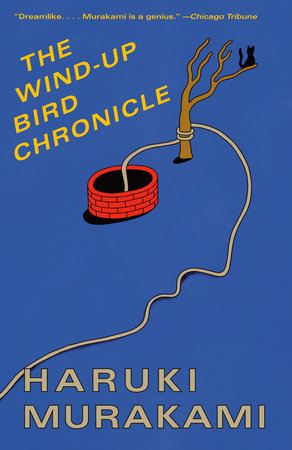
The Wind-Up Bird Chronicle
When Toru Okada is asked to find his missing cat in a Tokyo suburb, the search becomes more unsettling after his wife Kumiko disappears as well.
About
Spoiler notice: Spoilers cover the missing cat and the search for Kumiko, along with the novel’s central setup and recurring figures. Major later revelations and the ending are not disclosed.
The Wind-Up Bird Chronicle begins with an absence that seems small enough to manage. Toru Okada, a young man living in a Tokyo suburb, is asked to find the household’s missing cat. The search draws him into a wider disturbance when his wife, Kumiko, also disappears. The publisher’s description presents the book as an imaginative detective story and an account of a marriage coming apart; those two strands set up its central movement from domestic routine toward uncertainty. Toru is not introduced as a professional investigator. He is an ordinary person following losses that refuse to stay ordinary, and each attempt to make sense of them opens another question about what has happened around him.
The story’s starting point gives it the shape of a mystery, but the investigation does not proceed like a conventional puzzle with a neat trail of clues. Toru’s search brings him into contact with an unusual assortment of allies and antagonists, while the familiar city seems to contain another, less visible world beneath its surface. Everyday details remain important even as events become uncanny. This shifting scale lets the novel hold practical concerns and dreamlike episodes together: a missing animal, a strained relationship, and encounters that resist a single realistic explanation. The uncertainty belongs to the experience of searching. Toru can keep moving without knowing whether each new contact brings him closer to an answer or farther into a different kind of problem.
The marriage at the centre of the novel changes the meaning of that search. Kumiko’s absence is not only a plot question; it leaves Toru to reconsider a shared life whose contours he may not fully understand. The relationship becomes an emotional mystery alongside the external one. What can a person know about someone close to them, and what remains hidden even inside daily companionship? The book approaches these questions through Toru’s effort to act in the face of incomplete knowledge. Rather than treating uncertainty as a brief obstacle, it makes uncertainty part of the landscape he has to inhabit. The result is a narrative where the desire to recover a person and the desire to understand a relationship remain closely linked.
Murakami’s title points toward another thread: the wind-up bird, an image that belongs to the book’s strange atmosphere and gives it a distinctive name. The novel’s imagery and recurring encounters invite connections among mechanical routine, private memory and forces that are difficult to see directly. These associations are suggestive rather than a code with one definitive key. The book leaves room for readers to notice patterns without reducing every image to a solved explanation. That openness suits a story concerned with buried secrets and changing perceptions. Toru’s world can feel recognizable one moment and newly charged the next, so that an ordinary object or meeting may gather significance without losing its everyday quality.
The account also reaches into Japan’s past. The publisher describes an excavation of buried secrets from the country’s campaign in Manchuria during the Second World War, placing historical violence beside the contemporary domestic story. That history broadens the novel’s field of attention: private lives do not unfold in isolation from what a society remembers, suppresses or passes on. The book connects its present-day search to material that is harder to approach directly, and its shifts between registers give the past a continuing presence. This is a fictional narrative, not a historical survey, and its wartime strand is part of the design through which it examines memory and concealment.
The novel’s combination of mystery, marital drama, historical memory and the uncanny makes it difficult to place in only one category. Penguin Random House also classifies it as literary fiction and contemporary fantasy. Those labels capture parts of its range, while the reading experience depends on the friction among them: the forward pull of a search, the intimacy of a relationship in crisis, and episodes whose meaning stays unsettled. The movement between these elements gives the book room to be funny as well as menacing, as the publisher notes, without making either tone cancel the other. Its imaginative turns do not erase the emotional stakes of Toru’s search; they make the boundaries around those stakes less certain.
Murakami’s Japanese novel appeared in three parts across 1994 and 1995, a span that suggests the scale of the world Toru enters. Its movement is patient enough for the search to branch into other lives and histories without leaving the original loss behind. The tension comes from holding those layers together. A domestic question opens onto an account of national memory; an encounter that first appears incidental may later change how Toru understands his surroundings. The novel asks readers to follow him through this uncertainty, giving attention to what he can observe and what he cannot yet explain. That approach makes the disappearance of Kumiko more than a mystery to be solved: it becomes a way of asking how a person locates another, and himself, amid stories that are only partly known.
Book details
- Author
- Haruki Murakami
- First published
- 1994
- Series
- No series listed
- Subgenre
- Literary fiction, Magical realism, Translated literary fiction
- Primary genre
- Literary Fiction
- Tags
- No tags for this book.
Review
Editor profile
Baby Bat
Goodreads and social links will be added soon.
- Goodreads — link coming soon
- Social media — link coming soon