
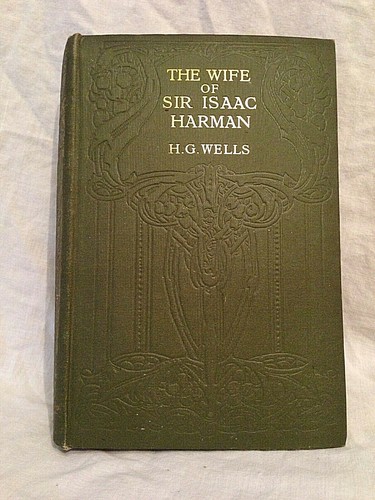
The Wife of Sir Isaac Harman
Ellen Harman has wealth, servants and a prosperous husband, but little authority over her own life.
About
Spoiler notice: This overview discusses Ellen’s struggle for independence, Sir Isaac’s death and the final meeting with Brumley.
The Wife of Sir Isaac Harman begins with a visit to a house, an apparently ordinary transaction which introduces a woman beginning to imagine a life different from the one arranged around her. Lady Harman arrives at Black Strand and meets its owner, the novelist George Brumley, whose household still bears the marks of his dead wife's taste. Their conversation sets curiosity and attraction in motion without either fully understanding the changes ahead. H. G. Wells tells the story through a conspicuously interfering narrator, ready to inspect motives and puncture flattering explanations. That comic scrutiny matters particularly when people describe themselves as generous: the novel repeatedly asks whether help is being offered for another person's benefit or as a means of keeping control.
Lady Harman is Ellen, married to Sir Isaac when she was eighteen. Her husband has built a successful business, and the wealth surrounding her makes dependence easy to overlook. She is magnificently provided for, yet she has no independent allowance. Bills are paid and money can be requested, leaving her access to it tied to an interaction with the person she wishes to oppose. When she resolves to attend Lady Beach-Mandarin's lunch against his orders, the practical difficulty of paying her way gives the conflict an immediate scale. A wife with expensive clothes and servants can still find her freedom constrained by a small sum in her purse. Wells builds the struggle from such particular arrangements, rather than allowing prosperity to stand as proof of contentment.
Ellen's objections grow beyond permission to attend a particular gathering. She wants friendships, ideas and movements which do not require her husband's approval, and begins to recognize the difference between being cherished and being allowed a separate existence. Sir Isaac treats the influences around her as a danger to the domestic order he understands. Black Strand becomes a place where he hopes to isolate and quiet her, turning the attractive house into an instrument of restriction. Brumley's growing devotion offers sympathy, but the narrator does not leave his proposed rescue untouched. An imagined elopement can express his own desire to possess Ellen as readily as it can express concern for her. The possibility of exchanging one man's authority for another's affection remains part of her predicament.
The eventual settlement between husband and wife provides some concrete freedoms without making their relationship equal. Ellen is to have a private bank account receiving a monthly allowance, greater freedom to come and go, and room to choose her reading and express opinions. Qualifications remain attached to the promises, including Sir Isaac's expectations about meals, his comfort and the management of his business. Even the account's privacy is vulnerable to his inspection. The narrator presents the arrangement as imperfect and partly undocumented, leaving its interpretation to future disagreements. Ellen has gained ground, but the terms reveal how easily a concession can preserve the authority of the person granting it. A workable daily truce does not answer the larger question of who owns her time and judgment.
Her attention also turns towards women whose financial position is much more precarious than her own. Questions about employees' wages and treatment lead into the hostel project, which offers accommodation and practical support for working women. The undertaking gives her independence a purpose beyond personal escape, while exposing her to difficulties that benevolent intentions cannot settle alone. Sir Isaac brings his habit of organization to the scheme, and the resulting rules reproduce some of the assumptions Ellen has struggled against at home. Good facilities are not the whole measure of a humane institution. How residents are addressed, how complaints are understood and how discipline is imposed become essential questions about whether assistance enlarges people's lives or merely rearranges the conditions under which they must obey.
Mrs. Pembrose's management sharpens that conflict. Ellen objects to repeated expulsions and to an approach which turns awkwardness, differences of manner and challenges to authority into reasons for punishment. Brumley can supply sympathetic generalizations without necessarily resolving the immediate problem. Wells keeps the work imperfect, giving neither philanthropic language nor literary intelligence an automatic claim to effectiveness. Meanwhile Sir Isaac's suspicion continues within the marriage. In Italy he opens a letter addressed to Ellen from Brumley, and the discovery leads to an angry confrontation and a serious seizure. The later announcement of his death changes her legal and personal position, but the final chapter resists treating widowhood as a simple transfer of the heroine to the man who has waited for her.
Brumley expects marriage; Ellen experiences freedom. She tells him that she will never marry again, explaining the decision as her own rather than merely the consequence of Sir Isaac's will. The will nevertheless gives the choice practical stakes: remarriage would transfer the hostels to a committee which includes Mrs. Pembrose. Brumley's distress exposes the possessiveness still mixed with his devotion, and he flees into the garden. Ellen follows because his companionship matters to her. Their reconciliation includes a renewed prospect of working on the hostels, followed by the kiss with which the novel ends. It does not report a wedding or settle their future. Affection survives, but Ellen's refusal to make marriage its necessary outcome remains the distinction on which that ending turns.
Book details
- Author
- H. G. Wells
- First published
- 1914
- Series
- No series listed
- Subgenre
- Literary fiction, Modern classics
- Primary genre
- Literary Fiction
- Tags
- No tags for this book.
Review
Editor profile
Baby Bat
Goodreads and social links will be added soon.
- Goodreads — link coming soon
- Social media — link coming soon