
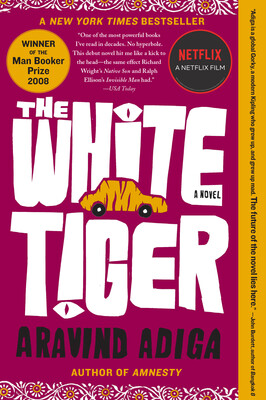
The White Tiger
Balram Halwai writes to the visiting Chinese premier about his rise from a poor village to work as a driver for a wealthy family in Delhi and, later, as an entrepreneur in Bangalore.
About
Spoiler notice: Spoilers cover Balram’s career change, a road incident and broad moral tensions; the specific crime and final family decision are withheld.
The White Tiger is narrated by Balram Halwai, who addresses a series of letters to the visiting premier of China. The unusual audience gives his story the shape of a private lesson in how he understands wealth, work and power. Balram is not a detached guide: he chooses what to reveal and how to frame it, presenting himself as both witness and interpreter. His voice can be witty and self-assured, but the confidence also asks the reader to notice how carefully he manages the account. The book’s central tension begins there, between the story Balram wants to tell about his rise and the troubling choices contained within it.
Balram’s story starts in a poor village, where family circumstances and limited opportunity shape the path open to him. He is identified as unusually perceptive, yet formal education does not give him a straightforward route into a different life. The nickname “white tiger” marks him as rare, a person expected to stand apart, but the image does not make his circumstances disappear. Adiga sets an individual appetite for change beside the conditions that confine it. Balram’s later self-description is therefore part of the novel’s question: does exceptional ambition offer a way out, or does it teach him to repeat the terms of the system he hopes to escape?
Work takes Balram from the village to Delhi, where he becomes a driver for a wealthy family. The move places him close to the comforts enjoyed by his employers while keeping him in a role defined by service. He learns the rhythms of their household and the differences between what they can expect and what he can ask for. These details make class visible in daily interactions rather than as an abstract label. Balram’s employment also complicates his relationship with Ashok, his principal employer: familiarity and dependence grow together, and Balram’s account keeps loyalty, resentment and calculation in the same frame. Being physically near wealth does not give him a share of its security, but it does let him observe the habits and vulnerabilities of people who have it.
The novel’s “rooster coop” image gives Balram a way to explain why servants remain bound to their position even when escape seems possible. He uses the metaphor to connect fear, family obligation and the prospect of punishment with the endurance of unequal arrangements. It is his explanation, delivered by a narrator with a strong interest in defending his own choices, rather than a neutral sociological account. The letters make that distinction important. Readers encounter a sharp critique of servitude, but also a speaker who uses the critique to shape how his conduct will be judged. The idea of breaking free consequently carries both a political force and a personal excuse.
As the family’s driver, Balram witnesses the distance between public respectability and private behavior. The novel sets contrasting responses to a road accident involving a child beside Balram’s later conduct when he has a driver of his own. These parallels suggest how power can determine who bears blame and who can move on. They also prevent Balram’s eventual position from functioning as a simple answer to the injustice he describes. His rise changes his place in the arrangement, but the novel asks whether it changes the arrangement’s underlying logic. The letter form keeps that question unsettled because Balram narrates both the events and the meaning he wants attached to them.
Delhi is not the endpoint of Balram’s account. His movement toward Bangalore and entrepreneurship brings the story into contact with a changing business culture, which he regards as another route to independence. Global business and outsourcing sit beside older patterns of servitude and inequality; the plot makes that collision personal by following one man trying to turn observation into advantage. Balram’s new identity depends on reinvention, but it also depends on choices that make success morally difficult to separate from harm. Adiga lets aspiration remain compelling without making it innocent, and the contrast between driver and entrepreneur does not erase what came before. The question is not only whether Balram escapes the position assigned to him, but also what kind of employer he becomes when he gains power over someone else’s work.
First published in 2008, The White Tiger is a darkly comic literary novel built around an unreliable, self-conscious narrator and a journey across sharply unequal social positions. Its satire focuses on the language people use to justify dependence, ambition and opportunity, while the letter to China’s premier gives Balram room to address a listener he imagines as a possible equal. The novel’s argument is not a broad verdict on a country or a single community; it is a deliberately situated account filtered through Balram’s perspective. This Free Press trade paperback edition carries ISBN 9781416562603 and contains 304 pages. The book’s lasting unease comes from the gap between Balram’s persuasive account of freedom and the costs attached to the way he pursues it.
Book details
- Author
- Aravind Adiga
- First published
- 2008
- Series
- No series listed
- Subgenre
- Literary fiction, Social realism, Epistolary novel
- Primary genre
- Literary Fiction
- Tags
- No tags for this book.
Review
Editor profile
Baby Bat
Goodreads and social links will be added soon.
- Goodreads — link coming soon
- Social media — link coming soon