
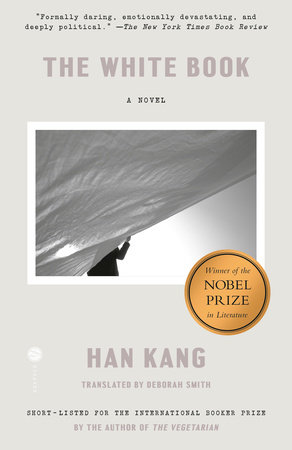
The White Book
During a writing residency in Warsaw, an unnamed narrator returns in thought to an older sister who died two hours after birth, before the narrator herself was born.
About
Spoiler notice: Spoilers for the premise and opening frame: the narrator considers the death of her older sister, who lived only two hours after birth, and writes from a European city shaped by wartime destruction. Later sections and the book’s final movement are not described.
The White Book takes its shape from a collection of white things: swaddling cloth, salt, snow, the moon, rice, a blank page and a shroud. Each object becomes a starting point for a short piece of writing, so colour is both the book’s subject and its organising thread. White can suggest beginnings, cleanliness or light, yet the list also turns toward absence and death. Han Kang follows those associations without assigning each image a single fixed meaning. The objects remain ordinary and physical, but they gather emotional weight as the book moves among memory, the body, language and the limits of what one person can know about another.
The speaker is an unnamed writer living away from Korea in a European city, identified as Warsaw in the book’s framing. She carries the story of an older sister who died two hours after birth, before the narrator herself was born. This loss reaches her through family memory rather than personal recollection: she cannot remember the child, but the knowledge of that brief life has a place in her own. The book approaches that distance carefully. It considers what can be imagined or addressed when the person being mourned was never known, and how a life can be present in the consciousness of someone who arrived later.
The city is more than a quiet backdrop for this inward work. Its buildings and streets bear marks of destruction and rebuilding, and the narrator’s walks bring private grief into contact with public history. The book does not turn the city into a simple symbol or offer a parallel that resolves either history. Instead, place gives the reflections a changing ground: the writer moves through an unfamiliar present while attending to a past she did not witness. The sister’s absence, the city’s damage and its continued life remain distinct, yet their proximity prompts the narrator to think about what survives when time has broken a connection or a landscape.
The form moves between fragments rather than building a conventional chain of scenes. Its three broad sections gather the pieces into a progression, but many entries can be approached as small meditations in their own right. A named object may open a memory, an observation or a question; another fragment may shift toward the writer’s physical surroundings or her attempt to address the sister. These changes make the book’s movement associative. Readers follow recurring images and emotional turns more than a plot driven by events. The arrangement allows a detail to return with altered significance, as an object can carry both the fact of a body and the possibility of renewal.
That structure gives the blank page a particular importance. Writing becomes a way to approach a story that was transmitted incompletely and to imagine an address across a separation that cannot be crossed literally. Yet the book does not claim that language repairs loss or restores the dead. Its attention stays with the attempt: how to make a form for grief, how to speak toward someone absent, and how to let uncertainty remain part of the account. The repeated white objects keep this work grounded in material things. They offer points of contact without turning the sister into a fully known character or asking the reader to mistake imagination for recovered memory.
The White Book is a hybrid work that sits between fiction, essay and prose poetry. Its narrator and recurring images give it a literary shape, while its short sections often read as reflective prose rather than chapters in a conventional novel. The design makes room for pauses, returns and shifts in scale, from a household object to a city’s history or a question about existence. Han’s approach is spare in its framing but wide in what it considers: birth and death, the persistence of family stories, damage and tenderness, and the fragile work of making meaning. The result asks for attention to pattern and tone as much as to narrative development.
White works here less like a code with one answer than like a surface on which different experiences can meet. The same colour belongs to a newborn’s clothing, winter weather, food and the cloth associated with burial. Those associations do not cancel one another out. Their nearness lets the book hold vulnerability beside comfort, and endings beside the possibility that something may begin. The title therefore names a field of attention rather than a key that unlocks a hidden message. Readers can notice how an image changes when it appears beside another, while the writing leaves room for personal associations that the narrator does not settle for them.
The work’s brevity and fragmentation also shape its emotional register. It rarely pauses to explain what every image should mean, and its movement between reflection, recollection and place asks the reader to supply connections across the gaps. A short section can feel complete while still echoing into the next one. This makes the experience quieter than a plot-led story, but not static: the accumulating pieces alter the sense of the original list and the questions behind it. The form suits a subject whose central loss cannot be reconstructed as a shared memory. What takes shape is an act of sustained attention, with each return offering another way to remain near what cannot be recovered.
Book details
- Author
- Han Kang
- First published
- 2016
- Series
- No series listed
- Subgenre
- Translated literary fiction
- Primary genre
- Literary Fiction
- Tags
- No tags for this book.
Review
Editor profile
Baby Bat
Goodreads and social links will be added soon.
- Goodreads — link coming soon
- Social media — link coming soon