
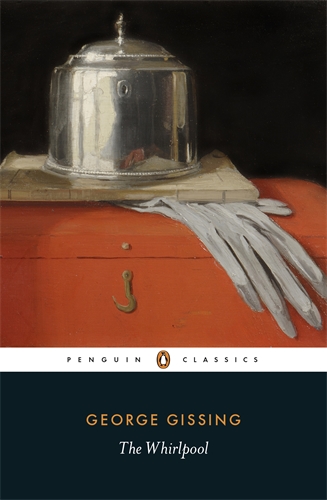
The Whirlpool
Harvey Rolfe hopes that financial independence and a quiet home can keep him clear of London’s pressures.
About
Spoiler notice: This overview discusses the financial collapse, Redgrave’s death, Alma’s final night and Harvey’s life with Hughie at the ending.
The Whirlpool enters its world through Harvey Rolfe, a man whose independent income has given him books, travel and considerable time to consider other people’s mistakes. At dinner in London he listens to the younger Cecil Morphew explain the profits he hopes to make through speculation. Morphew needs money to satisfy the expectations surrounding the woman he wants to marry, and treats a dangerous shortcut as a sensible plan. George Gissing places that conversation near the beginning of a novel in which apparently private ambitions repeatedly depend on uncertain financial and social arrangements. Harvey can see the risks from his comfortable position, but he will discover that recognizing a pressure does not keep it outside his own household.
Alma Frothingham brings musical ambition and a more restless relation to society into his life. Her father’s financial catastrophe damages the security and reputation she has inherited, leaving her to decide what kind of independence she wants. Travelling in Germany initially seems to offer release from duties and expectations, though the money and conditions supplied by her stepmother still make that freedom possible. Her violin remains a potential vocation, but cultivating an identity as an artist and doing sustained artistic work do not always coincide. Gissing attends to that difference without making the wish for achievement trivial. Alma wants a life in which she matters beyond familiar domestic roles, yet she is vulnerable to praise, comparison and the hope that recognition will settle uncertainties she carries within her.
Harvey’s marriage to Alma seems to open another possibility, particularly when they plan a home in Wales. Distance from London promises a manageable existence, and their son Hugh gives Harvey a growing emotional commitment beyond his habits of solitary observation. The marriage nevertheless contains different ideas about what should make life satisfying. Alma’s aspirations do not disappear because a peaceful house is available, while Harvey’s reluctance to encourage public ambition can mix practical concern with his own preferences. Money, servants, education and the distribution of time keep shaping these apparently intimate disagreements. Neither partner can simply arrange a household once and assume that the other will remain content within it. Their return towards London’s opportunities also returns them to its forms of rivalry and dependence.
Cyrus Redgrave connects the pursuit of success to a more compromising social world. His influence and attention make assistance difficult to separate from personal claims, while Alma’s relations with Sibyl Carnaby involve admiration, competition and increasingly bitter suspicion. Hugh Carnaby, Harvey’s friend and Sibyl’s husband, becomes the centre of a public tragedy when he kills Redgrave. The ensuing case does not deliver a transparent account of every private relationship behind the event. Carnaby’s insistence upon his wife’s innocence is itself one of the things Harvey must decide how to receive. The court sentences him to two years’ imprisonment for manslaughter. Gissing keeps public judgment and private uncertainty alongside each other, showing how an official outcome can leave the people closest to it with questions they cannot settle.
Alma’s recital takes place amid this crisis, giving the desire for public recognition an uncomfortable double setting. She experiences the performance as a triumph, but the reports she reads afterward offer a mixture of praise, qualification and promises of future distinction. The least favourable notice wounds her first; more flattering letters briefly restore her confidence. Her body cannot sustain the excitement as readily as she wants, and her anxiety about the Carnabys’ affairs remains bound up with the concert’s aftermath. Harvey alternates between the fear that he has obstructed genuine talent and concern at what the struggle is doing to her. The title’s image gathers force through these repeated movements: applause, money and reputation draw people back into pressures they had hoped a fresh arrangement would escape.
The final crisis turns on a demand for belief. Alma tells Harvey about her own position and presses him to accept her accusations against Sibyl as well. He wants to preserve their marriage without treating suspicion as proof; she cannot easily separate being loved from being believed in everything. Their eventual tenderness permits plans for a quiet new life, but it does not end her sleeplessness. During the night she takes her usual sleeping draught, then another, larger dose when distress returns. In the morning Harvey finds her unresponsive, and the doctor can only recall the warnings already given. The scene presents repeated dosing amid an effort to obtain sleep and imagined recovery. It does not justify simplifying her death into a declared intention the narrative never supplies.
The last chapter follows Harvey as a father, with Hughie now seven and much of his reading directed towards teaching the boy. An afternoon at the Mortons’ house offers company, music and a model of domestic continuity, yet Harvey still doubts whether his own uncertainties have harmed his child’s education. News of the surviving acquaintances shows that the wider world continues with schemes, money-making and polished public appearances. Conversation about imperial enthusiasm and war places the children’s futures under pressures much larger than one family’s choices. Harvey’s delight in their singing has to coexist with that apprehension. He and Hughie leave hand in hand, each occupied by his own thoughts: a small companionship after devastating loss, carrying no assurance that the world ahead will be easier to understand.
Book details
- Author
- George Gissing
- First published
- 1897
- Series
- No series listed
- Subgenre
- Literary fiction, Modern classics
- Primary genre
- Literary Fiction
- Tags
- No tags for this book.
Review
Editor profile
Baby Bat
Goodreads and social links will be added soon.
- Goodreads — link coming soon
- Social media — link coming soon