
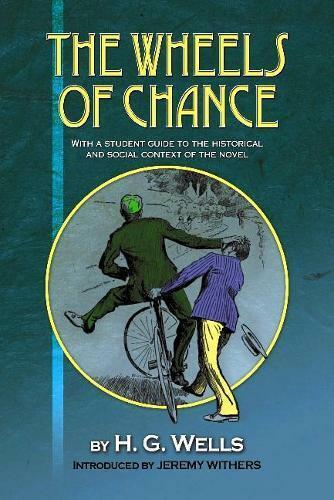
The Wheels of Chance
Mr.
About
Spoiler notice: This overview includes Hoopdriver's confession, Jessie's return arrangements and the ending.
Behind the counter of a Putney drapery shop, Mr. Hoopdriver appears to be an ordinary assistant performing familiar gestures and repeating familiar sales phrases. The narrator of H. G. Wells's 1896 novel asks the reader to look more closely, then reveals the bruises hidden by his respectable clothes. Learning to ride a bicycle has been a painful business. Those injuries introduce something his working manner conceals: a wish for movement, adventure and an existence beyond serving customers. The comedy begins by taking that wish seriously enough to examine its ungainly physical consequences. Hoopdriver may imagine himself a much more impressive figure than anyone else sees, but his efforts are real. A ten-day holiday gives him a short opportunity to test a different version of his life.
The bicycle offers freedom without supplying the competence or social confidence needed to enjoy it easily. His route through southern England brings exertion, unfamiliar encounters and opportunities to misunderstand what is happening around him. The Young Lady in Grey becomes the most important of those encounters. Jessie Milton is also trying to escape a life she finds restrictive, although her resources and circumstances differ greatly from his. Hoopdriver's imagination turns their repeated meetings into material for romantic adventure before he understands her situation. Wells lets the reader follow the excitement while observing its distortions. The rider's clumsiness is visible, but so is the gap between an elaborate inner identity and the uncertain person attempting to make that identity believable on the road.
Jessie's companion Bechamel gives that uncertainty a darker counterpart. He has encouraged her desire for independence and promised help with her ambitions as a writer, then tries to convert the journey into a claim over her. He admits that the supposed sister they were to visit does not exist and that he intended to compromise her. Calling her his wife at an inn becomes part of the pressure, making other people's assumptions useful to him. His talk of friendship and freedom has concealed a different purpose. Jessie can recognize the deception without immediately seeing a safe route away from it. Going home would expose her to the authority she fled; continuing with him would mean trusting someone who has already used her trust against her.
Hoopdriver helps her leave Bechamel at Bognor through an escape that mixes genuine nerve with improvised absurdity. Getting the bicycles out of the yard requires distracting the attendant, and his attempted excuses become increasingly strained. Once the opportunity comes, he rides away with Jessie on Bechamel's machine. Her praise transforms how he feels about an action that moments earlier made him think of himself as a hunted thief. They now travel together, but the adventure has not become a smooth fulfilment of his dreams. Fatigue, practical decisions and the possibility of pursuit accompany them. The borrowed grandeur of his manner can make events funny without making the consequences imaginary: two people still need somewhere to sleep, money to spend and an explanation for the journey others may find suspicious.
His invented identity eventually becomes a burden he decides to put down. He has called himself Benson and supplied stories about South Africa, including adventures he has never experienced. Confessing his real name and occupation leaves him embarrassed but makes a more useful conversation possible. Jessie sees no necessary shame in being a draper's assistant; Hoopdriver explains the hours, dependence and lack of prospects that make him ashamed. The respectable clothes, he says, disguise a life with little freedom or leisure. Their discussion turns toward education and whether he can still make up for opportunities missed. Jessie encourages him to try, while his doubt remains substantial. The question concerns an actual future he might work toward, replacing the impressive past he had fabricated for immediate effect.
The search for Jessie ends with a gathering at the Rufus Stone Hotel, where adults discuss her conduct with great confidence and limited willingness to hear her. A clergyman interprets the journey as disobedience, while other participants invoke class, reputation and the danger of public knowledge. Their concern for her safety becomes difficult to separate from their demand that she accept a prescribed place. Jessie negotiates concrete conditions for returning: a room of her own, books, teaching and freedom to go out. The insistence on definite promises distinguishes her position from the general declarations of protection around the table. Hoopdriver, waiting outside, has little authority in these proceedings. Her agreement to return gives the adventure a practical conclusion without establishing that all the conflicts at home have been resolved.
Their farewell leaves feelings neither can fully express. Jessie promises books, asks him to work and imagines what he might become over the following years. He cannot comfortably tell her everything he feels, and she watches him walk away without arriving at a complete understanding herself. The final envoy explicitly refuses to supply the later outcome. Hoopdriver rides back toward London, alternating between pride, discouragement and the hope that education might offer something more. Returning to the shop means the same early rising and drudgery, but memories and ambitions have replaced some of his earlier fantasies. The gate closes behind him before those ambitions can be tested. Wells gives him an altered sense of possibility while leaving the hard work, and the possibility of disappointment, beyond the story's end.
Book details
- Author
- H. G. Wells
- First published
- 1896
- Series
- No series listed
- Subgenre
- Literary fiction, Modern classics
- Primary genre
- Literary Fiction
- Tags
- No tags for this book.
Review
Editor profile
Baby Bat
Goodreads and social links will be added soon.
- Goodreads — link coming soon
- Social media — link coming soon