
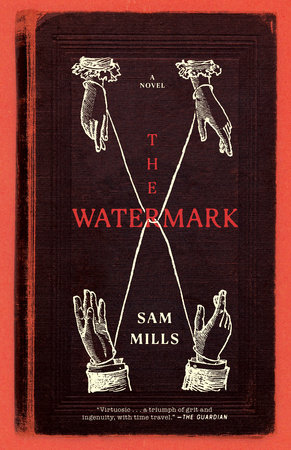
The Watermark
Jaime Lancia travels to a Welsh cottage to interview reclusive novelist Augustus Fate, while worrying about Rachel Levy, the painter he met online who has gone missing.
About
Spoiler notice: Spoilers cover the premise, capture, nested story settings, and the couple’s attempts to move between books. The final confrontation and ending are not disclosed.
Jaime arrives at the remote Welsh home of Augustus Fate expecting an interview with a celebrated novelist. He believes he has won a competition that could lead to journalism work, but his thoughts keep returning to Rachel Levy, a painter he met through an online forum and who has recently stopped responding. Fate is not interested in a straightforward conversation about his books. He is blocked on a new novel and regards the lives of other people as material that might solve his creative problem. Rachel is already at his cottage, where Fate has drugged and confined her. Jaime’s visit turns out to have been arranged for the same purpose. Their private relationship and their separate reasons for being there become entangled with a writer who sees people as characters he can direct.
Fate’s first project is a Dickensian coming-of-age story set in a fictionalised 1860s Oxford. Jaime is made to inhabit Thomas Turridge, while Rachel remains Rachel. They are not simply reading a manuscript or pretending to be its characters: they find themselves inside the story Fate is composing around them. When the effects of his drugged tea weaken, they can hear his narration, making the author’s control audible within their world. Fate wants the people he has captured to lend his fiction the life and feeling he believes his writing lacks. That arrangement creates a practical problem for the pair as well as an existential one. They must work out how to act inside a world whose events appear to be shaped by an author outside it, while searching for a way back to their own lives.
The tea also gives Jaime and Rachel a way to move between books. Their first departure brings them to a version of Manchester in 2014, imagined in an earlier story by an author whom Fate had imprisoned and drugged years before. The detail matters because the setting is a fictional future from the point of view of the novel written within the novel. In each new text, the couple encounter lives with altered circumstances and sometimes different names. Rachel remains a painter in the broader pattern, while Jaime’s place and identity shift with the story around him. Rather than treating each book as a separate adventure, the novel makes their accumulated memories a fragile guide: they have to remember where they were and what happened there as the next fictional world begins to press on them.
A further move takes them into Carpathia in 1928, in a work of magical realism. Its invented creature, the yukiri, is part animal and part instrument, with the appearance of a harp bearing a bird’s face. The setting’s unfamiliar folklore and the couple’s changing positions make recognition difficult, but the relationship between them persists across the shifts. The novel then sends them into science fiction in a future London where people live alongside autonomous robots, with friction between human beings and their artificial neighbours. Rachel’s role as an artist and her recurring interest in what gives a work its distinctive character connect these worlds. Each story tests whether a person can remain recognisably themselves when genre, historical moment and social position keep changing around them.
Fate’s design is not the only source of authorship in the book. Rachel tries to claim some control by writing her own biography, an action that raises its own complication: if she is already a character in a story, can she describe herself from outside it? Another author, introduced through one of the fictional works, offers a possible counterforce to Fate. The nested structure keeps shifting the boundary between a writer’s invention and the apparent independence of the people being written. Jaime and Rachel hear Fate’s voice, cross from one book into another and carry memories that the current narrative may not have supplied. Their efforts to orient themselves therefore rely on scraps of prior experience rather than a stable map. The story’s suspense grows from the question of whether knowledge, memory and collaboration can give them room to choose.
The novel’s settings include contemporary Britain, Victorian Oxford, a projected Manchester, Carpathia, a future London and a later, glitching return to Thomas Turridge’s world. Those are not all equivalent historical accounts: several are explicitly books-within-the-book, shaped by their imagined authors. The independent essay in 3:AM describes five central fictional works and traces how characters and ideas recur across them; the publisher likewise presents the book as a journey through interlinked novels. This structure gives Mills room to place different social arrangements beside one another, including questions of artistic ownership and the limits of human authority over artificial intelligence. These ideas enter through the action of the stories and Rachel’s recurring work as a painter, while Jaime’s attention to their earlier lives gives the sequence an emotional thread.
At its centre, The Watermark follows a young couple trying to protect a relationship while a novelist repeatedly rewrites the conditions under which they meet. Jaime and Rachel’s connection changes with their names, surroundings and circumstances, but each new version carries traces of the earlier ones. Their problem is not only escape from Fate’s control; they must decide what parts of a life remain theirs when memory and identity are tested by successive narratives. The book moves between romance, literary mystery, historical settings and speculative fiction, keeping the characters’ attempts to recognise one another in view. Its nested construction makes the act of storytelling part of the plot: a voice can frame a life, but the people inside that frame retain memories and desires that complicate the author’s plans.
Book details
- Author
- Sam Mills
- First published
- 2024
- Series
- No series listed
- Subgenre
- Literary fiction, Experimental fiction, Robot and AI
- Primary genre
- Literary Fiction, Sci-Fi
- Tags
- No tags for this book.
Review
Editor profile
Baby Bat
Goodreads and social links will be added soon.
- Goodreads — link coming soon
- Social media — link coming soon