
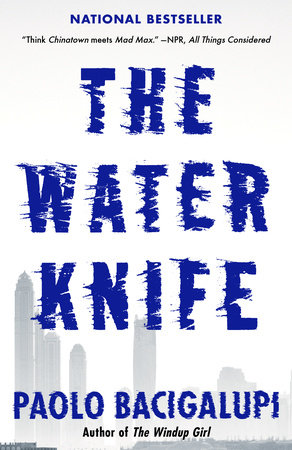
The Water Knife
In a drought-stricken near-future American Southwest, Angel Velasquez works as a water operative for Las Vegas, where protected arcologies depend on securing scarce supplies.
About
Spoiler notice: This overview discusses the novel’s drought-stricken setting, its three central characters and the conflict over a possible new water source. It avoids later betrayals, character fates and the resolution.
The Water Knife takes a basic necessity and makes its distribution the engine of a political thriller. In this near-future American Southwest, the Colorado River has dwindled and the cities built around it face hard choices about who will retain access to water. The shortage has not erased government, law or civic institutions; instead, those structures have become part of the struggle. Water rights, public authority, private power and violence overlap, giving the crisis a human scale as well as a regional one. Paolo Bacigalupi’s speculative setting asks what happens when a resource that usually arrives invisibly through pipes becomes impossible to take for granted.
Angel Velasquez is a specialist in making water move toward the interests of Las Vegas. His title, a water knife, captures the sharp edge of that work: he uses intelligence, intimidation and force to cut rivals away from supplies. The city’s privileged arcologies promise an orderly refuge, built to conserve and recycle what they can, while the surrounding landscape is increasingly exposed to heat and scarcity. Angel’s assignment takes him from this managed enclave to Phoenix, where rumors point to a water source capable of changing the balance among competing cities. He arrives as an operative, but the search draws him into a situation that no single employer can neatly control.
In Phoenix, Angel’s path crosses with Lucy Monroe, a journalist pursuing her own agenda, and Maria Villarosa, a young migrant from Texas who hopes to travel north. Their positions make the same crisis look different. Angel understands the contest through strategy and enforcement; Lucy approaches it through investigation and the need to uncover what powerful people would rather keep hidden; Maria experiences it through the immediate vulnerability of displacement and the search for a place where survival might be possible. The three perspectives let the story move among institutions, information and personal exposure. They also prevent the book’s conflict from becoming only a contest between governments or water agencies.
Bacigalupi builds tension through a chain of shifting interests. Phoenix is not simply a backdrop for Angel’s assignment: it is a city under pressure, filled with people and authorities trying to anticipate what a new source of water would mean. The possibility attracts more than one claimant, and the people who seek control do not share a common purpose. The publisher’s description frames the characters as pawns in a corrupt game, while the story’s premise makes clear why alliances cannot be assumed to hold. When water carries political and economic power, even reliable arrangements can become temporary. The resulting suspense comes from uncertainty about whose plans will survive the next change in leverage.
The novel’s violence grows from the way scarcity is organized. Its world contains legal claims, public bodies and powerful organizations, yet enforcement does not guarantee fairness or safety. A city’s technical capacity to conserve water can protect its residents while excluding people beyond its walls. A formal entitlement may matter enormously, but its practical value depends on who can defend it. The water knife figure gives Bacigalupi a way to turn those abstract arrangements into action: Angel embodies a system in which legal and political maneuvering can be carried out by a person trained to make another community’s access disappear. That combination keeps the book’s conflict grounded in institutions even as it moves at thriller speed.
The arcologies offer another expression of the book’s uneasy future. These dense developments are designed to retain resources, recycle water and sustain a more controlled way of life. Their efficiency is real within the story, but so is the boundary they create between those protected inside and those left exposed outside. The towers do not resolve the broader conditions that made them necessary. They show how adaptation can be both ingenious and morally limited: survival for one enclosed population may depend on arrangements that transfer risk to others. The contrast between insulated interiors and an increasingly hostile landscape gives the setting a visible social shape.
Although the book depicts a world of extreme drought, its central concern is not technology for its own sake. The imagined future stays close to recognisable systems of water management, urban growth, legal claims and political bargaining, then intensifies their consequences. Bacigalupi has connected the novel’s origins to reporting on Western water issues and has described wanting to make water rights and the winners and losers of scarcity more immediate. That aim is reflected in the thriller structure: instead of treating environmental change as distant background, the story follows people whose choices are constrained by it. The climate premise matters because it changes what cities can promise and what individuals must risk.
The Water Knife joins speculative fiction to crime and espionage conventions, using pursuit, concealed information and unstable loyalties to explore who gets to control a shared resource. Angel, Lucy and Maria do not begin from equal positions, and their intersecting aims draw attention to the gap between abstract claims and lived vulnerability. The book’s bleak landscape is built from more than dust and heat; it also comes from the decisions that make scarcity profitable or survivable for different groups. Its central question is therefore political as well as environmental: when water becomes the measure of power, who can claim it, who can enforce that claim, and what happens to everyone who is left outside it?
Book details
- Author
- Paolo Bacigalupi
- First published
- 2015
- Series
- No series listed
- Subgenre
- Climate fiction, Dystopian, Spy thriller
- Primary genre
- Sci-Fi, Mystery & Thriller
- Tags
- No tags for this book.
Review
Editor profile
Baby Bat
Goodreads and social links will be added soon.
- Goodreads — link coming soon
- Social media — link coming soon