
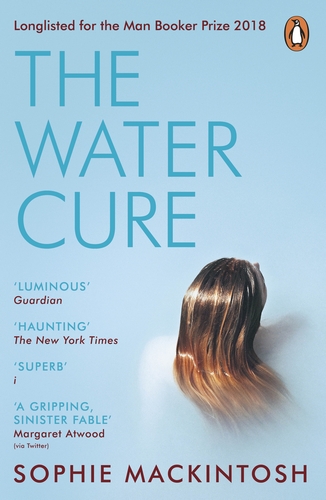
The Water Cure
Grace, Lia and Sky have been raised by their parents in isolation on a coastal island, where they are taught that the outside world is toxic and men are dangerous.
About
Spoiler notice: Discusses the opening setup, the sisters’ upbringing, their father’s death, and the arrival of three strangers; it does not reveal later developments or the ending.
Grace, Lia and Sky have grown up in a remote house beside the sea, where their parents have taught them that the world beyond the island is poisonous and that men are especially dangerous. In their isolated household, warnings are not abstract lessons: they shape what the girls eat, how they move, and the rules by which they understand their bodies. The sisters have been trained to treat hardship as protection. Their father, known as King, devises harsh practices that the family frames as preparation, while Mother preserves the routines that keep the girls inside this closed world. The premise leaves an important uncertainty in place. The environment may be dangerous, but the sisters know it through the accounts and rituals of the adults who control their lives. That gap between what they are told and what they can verify gives the novel its pressure from the start.
The opening disturbance is King’s disappearance and death, which the girls only gradually understand. The event alters the household without immediately supplying a reliable explanation for the island or the outside world. Mother remains, and the sisters continue to live among the rooms, gardens, pools and shoreline that have formed their entire map of experience. This confined setting gives ordinary spaces a double character: they are home, but also the boundaries of what the girls have been permitted to know. Their protection is inseparable from control. The novel does not begin with an expedition into a fully explained dystopia; instead, the reader encounters a small family whose habits already embody its larger crisis. Questions about environmental danger, inherited fear and parental authority arrive through daily life rather than a detached account of how the world became this way.
Mackintosh gives the sisters more than one narrative shape. Some chapters use a plural voice that lets Grace, Lia and Sky speak together, as if closeness has made a shared self possible; elsewhere, Lia and Grace take up distinct first-person perspectives. In her Booker Prize interview, Mackintosh says the collective voice grew from the sisters’ closeness and from her wish to include Sky, the youngest, before the girls’ voices separate more clearly. That formal choice makes sibling intimacy part of the book’s structure. The sisters can understand one another in ways that outsiders cannot, but shared language does not erase their differences. Their ages, desires and responses to the family’s rules do not line up neatly. As the point of view shifts, a bond that first seems almost indivisible becomes a way to register how each girl is shaped by the same history in a different way.
Ritual is one of the family’s main forms of explanation. The title refers to a cruel water-based practice intended to make the girls resilient, and the sample pages show that it is one of several exercises presented as necessary preparation. The actions themselves are physical and difficult; their meaning comes from the beliefs surrounding them. A child can be told that pain is care, that fear is training, and that obedience is survival. By placing such practices within family life, the novel examines how violence can be made ordinary when it is given a protective name. Mother’s continued participation in the household’s customs also complicates any easy division between authority and victimhood. The rituals are not presented as a neutral system that the girls freely choose. They are part of the inherited world the sisters must interpret, and their effects travel through the family even after King is gone.
When three male strangers reach the island, the sealed order faces a change it cannot absorb. The visitors include two adults and a boy, bringing the outside world into direct contact with the sisters’ learned fears. Their arrival does not instantly settle whether the parents’ warnings were true, exaggerated or useful to someone’s power. Instead, it makes the girls confront people as people, while also carrying the expectations and danger attached to the word ‘men’ in their home. The island’s boundary has kept out more than physical threats: it has kept the sisters from testing the stories that define those threats. With outsiders present, the old rules no longer sit safely in the background. The encounter shifts the family story toward questions of trust, bodily autonomy and what each sister has been prepared to believe about herself and others.
Mackintosh has described the novel as emerging from two linked concerns: an isolated family surviving amid an unnamed environmental disaster, and her own thoughts about what it means for women to live within patriarchal structures. In the Booker interview, she explains that she wanted the world of the sisters and the shaping force of their trauma to remain central, with the wider crisis approached quietly and abstractly. That account helps explain the book’s scale. The poisoned world is not developed as a catalogue of futuristic technology or political institutions; the focus stays close to the family and the language it uses to make danger intelligible. The speculative premise gives a literal form to a household’s warnings, but the narrative’s attention rests on how those warnings shape closeness, fear and dependence. Readers looking for exhaustive world-building may find that the outside remains deliberately indistinct.
The novel also draws force from the contrast between a beautiful coastal setting and the rules imposed within it. The house, grounds, water and sea are not simply scenery; they form the material limits through which the sisters experience safety and confinement. The beginning’s heat, domestic rooms and repeated practices create a closed atmosphere. Mackintosh’s style, as the publisher sample demonstrates, stays close to the sisters’ observations and bodily experience, while the shifts between plural and individual narration change how much distance the reader has from them. If protection is built from fear, punishment and restricted knowledge, how can the sisters tell care from control? The early story sets that question in motion and leaves its answer with the girls’ developing understanding of their own lives.
Book details
- Author
- Sophie Mackintosh
- First published
- 2018
- Series
- No series listed
- Subgenre
- Dystopian
- Primary genre
- Literary Fiction
- Tags
- No tags for this book.
Review
Editor profile
Baby Bat
Goodreads and social links will be added soon.
- Goodreads — link coming soon
- Social media — link coming soon