
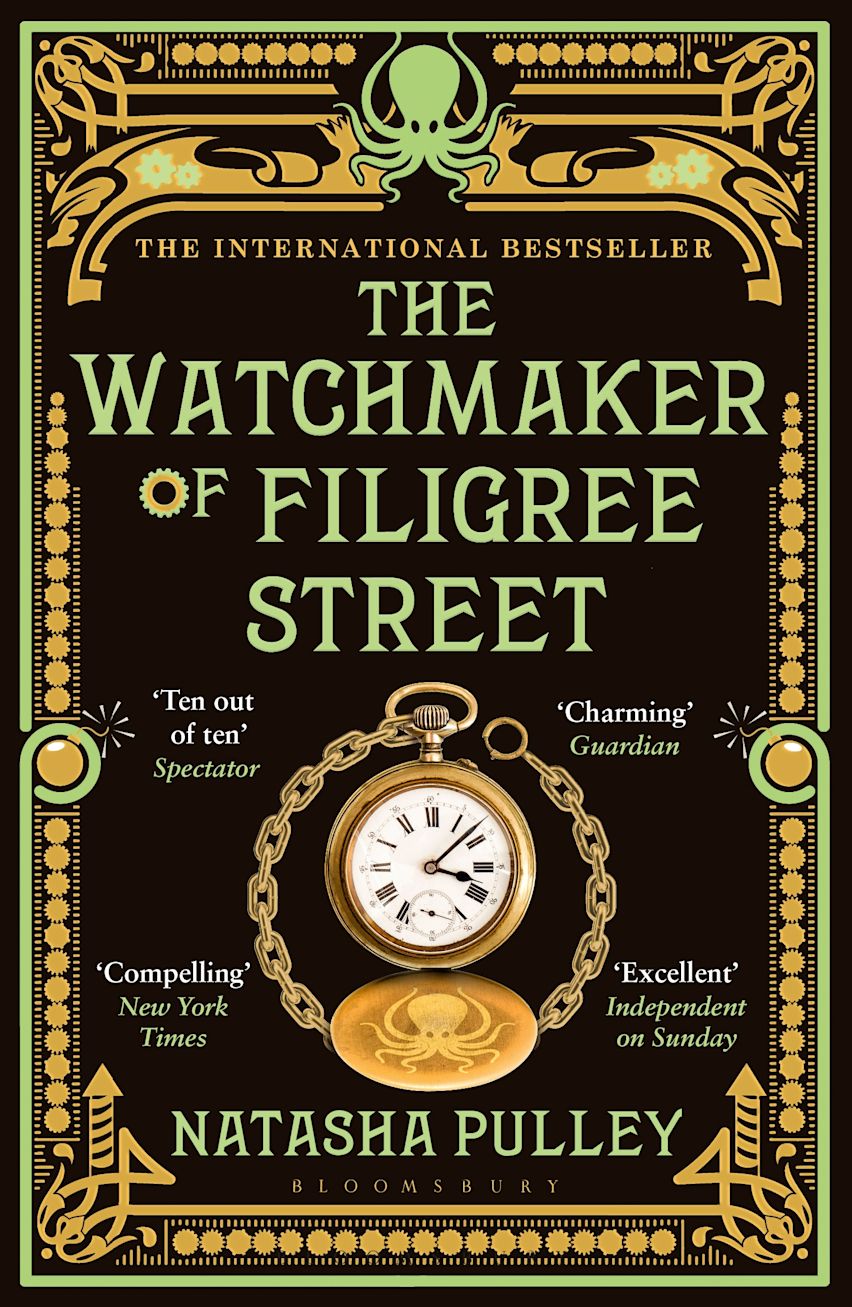
The Watchmaker of Filigree Street
In 1880s London, Home Office clerk Thaniel Steepleton finds an intricately made gold watch on his pillow.
About
Spoiler notice: This account covers the setup, the three central characters and Mori’s unusual way of perceiving events. It avoids the novel’s closing turns and ending.
In 1880s London, Thaniel Steepleton works as a clerk in the Home Office and lives in a cramped flat on a modest routine. That routine is interrupted when he finds an intricate gold pocket watch on his pillow, left without a note or an explanation. Its arrival feels less urgent than the political danger around his work until a bombing at Scotland Yard makes the watch’s intervention impossible to dismiss. The incident gives Thaniel a practical reason to trace the object to its maker, but it also changes the scale of his private life: a small, precise machine has placed him inside a mystery connected to public violence. Pulley starts with recognisable pressures of employment, money and security, then lets an impossible object unsettle them.
Thaniel follows the watch to Keita Mori, a Japanese immigrant and watchmaker whose craft gives the book its particular meeting point between machinery and fantasy. The two men form an intimate friendship, though the circumstances that bring them together leave a serious suspicion in place: Mori may have been involved in the bombing. Their connection therefore grows alongside a question of trust. Thaniel is not investigating a distant puzzle from outside it; his search makes him dependent on the person who might have helped cause the danger. The relationship also places Mori’s work and identity in the middle of London life, where he is treated as both a skilled maker and a foreign presence. The book lets affection and uncertainty coexist instead of resolving them as soon as the central pair meet.
The watchmaker is not the only person whose plans redirect Thaniel. Grace Carrow is a physicist in Oxford, where she is trying to establish the existence of the luminiferous ether in an academic culture that doubts and mocks her. Her intellectual ambition runs up against social expectations as well: her mother is pressing her toward marriage. Grace’s position gives the novel another kind of constrained life from Thaniel’s. He has a government post but little room for a larger purpose; she has a scientific question but must work around the assumptions attached to her sex and family role. When her interests overlap with Thaniel’s, their cooperation begins as a way to pursue separate aims, not as a simple alliance. Their different suspicions of Mori keep that arrangement unsettled.
Pulley widens the frame beyond one London mystery by moving between London in the 1880s and Japan in the 1870s. The characters’ private decisions sit against Irish nationalist activity in England and upheaval in Japan, so political history is part of the pressure around them rather than decorative period scenery. English, Irish and Japanese national projects come into view through people involved in those forces without fully controlling them. This gives Mori’s presence additional weight: his life in London connects him to a country being reshaped, while Thaniel’s work brings him close to a different struggle at home. The shifts of time and place make personal loyalties part of a broader historical movement.
The story’s speculative question grows out of Mori’s way of understanding time. He remembers what is still ahead and can make observations that seem almost prophetic, a capacity that gives Grace reason to suspect more than unusual skill. The idea does not make him all-knowing: chance still has a place in the novel, and even a coin toss can evade his foresight. That limit matters because it keeps prediction separate from total control. Thaniel and Grace have to judge what Mori knows, what he chooses to say and what his apparent foresight means for their own choices. The pocket watch consequently works both as a crafted object and as the story’s first sign that cause, intention and timing may not fit together in ordinary ways.
Thaniel’s inner life adds a quieter thread to the clockwork and political plot. He often experiences sound and other sensations in a synesthetic way, while music is bound up with a difficult part of his character. This detail offers another form of unusual perception beside Mori’s relation to the future. It also complicates the image of Thaniel as merely a sensible clerk: his attention to the world does not always follow the categories other people expect. Against Grace’s explicit scientific ambitions and Mori’s mysterious knowledge, Thaniel’s perceptions are more private, but they shape how he responds to people and to the events around him. The novel’s concern with what can be known therefore extends beyond its central mystery.
Across these strands, the book brings together a threatened government office, an Oxford scientific dispute, a watchmaker’s workshop and relationships marked by unequal expectations. Its central tensions concern what people owe one another when trust is incomplete, and how much freedom remains when family, institutions or someone else’s knowledge seem to have planned the available choices. Grace challenges assumptions about who can take part in science; Mori unsettles the boundary between prediction and chance; Thaniel must decide how to relate to both of them. The novel combines historical settings with a speculative mechanism, but its questions stay close to ordinary attachments: friendship, loyalty, love and the wish to make a life larger than its assigned role.
Book details
- Author
- Natasha Pulley
- First published
- 2015
- Series
- No series listed
- Subgenre
- Historical fantasy
- Primary genre
- Fantasy, Historical Fiction
- Tags
- No tags for this book.
Review
Editor profile
Baby Bat
Goodreads and social links will be added soon.
- Goodreads — link coming soon
- Social media — link coming soon