
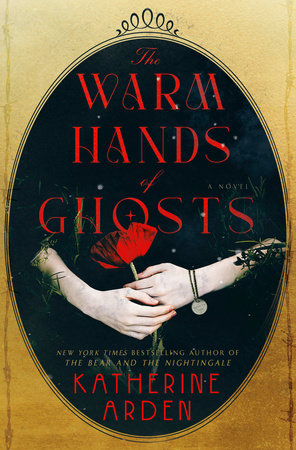
The Warm Hands of Ghosts
Wounded and discharged, Canadian nurse Laura Iven is home in Halifax when she receives her brother Freddie’s belongings and word of his death.
About
Spoiler notice: Spoilers for Laura’s return to the Western Front, Freddie and Hans’s alliance, Faland’s memory-taking power, and Laura’s visions at his inn. The outcome of the siblings’ search is not described.
The novel moves between two nearby but unequal moments in the First World War. In January 1918, Canadian nurse Laura Iven is home in Halifax, trying to learn what happened to her brother Freddie after receiving his belongings and a report that he died. Freddie’s chapters begin earlier, in November 1917, after an explosion leaves him trapped with a wounded German soldier. Because the accounts do not start together, the reader sees Laura searching through rumour and absence while Freddie’s story unfolds from inside the danger she is trying to understand. Their alternating paths make the question of whether they can find each other part of the plot’s structure, while each sibling’s chapters also give that search a life of its own.
Laura’s return is shaped by work as much as by grief. Before she is wounded and discharged, she is a trained, working nurse at the front, not a volunteer who has arrived without professional experience. After the Halifax disaster, news that Freddie is missing and presumed dead makes staying home impossible for her. She returns to Belgium as a volunteer at a private hospital and follows what she can learn in the limited time left around her duties. Her medical background gives her practical knowledge of injury and care, but it cannot tell her what happened to her brother. She must move between the ward, soldiers’ stories and the landscape beyond the hospital, where accounts of the dead and missing do not always agree.
Freddie’s earlier chapters give the search another centre. He wakes in an overturned pillbox with Hans Winter, a wounded German soldier on the other side of the front. The men have reason to fear one another, yet their immediate problem is surviving the shelter and finding a way out. They manage an alliance and leave together rather than return directly to the fighting. That decision takes them towards a stranger whose refuge seems to offer a temporary distance from the war. Freddie’s account therefore follows more than the fact of his disappearance: it shows the choices and encounters that Laura cannot see from her later position. Hans is not merely a clue in her investigation, but a person Freddie must reckon with while the two are still trying to stay alive.
The stranger is Faland, a musician whose hotel and wine promise soldiers a pause from the trenches. Freddie and Hans encounter him when returning to the battlefield feels unbearable, and the reprieve is bound to a dangerous exchange: Faland feeds on memories and turns what he takes into music. The supernatural bargain gives the story a concrete form for the pull of oblivion. To forget can look like mercy to people carrying the front with them, but the lost memories are part of what makes them themselves. Laura hears reports of a wandering fiddler from soldiers who alternately curse and praise him. Their contradictory accounts mean that the same figure can sound like a rescuer or a threat, depending on what a person needs and what he has taken.
At Faland’s inn, the uncanny does not stay confined to Freddie’s past chapters or to soldiers’ rumour. Wounded and exhausted, Laura drinks the wine and sees the figure of her dead mother; later, a tarnished mirror seems to show Freddie. Her friend Pim also stands before the mirror, caught in a vision of her own desire. The scene leaves room for ordinary explanations—fever, alcohol, illness and the power of suggestion—while making those explanations feel insufficient to Laura, who has crossed an ocean because she cannot accept the official account of Freddie’s death. The ghost story grows from these characters’ private losses, so a haunting can be both a supernatural event and a sign of what war has made them desperate to recover.
Laura’s work at the private hospital puts another kind of front beside the trenches. She treats the damage left by fighting and learns how little the familiar language of duty can capture what the people around her have endured. Her professional training and working-class background place her outside the familiar image of the young volunteer nurse: women who had chosen nursing as a profession followed a different path and were often pushed to the margins of wartime memoirs. That context gives the hospital scenes a specific focus. Laura’s skill matters, while the story makes visible the labour and experience of nurses who were less often recorded. Freddie’s voice offers a different contrast. He is younger, vulnerable, an artist and a poet, while Laura is practical and professionally trained; the siblings meet the same historical violence with distinct habits of seeing and responding.
The chapter headings draw on the Book of Revelation and Paradise Lost, placing the siblings’ ordeal beside older visions of catastrophe and the underworld. That scale belongs to the world they are living through: war has made an ordinary landscape almost unrecognisable, while Faland offers an intimate kind of danger within it. Shellfire does not need to know a person before destroying them. The fiddler’s power works through knowing what someone wants to escape. The difference matters to both siblings, whose search depends on remembering a life beyond the war even when remembering is painful.
Book details
- Author
- Katherine Arden
- First published
- 2024
- Series
- No series listed
- Subgenre
- Historical fantasy, World War I fiction
- Primary genre
- Fantasy, Historical Fiction
- Tags
- No tags for this book.
Review
Editor profile
Baby Bat
Goodreads and social links will be added soon.
- Goodreads — link coming soon
- Social media — link coming soon