
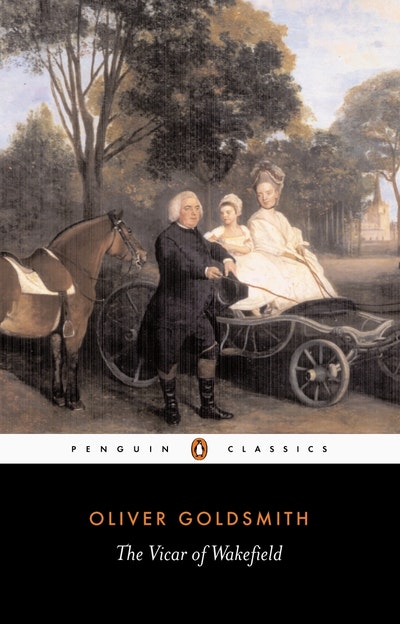
The Vicar of Wakefield
Dr Primrose’s comfortable country household loses its fortune and moves to a smaller living near the wealthy Squire Thornhill.
About
Spoiler notice: Full-plot spoilers, including Olivia’s marriage, Burchell’s identity, Sophia’s rescue and the final family reunions.
Dr Primrose introduces his family as though their happiness proves the soundness of his principles. He is a country clergyman, a husband and the father of six children, proud of a household that welcomes travellers and poorer relations to its fireside. His wife Deborah shares his affection for their children, though her ambitions for them sometimes reach further into fashionable society. George has been educated at Oxford, while Moses has received a less regular education at home; Olivia and Sophia have different temperaments but equal places in their father's admiration. Goldsmith gives this comfortable beginning a comic edge. Primrose's generosity is real, yet his confidence in his own judgment leaves plenty of room for the people around him to understand a situation differently.
That security disappears when the merchant holding the family's money absconds. George's proposed marriage to Arabella Wilmot is caught up in the collapse, and the Primroses leave their comfortable surroundings for a smaller living and farm. Work and economy replace the ease of the opening household, but Primrose tries to find contentment in their changed circumstances. Their new neighbourhood also brings two very different acquaintances. Squire Thornhill has wealth, local influence and the attraction of fashionable company. Mr Burchell appears to have little money, speaks with unusual freedom and becomes a visitor at the family home. The contrast makes social position difficult to judge: the man whose company promises advancement is not necessarily the person whose presence makes the household safer.
Much of the early action follows small domestic hopes that become expensive mistakes. Moses returns from a fair after selling a horse, delighted with the bargain he has made in a gross of green spectacles. Their supposedly silver rims turn out to be varnished copper. The disappointment is funny because his reasoning sounds so persuasive to him, but losing an asset matters much more to a family with little left. Deborah and the daughters are also drawn toward the distinction that wealthy visitors seem to offer. Their aspirations bring dress, courtship and appearances into the family's daily calculations. Primrose can recognise foolishness in others without escaping it himself, and the first-person account lets his solemn explanations sit beside events that do not support his certainty.
Olivia's disappearance changes the scale of those disappointments. Primrose leaves to search for her, and the journey carries his account away from the familiar farm into encounters and other people's histories. He eventually hears her voice at an inn, where she is being driven out because she cannot pay. His response is to take her into his arms and forgive her, even while she believes disgrace has made a return to family life impossible. The scene gives his religious principles a harder test than an argument at the fireside. Olivia is his daughter before she is an offence against his expectations. On returning home, he faces another catastrophe: the house is burning, and his two youngest children are still inside. He carries them out through the flames, saving their lives while the family's possessions are destroyed.
The losses continue into a debtor's prison, where Primrose encounters Jenkinson, a man whose knowledge of deception eventually becomes useful to him. Primrose also turns to the other prisoners, trying to offer moral instruction and arguing against treating punishment simply as revenge. His own family remains exposed to dangers outside the walls. Olivia is reported dead, Sophia is abducted, and George is brought before his father in irons after challenging Thornhill and resisting the servants sent to seize him. The reassuring letter describing George's military prospects has scarcely been read before his actual arrival destroys that comfort. These reversals make the prison more than a final low point in a string of adventures: it becomes the place where Primrose must try to live by the consolation he offers everyone else.
The rescue begins with Sophia's return in Burchell's company. Burchell is revealed to be Sir William Thornhill, the squire's uncle, whose wealth and authority were concealed beneath his unassuming manner. An examination of servants and accomplices exposes the nephew's scheme to arrange Sophia's abduction and then appear as her heroic rescuer. Arabella learns that the accounts separating her from George were false. Jenkinson supplies another decisive revelation: Olivia is alive, and the marriage Thornhill intended as a sham is legally binding. Jenkinson obtained a genuine licence and priest because keeping proof of the marriage would give him leverage over the squire. His help has mixed motives, but it defeats a plan that depended on other people remaining unable to prove what had happened to them.
The final chapter restores money as well as family connections: the failed merchant has been arrested at Antwerp with enough property to satisfy his creditors. Primrose marries Sophia to Sir William and George to Arabella, then returns to the familiar pleasures of company, food and a gathered fireside. Olivia's position is less simple than the celebrations might suggest. She remains the younger Thornhill's wife, while he lives elsewhere; she still remembers him with regret and may relent if he reforms. The conclusion allows that unresolved attachment to remain inside its general happiness. Primrose ends with his small children on his knees and a sense that he has nothing more to wish for. His final task is gratitude, after a story in which his household has repeatedly confused attractive appearances with dependable goodness.
Book details
- Author
- Oliver Goldsmith
- First published
- 1766
- Series
- No series listed
- Subgenre
- Literary fiction, Family novel
- Primary genre
- Literary Fiction
- Tags
- No tags for this book.
Review
Editor profile
Baby Bat
Goodreads and social links will be added soon.
- Goodreads — link coming soon
- Social media — link coming soon