
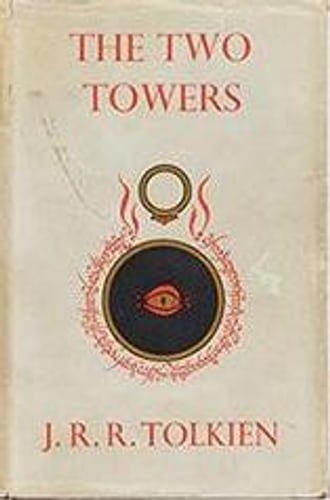
The Two Towers
The Two Towers picks up with the Fellowship broken.
About
The Two Towers first appeared in 1954 as the second of the three volumes that make up J. R. R. Tolkien's The Lord of the Rings, which had been written as one long work and was divided for publication. Tolkien was a philologist at Oxford who had spent decades building the languages and histories behind the story, and the appendices at the end of the third volume carry the material that could not fit inside the narrative. The volume's title is famously ambiguous, since the book names five towers and Tolkien gave more than one account of which two he meant.
Structurally the book splits into two strands that run in parallel. The first follows Aragorn, Legolas and Gimli through Rohan, where the kingdom is being pulled apart by the counsels of Grima Wormtongue and by the armies of Saruman, and where the fortress of Helm's Deep becomes the setting for the largest battle in the trilogy. The second stays with Frodo and Sam, whose journey is smaller in scale and closer to the ground, and whose companion Gollum is the character Tolkien uses to test whether mercy is a strategy or a weakness.
The volume was welcomed by reviewers on publication as an exciting continuation rather than a complete book, and it formed the basis for the second of Peter Jackson's films in 2002. Its middle-book shape is real: it begins after a death and ends with a decision about how to approach a tower, which is one reason the trilogy is usually read as one novel in three parts.
Book details
- Author
- J. R. R. Tolkien
- First published
- 1954
- Series
- The Lord of the Rings, book 2
- Subgenre
- Epic fantasy, Classic fantasy
- Primary genre
- Fantasy
- Tags
- No tags for this book.
- Reading order
- Also on this shelf: The Fellowship of the Ring (book 1), The Return of the King (book 3)
Rating
Review
Editor profile
Baby Bat
Goodreads and social links will be added soon.
- Goodreads — link coming soon
- Social media — link coming soon