
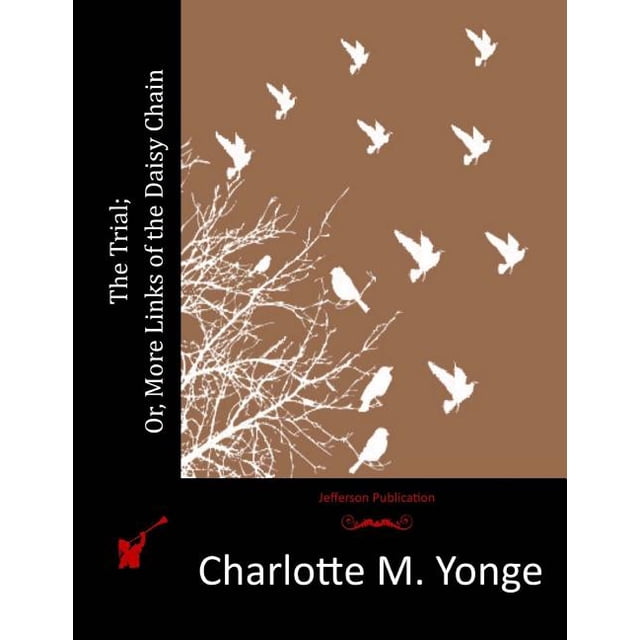
The Trial
The May family’s circle is shaken when Leonard Ward is accused of murdering his uncle, Francis Axworthy.
About
Spoiler notice: This overview discusses Leonard’s conviction and commuted sentence, the evidence found after Sam Axworthy’s death, the pardon, Tom and Averil’s marriage and the mission-work coda.
The Trial returns to the May family after the youthful hopes and household struggles of The Daisy Chain have become adult responsibilities. Richard is established at Cocksmoor, Ethel remains a centre of family life, and marriages have carried several of the younger people into homes of their own. Letters from a honeymoon share space with news of illness in the town. Charlotte M. Yonge’s 1864 novel begins within that familiar traffic of affection, work and concern before a murder brings the household into contact with a much harsher form of judgment. The subtitle, More Links of the Daisy Chain, describes the continuity: the family’s influence extends into other lives, while events outside its home test what loyalty and practical care can accomplish when ordinary reassurance is no longer enough.
The case centres on Leonard Ward and the death of his uncle, Francis Axworthy. At the scene, the room appears disturbingly ordinary. Objects remain in place, drawers have not been emptied and there is no obvious sign of a struggle or robbery. Leonard’s rifle, however, stands nearby with blood and white hairs on it. Dr. May recognizes the weapon and immediately wants to know how someone else could have obtained it, but the circumstances seem to point towards the absent young man. The book gives suspicion a material form in familiar possessions turned into evidence. People who know Leonard must confront the possibility that their confidence in his character will carry little weight against an account assembled from what can be found, identified and displayed.
Money and a missing receipt become essential to Leonard’s explanation of his movements. His uncle had wanted funds placed beyond the reach of another nephew, Sam Axworthy, whose demands had made the local arrangements insecure. Leonard’s account depends on having acted as a messenger rather than fled after a crime. Without the document that would support him, his story cannot overcome the case built against him. At the assizes, the jury finds him guilty while recommending mercy. Leonard accepts that the appearances have made their conclusion understandable, but still denies hurting his uncle. He also acknowledges an earlier violent outburst against his brother. That admission distinguishes guilt for something he really did from responsibility for the murder of which he is accused, even as his religious conscience makes the punishment harder to separate from his own past faults.
The death sentence is eventually commuted to penal servitude for life. For those outside the prison, the news brings relief and an immediate wish to believe that truth must now emerge. Leonard faces a different prospect: the execution has been prevented, but conviction, separation and disgrace remain. Dr. May’s visit reveals how difficult it is to demand gratitude or cheerfulness from someone whose future still appears closed. Leonard wants a lock of his hair saved for Averil before the prison authorities cut it, a small act that gives the separation an intimate scale. Yonge follows endurance as an experience that can continue after other people feel a crisis has passed. Hope exists, but it does not erase the daily conditions of confinement or guarantee when a loved person will be seen again.
Even promising evidence proves slower to help than the family expects. A missing cheque for twenty-five pounds is presented after a long concealment, and Tom and his father initially think the discovery will establish Leonard’s account. The lawyers distinguish what convinces them personally from what can reopen a conviction. The cheque’s signature is uncertain, its delayed appearance is suspicious, and its connection to the missing receipt still cannot be proved. The discussion makes vindication depend on more than discovering something that fits a preferred explanation. It also prolongs the distance between the people actively seeking a way forward and the prisoner who cannot control the investigation. The novel’s suspense comes from that delay as well as from the question of who committed the crime.
The decisive change arrives after Sam Axworthy is fatally hurt in a brawl in Paris. Leonard’s pocketbook and receipt are found on him, establishing the evidence that has been absent. There is no confession. Leonard receives a pardon, and Dr. May brings the news to the prison himself. Freedom does not immediately restore the young man who entered it: he follows instructions almost mechanically and struggles to comprehend what has happened. On the journey home, he asks whether he really did the thing described in court, revealing how confinement and repeated accusation have unsettled his own recollection. The Doctor has to repeat the external evidence before the distinction between fact and fearful imagining becomes secure. Returning him home therefore involves patient attention to his changed state, not simply announcing that the legal obstacle has gone.
The conclusion brings recovery into the practical life of a household. Tom marries Averil while her health remains precarious, and Dr. May offers guarded hope rather than certainty about the years they may have together. Leonard finds a purpose in mission work, seeing even the manual skills learned in prison as something he can use. A closing look forward shows his letters reaching Stoneborough and Averil supporting the mission from her sofa through correspondence, supplies and accounts. Her place also becomes a centre to which the family brings its news and troubles. These arrangements do not make suffering disappear. They give the survivors ways to contribute and to receive care without waiting for every loss to be reversed. The title’s trial has extended beyond the courtroom into the work of living with other people after judgment, illness and separation have changed them.
Book details
- Author
- Charlotte M. Yonge
- First published
- 1864
- Series
- No series listed
- Subgenre
- Victorian fiction, Family novel
- Primary genre
- Literary Fiction
- Tags
- No tags for this book.
Review
Editor profile
Baby Bat
Goodreads and social links will be added soon.
- Goodreads — link coming soon
- Social media — link coming soon