
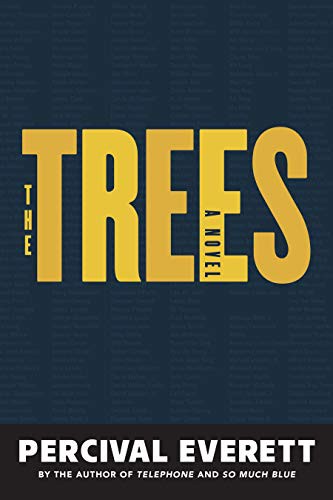
The Trees
In Money, Mississippi, a series of brutal murders is marked by a second body resembling Emmett Till, the Black boy lynched in the town decades earlier.
About
Spoiler notice: Discusses the opening murders, investigation and historical themes; avoids later revelations and the ending.
The Trees opens as a murder investigation in Money, Mississippi, but its first puzzle is already bound to a history that the town would prefer to treat as finished. At a white family’s home, investigators find a Black man beside the murdered residents, and the stranger’s resemblance to Emmett Till connects the present crime scene to the boy lynched in Money decades earlier. Everett makes the past physically present inside the procedures of a contemporary case. The premise asks what a detective story can do when violence appears not as an isolated act but as part of a continuing record, carried in names, places, silences and the people who inherit them.
The two Black detectives sent to investigate, Ed and Jim, give the novel a recognisable crime-fiction frame: a pair of investigators, baffled local authorities, witness interviews and a sequence of clues. Their dry exchanges and professional routines provide comic timing, yet the humour does not dissolve the violence around them. Instead, the contrast draws attention to the limits of familiar police-story expectations. A case that initially looks contained within one family and one small town begins to demand a wider account. Ed and Jim must work through the evidence while also reading the racial assumptions that shape how the white residents explain themselves and how institutions respond.
Everett shifts the book between murder mystery, horror, satire and social allegory. Those forms pull in different directions: the mystery asks who is responsible and how events connect; horror gives historical violence an uncanny, bodily return; satire makes racist self-justification look grotesque through exaggeration and comic reversal. The novel uses popular genre machinery to keep its inquiry moving, then lets that machinery expose what a conventional whodunit might leave outside its frame. The result is not a puzzle whose solution can restore order. Each new connection enlarges the question of what justice means when a crime’s history stretches far beyond the immediate suspects.
Money is more than a backdrop for the investigation. Its relationship to Emmett Till’s murder places the fictional case beside a documented American history, and the novel repeatedly tests the comforting language of “past history.” The dead man’s uncanny appearance makes remembrance part of the plot rather than background information. Everett’s use of an impossible or supernatural element does not replace historical reality with fantasy; it gives an image to the persistence of what a community has tried to put away. The town’s response matters as much as the murders themselves, because denial, nostalgia and selective memory shape what residents consider discussable.
The novel also turns its satire toward the conventions that have long organised American racial storytelling. White characters are often drawn in broad, deliberately comic strokes, while Black characters occupy the investigative and interpretive centre. That reversal changes who gets to observe, question and define the meaning of events. Everett uses caricature as a formal pressure: it can make familiar racist logic sound absurd, but the ugliness underneath the joke remains visible. The comedy asks readers to notice how easily violence can be normalised when language and popular stories have already reduced people to types.
As the investigation widens, the book changes scale. A local case points toward similar events elsewhere, linking the detectives’ work to a longer national pattern. This movement from town to country prevents Money from being treated as an exceptional place with an exceptional past. The inquiry keeps returning to the work of recording: names matter, evidence matters, and the act of documenting a victim resists the erasure that follows violence. The novel’s historical argument is therefore carried through detective work, where an overlooked fact can connect apparently separate scenes and where the record itself becomes contested.
Everett’s pacing supports that widening scope. The chapters are notably brief and the focus can shift quickly, giving the book a clipped, restless rhythm rather than the slow accumulation of a single detective’s private reflections. Short scenes can land a joke, sharpen a clue or expose a change in tone before the narrative moves on. That speed makes the novel readable as a page-turning investigation, while the recurring images and historical references ask the reader to pause over what the momentum might otherwise rush past. Comedy and dread often sit close together, and the abrupt transitions keep either mood from becoming comfortable.
The Trees is concerned with the stories a nation tells about justice, memory and who is allowed to be mourned. Its genre shifts let it approach those questions from several angles: crime fiction follows evidence, horror gives history an uncanny presence, and satire attacks the excuses that protect racial violence. Everett does not offer a tidy separation between past and present, or a solution that makes the record harmless. The title’s image of rooted, living things resonates with the book’s insistence that buried history can remain active. The novel asks what it takes to face that inheritance, and what forms of justice might follow from remembering clearly.
Book details
- Author
- Percival Everett
- First published
- 2021
- Series
- No series listed
- Subgenre
- Modern horror, Crime thriller, Literary fiction
- Primary genre
- Literary Fiction, Mystery & Thriller
- Tags
- No tags for this book.
Review
Editor profile
Baby Bat
Goodreads and social links will be added soon.
- Goodreads — link coming soon
- Social media — link coming soon