
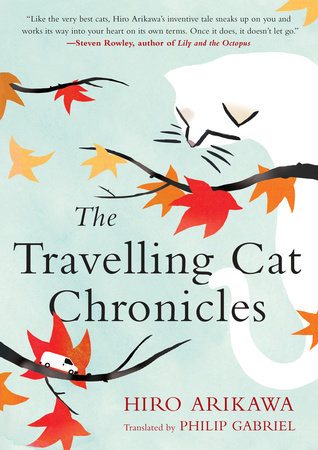
The Travelling Cat Chronicles
A stray cat with a crooked tail accepts food from Satoru, a young man who soon becomes his companion.
About
Spoiler notice: Full-plot spoilers below: the reason for the journey, Satoru’s death, and Nana’s life with Noriko afterward.
The Travelling Cat Chronicles opens with a stray cat making a cautious decision about a human. A young man named Satoru leaves food for the cat, whose crooked tail gives him a distinctive silhouette. The cat accepts the food but keeps his independence; the relationship grows through repeated encounters until Satoru gives him the name Nana. This beginning gives the book two centers of attention. Satoru offers care and patience, while Nana watches human habits with feline reserve and a dry sense of his own importance. The narration can move between their perspectives, so a simple domestic bond becomes a way to compare what each of them notices, values and misunderstands.
Nana has preferences, irritations and a clear sense of territory. He responds to travel through the concrete things available to him: unfamiliar animals, food, smells and the behaviour of the people around Satoru. His viewpoint can be comic because he judges human customs from the outside, but it also changes the emotional scale of the story. He encounters other creatures on the road, and his reactions keep the journey close to a cat’s immediate concerns even as Satoru carries a more difficult purpose. Loyalty is not expressed only through declarations. It appears in the repeated fact of travelling together, in how Satoru attends to Nana’s needs and in Nana’s own certainty about where he belongs.
The novel’s central journey begins when Satoru decides to travel with Nana in his silver van and visit several longtime friends. Nana understands the outing as a trip, but Satoru also hopes one of these people might take the cat in. He does not explain the reason immediately. That difference in knowledge gives the visits a quiet tension: each stop is welcoming on its surface, yet the reader is invited to wonder why Satoru is trying to arrange Nana’s future. The journey is not driven by danger or a puzzle to solve. It proceeds through conversations, memories and the changing scenery of Japan, letting ordinary reunions gradually disclose what matters.
The friends they meet represent different periods of Satoru’s life. Kosuke, a childhood friend, is tied to an earlier cat whose care shaped Satoru’s understanding of attachment. Other visits bring the pair to Yoshimine, a friend from school, and to Sugi and Chikako, who run a lodging house where guests can bring their pets. These encounters are not merely introductions to possible new owners. Each reunion lets Satoru and his friends revisit the people they were and the choices that separated or sustained them. Nana, present in the room and alert to its practical details, observes the human emotion around him without interpreting everything in the same terms as the people do.
As the trip unfolds, the past arrives in episodes rather than in a single uninterrupted account. The novel connects Satoru’s adult gentleness to childhood upheaval: after his parents die, he goes to live with his aunt Noriko, while the cat Hachi cannot accompany him. Kosuke’s father had already refused to keep Hachi, so the separation is not simply a matter of Satoru choosing to leave a pet behind. Adults decide where the cat can live, and Satoru has little control over those decisions. The story of Hachi helps explain why the bond with Nana carries more history than a routine owner-and-pet arrangement. It also gives the road trip a recurring question about what it means to keep faith with someone when circumstances make staying together difficult.
The book allows humour into these memories, especially through Nana’s frank observations, while keeping loss and separation close to the surface. Satoru’s friends are not simply background figures from a hidden past; the years between encounters have changed their circumstances, and the reunions let them see those changes. Satoru’s childhood and his adult friendships become linked through the care of animals and the obligation people feel toward one another. The van gives these reflections a mobile setting: landscapes and seasons pass outside while old stories are brought into the present. Travel becomes a way of returning to relationships and understanding how earlier decisions still shape them.
The journey eventually reveals why Satoru has been looking for a home for Nana. Satoru is seriously ill and knows he will not be able to care for the cat indefinitely. The visits therefore carry the painful practical purpose that Nana has not understood. Satoru dies, and Noriko takes Nana in, along with another abandoned cat. Nana lives in Noriko’s household, but the ending preserves his own account of belonging: he considers himself Satoru’s cat, even while accepting a new daily life. The resolution holds loss and continued care together. A home can change, and a relationship can outlast the person who first made it possible. Arikawa’s road novel reaches its emotional destination through specific acts of care, remembered friendship and the stubborn perspective of a cat who knows whom he loves.
Book details
- Author
- Hiro Arikawa
- First published
- 2012
- Series
- No series listed
- Subgenre
- Literary fiction
- Primary genre
- Literary Fiction
- Tags
- No tags for this book.
Review
Editor profile
Baby Bat
Goodreads and social links will be added soon.
- Goodreads — link coming soon
- Social media — link coming soon