
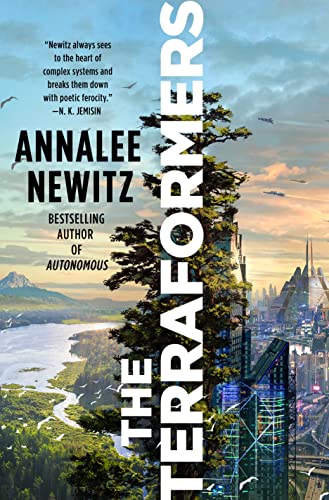
The Terraformers
On Sask-E, a planet being terraformed by the corporation Verdance, ranger Destry and the Environmental Rescue Team work to protect the developing ecosystems.
About
Spoiler notice: Full-novel spoilers below, including the discovery that changes the Environmental Rescue Team’s mission and later conflicts over Sask-E’s land, infrastructure, and citizenship.
The Terraformers begins with work that looks almost impossibly large: making a planet into a home. Sask-E is under development by Verdance, a corporation shaping its landscape and ecosystems for future residents. Destry belongs to the Environmental Rescue Team, whose members care for the emerging environment across generations. Their work is both scientific and political. They monitor ecological relationships, respond when people threaten them, and try to keep the planet from being reduced to a product designed for wealthy buyers. The novel follows this project over thousands of years, so the place itself becomes a main character. Rivers, forests, settlements, and transportation systems change, while the consequences of earlier decisions remain. Each era inherits a landscape that is already shaped by someone else’s plans.
Destry’s first section turns a ranger’s assignment into a question about who counts as a person. While working on Sask-E, she discovers a community hidden inside a volcano, a population that should not exist according to the corporation’s plans. The encounter unsettles the story’s categories: humanity is not the only form of intelligence, and the visible division between human, animal, and machine does not settle who deserves a voice. Destry’s relationship with Whistle, a moose who can fly, makes this conflict intimate as well as institutional. He is not simply a companion animal in the story’s world. His abilities and limits expose how legal definitions can be manipulated to preserve someone else’s convenience. When the company treats unexpected people as obstacles, the team’s ecological duty becomes a dispute about recognition and consent.
The novel then widens its focus rather than resolving Sask-E’s politics in a single heroic confrontation. Its connected sections jump forward by centuries, bringing new characters and different practical problems into the history. The planet’s inhabitants have to decide who may settle on land, who controls water, how people move between communities, and whose needs shape public infrastructure. Those are concrete questions of planning, but the book treats them as questions of belonging too. A city is not just buildings placed on terrain; its roads, transit, housing, and shared resources decide which lives it supports. The different generations inherit earlier arrangements, revise them, and encounter new attempts to turn common environments into private assets. Sask-E’s future is made through negotiation and conflict at the same time.
That long view lets Newitz link ecological change to social organization without making either one a backdrop. The terraformers cannot treat nature as untouched scenery because the planet is being deliberately engineered. Yet engineering does not grant Verdance unlimited moral authority over every being and place its project affects. The Environmental Rescue Team’s practice of protecting ecological balance becomes a challenge to ownership: maintenance, knowledge, and care create relationships with a landscape that a deed cannot fully describe. The company’s desire to sell an idealized version of Earth also turns environmental restoration into a commodity. The tension is not simply between technology and wilderness. Sask-E is already a designed world, and the central issue is whose purposes its design serves, who bears its costs, and who has the power to change it.
The book’s speculative cast makes its account of citizenship unusually literal. Sentient trains, engineered animals, and people with different kinds of bodies and minds share the same setting. Their presence tests the rules that institutions use to distinguish a full citizen from a useful worker or a managed resource. The stories show how recognition can be granted in principle and withheld in practice, including through assessments that define intelligence narrowly. Whistle’s speech limiter is a particularly direct example: a technical intervention helps make his exclusion appear natural. This is why personhood remains a material issue rather than an abstract philosophical debate. It affects who can speak, travel, work, own a home, or refuse a role assigned by the system around them.
Because the narrative keeps moving across generations, its hope is tied to continued collective effort. The later sections do not suggest that one successful rebellion permanently ends exploitation. Instead, each new community faces arrangements that have hardened over time and must find ways to make them answerable to the people living with their effects. Collaboration, public works, compromise, and resistance all become part of world-building. Newitz places adventure and strange inventions beside the less glamorous decisions that determine whether people can live together: distributing resources, organizing transport, and deciding who gets heard. That scale gives the novel room for both setbacks and possibility. Sask-E remains contested, but its inhabitants can imagine institutions and relationships that do not take corporate convenience or human supremacy as natural law.
The Terraformers ultimately treats the making of a livable world as an ongoing civic task. Its premise might suggest that terraforming ends when a planet reaches a target climate or looks enough like an old Earth. The novel instead asks what kind of society is being constructed along with the ecosystem. A technically successful landscape can still be unjust if its inhabitants are denied agency, if public goods are withheld, or if some intelligent beings exist only to serve others. By following characters separated by centuries, Newitz shows how moral choices become part of the terrain inherited by people who were not present when they were made. The result is a science-fiction history in which ecology, infrastructure, and personhood continually shape one another, and in which a better future depends on who is allowed to help build it.
Book details
- Author
- Annalee Newitz
- First published
- 2023
- Series
- No series listed
- Subgenre
- Climate fiction, Space opera
- Primary genre
- Sci-Fi
- Tags
- No tags for this book.
Review
Editor profile
Baby Bat
Goodreads and social links will be added soon.
- Goodreads — link coming soon
- Social media — link coming soon