
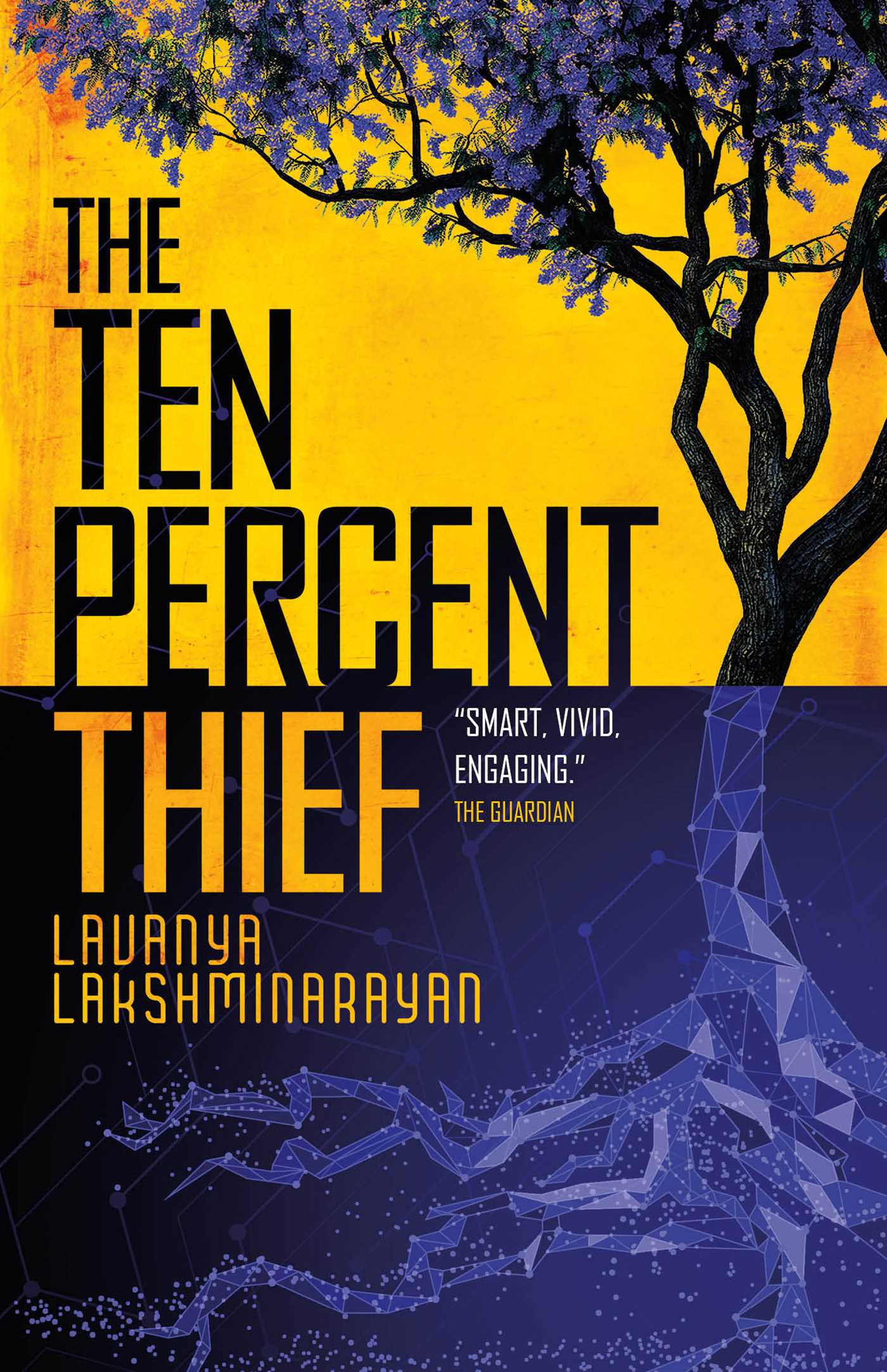
The Ten Percent Thief
In near-future Apex City, Bell Corp uses a productivity algorithm to divide society into privileged Virtuals, a broad working majority and impoverished Analogs excluded from the city’s protected life.
About
Spoiler notice: Spoilers for the opening theft, several character situations, and the direction of the collective uprising; the final outcome is not described.
Lavanya Lakshminarayan’s The Ten Percent Thief imagines a near-future city that has turned productivity into a measure of human worth. Apex City occupies the site of Bangalore after climate damage and political collapse have reshaped the world. Bell Corp governs the city through a mathematically defined Bell Curve, sorting people into social tiers according to an algorithmic account of their value. The upper Twenty Percent, called Virtuals, receive status, comfort and extensive technology. Most others live under more limited conditions, while the lowest Ten Percent are classified as Analogs and pushed outside the city’s protected boundaries. The arrangement presents itself as fair because it is quantified. The novel’s setting asks what happens when a system’s apparent neutrality conceals who designed its measures, whose lives they reward, and what consequences it can impose.
The book begins with Nāyaka, an Analog known as the Ten Percent Thief, crossing the barrier between the Analog districts and the privileged city. She steals a jacaranda seed from the property of one of Apex City’s elite and carries it back to her community. Bell Corp treats plants and other scarce resources as privileges earned through productivity, so the theft is both a material act and a rejection of the corporation’s rules. The seed’s significance exceeds its immediate usefulness: it represents a form of life that cannot be reduced to a score or justified by its contribution to an official measure. The publisher frames this small theft as the spark for a revolution. The story’s larger movement, however, unfolds across the experiences of many residents rather than following Nāyaka alone.
Lakshminarayan describes the book as a story that needed many perspectives because no one character could represent the changing city in its entirety. Its linked episodes move among people at different levels of Apex society, sometimes returning to earlier figures or details. A character’s brief appearance can acquire a different meaning when another episode shows the same institution from elsewhere. The form gives everyday compromises their own space: employment, education, caregiving, public reputation and access to technology are each shaped by the Bell Curve. These accounts do not simply assemble evidence for a central hero’s cause. They show that Bell Corp’s rules reach people whose immediate concerns may have little to do with a rebellion, even as their decisions and vulnerabilities are connected to the same system.
The boundary between Analog and Virtual life is especially unstable for people who have to prove that they belong. One story follows John Alvarez, a Bell Corp employee whose prospects for promotion depend on changing his thoughts and tastes to fit the company’s preferred idea of success. Another centres on Anita, whose depression makes it difficult to satisfy a programme intended to improve her productivity; failure risks her reclassification and removal from her home. Their circumstances show that the city’s middle ranks are conditional. A person may have access to advanced systems and still be threatened by the possibility of losing that access. The distinction between privilege and exclusion is maintained through constant evaluation, so self-presentation and even private thought become part of work.
Other episodes examine the pressure from the prosperous end of the hierarchy. Tanvi, a celebrity and expectant mother, faces professional consequences after discussing a natural birth instead of using an artificial womb that would allow her to remain at work. The episode ties reproductive choice to an economic order that expects uninterrupted productivity. Elsewhere, online influencers must protect anonymous identities while attending a highly visible awards ceremony. These situations can carry satire, but the humour sits beside surveillance and coercion: public approval depends on adhering to standards that are neither neutral nor stable. The novel’s imagined technologies do not create these pressures by themselves. They give Bell Corp new ways to administer existing expectations and make conformity look like personal ambition.
Nina’s story offers another view of how the hierarchy reaches childhood. An orphan from the Analog class, she is adopted by Virtual parents but faces restrictions and discrimination as she tries to qualify for full standing in the city. She studies for a citizenship test while developing as a pianist without the musical aids available to many Virtual students. The same genre of music means different things in her life and John Alvarez’s: he seeks to alter his own preferences to imitate the elite, while Nina’s musical pursuit becomes a source of expression and support. Their contrasting experiences keep the novel from treating culture as a simple badge of status. What matters is also how a practice enters someone’s life, and whether it is chosen, imposed or made possible by care.
As the episodes accumulate, the planned revolt approaches without making every character a participant or reducing their lives to steps in a single plot. Nāyaka’s resistance has its own structure and ambitions, which raises a question the novel extends to all systems of authority: a movement seeking to replace Bell Corp must still decide whose experiences count and what its new rules will permit. The title’s seed connects the opening act to that wider problem. It can stand for defiance, but its growth cannot be measured by the same productivity scale that governs Apex City. The result is a mosaic of lives shaped by technology, climate, inequality and competing ideas of progress. The city changes as these accounts come together, while the book leaves room to consider how a new order might repeat parts of the old one.
Book details
- Author
- Lavanya Lakshminarayan
- First published
- 2020
- Series
- No series listed
- Subgenre
- Dystopian, Cyberpunk, Climate fiction
- Primary genre
- Sci-Fi
- Tags
- No tags for this book.
Review
Editor profile
Baby Bat
Goodreads and social links will be added soon.
- Goodreads — link coming soon
- Social media — link coming soon