
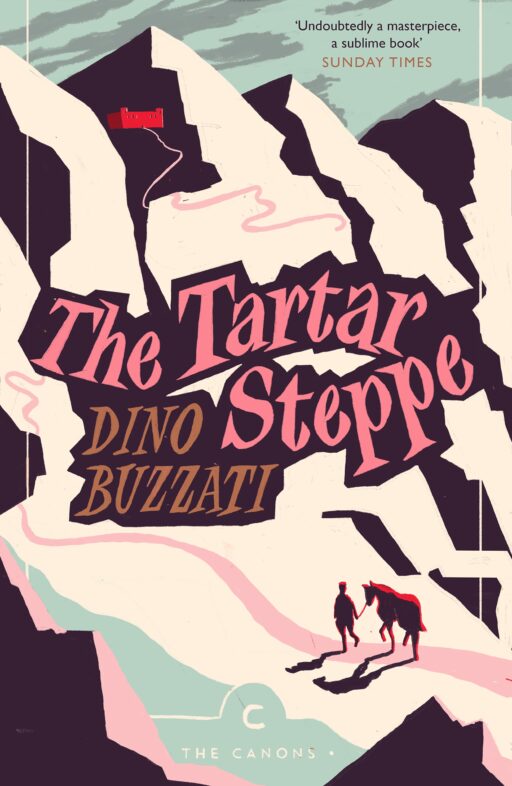
The Tartar Steppe
Newly commissioned officer Giovanni Drogo is posted to remote Fort Bastiani, where he expects a short tour of duty and a chance to distinguish himself.
About
Spoiler notice: Covers Drogo’s departure, first journey to Fort Bastiani, and the premise that its soldiers wait for an enemy; does not reveal later developments or the ending.
Giovanni Drogo’s posting to Fort Bastiani begins with a feeling he cannot quite explain. On the morning he leaves, he has finally become an officer after years of academy study and barrack routine. He expects the moment to feel like the start of his real life, but the uniform and mirror do not give him the triumphant version of himself he imagined. His farewell to his mother is awkward; he worries about the words he cannot find and senses that this departure may matter more than an ordinary assignment. The scene establishes the novel’s central tension before Drogo reaches the border: a person can wait for life to begin, then find that the decisive moment arrives mixed with doubt. Buzzati gives that unease ordinary objects and gestures—the oil lamp, the searched-for cap, a familiar voice—so the strangeness grows out of a recognisable leave-taking.
Drogo’s friend Francesco Vescovi rides with him for the first part of the journey. Their morning route carries them out through quiet streets into fields and autumn woods, and the conversation exposes how their shared past has already begun to separate them. Vescovi has settled into civilian life while Drogo has entered military service; neither needs to make a speech about the difference. The fort itself remains indistinct. Vescovi points to a distant outwork, but neither man can say with confidence how long the journey will take or what waits at the destination. This uncertainty gives the departure its shape: Drogo is travelling toward a post he has not chosen with full knowledge and cannot yet picture. The landscape changes gradually, while the familiar city slips away behind him. The first threshold is therefore social as well as geographic, a movement from home and friendship toward an institution whose rules he does not understand.
As the road climbs, the small signs Drogo uses to measure distance become less reliable. A carter has never heard of Fort Bastiani; the route grows steeper and emptier; Drogo pushes on without stopping to eat, eager to arrive before night. The episode is both practical and unsettling. A new officer is simply trying to find his assignment, yet the people and terrain around him offer no firm confirmation that he is going the right way. Buzzati lets the scale of the valley do narrative work: Drogo and his tired horse are reduced against rising slopes, and evening seems to advance faster than they can travel. The fort is not introduced as a clear destination visible from the start. It appears late, across a gap in the crags, on a bare hill still catching the sunset. That distant first sight makes the post feel less like a workplace than a place that has been waiting beyond ordinary reach.
The first view does not resolve the journey. By the time Drogo reaches the walls, darkness has gathered; there is no light in the windows, and he cannot find an entrance. A stranger tells him the fort has been shut for years, then points out the real stronghold far away across the mountains. The misdirection is brief, but it changes the journey’s scale again: what Drogo thought was the end becomes another leg of the road. The fortress is described through distance, shape and diminishing light, not through a welcoming interior. Its yellowish outline against the sunset catches Drogo’s attention even as his horse is spent and the day is nearly over. The scene sets an important pattern for the opening: the promise of arrival keeps moving ahead of him. Each apparent endpoint produces a further wait, and each wait makes the remote place more compelling.
On the next stretch, Drogo meets Captain Ortiz, an officer travelling toward the same fort. Their conversation is halting at first. Drogo calls across a ravine simply to greet him, then worries that the exchange sounded foolish or disrespectful. When they finally join paths, the practical talk reveals how little Drogo knows about his posting. Ortiz assumes the tour lasts two years and explains that service at the remote fort brings an advantage in seniority; Drogo has not even been told how long he is expected to stay. The difference between institutional custom and individual understanding arrives almost casually, amid thirst, hot weather and a road still climbing through ravines. Ortiz’s matter-of-fact tone makes the uncertainty more affecting. Drogo is not being given a grand revelation; he is learning, one awkward answer at a time, that his future has already been shaped by decisions made elsewhere.
Fort Bastiani is manned by veterans who have grown old without seeing the enemy, while Drogo expects an advance across the desert to bring the battle he imagines. His first journey carries a promise with a long horizon. The remote fortress offers military purpose and a possible future distinction, but its defining event remains elsewhere, beyond the walls and over the steppe. Buzzati builds that expectation from small mismatches: a destination few can locate, a fort that first seems closed, and a posting whose length is assumed by others. These details make waiting feel like part of the fort’s architecture before Drogo has even settled into his room. The story’s tension grows from the distance between the life he expects and the time he may spend looking for its decisive moment. What begins as an assignment becomes a question of how long a person can postpone everything else for one imagined event.
Book details
- Author
- Dino Buzzati
- First published
- 1940
- Series
- No series listed
- Subgenre
- Literary fiction
- Primary genre
- Literary Fiction
- Tags
- No tags for this book.
Review
Editor profile
Baby Bat
Goodreads and social links will be added soon.
- Goodreads — link coming soon
- Social media — link coming soon