
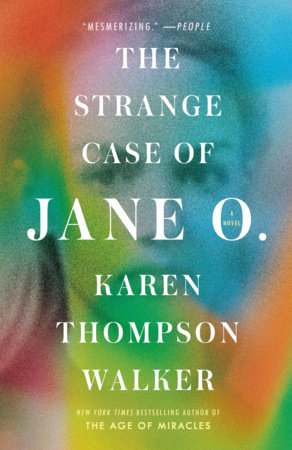
The Strange Case of Jane O.
In 2018, New York psychiatrist Henry Byrd begins treating Jane O., a 38-year-old single mother whose unusual memory is followed by blackouts, premonitions and visions of a young man who died years earlier.
About
Spoiler notice: Spoilers for the opening setup and narrative structure; the later explanations and ending are not described.
Karen Thompson Walker’s The Strange Case of Jane O. opens as a psychiatrist’s account of a difficult case. In the spring of 2018, Jane, a 38-year-old woman, comes to Henry Byrd’s Manhattan office for her first psychiatric appointment. Henry remembers the room, her coat, the silences and the few details she supplies. She gives little explanation for the visit, and the meeting ends after only fourteen minutes. Three days later, Jane disappears; the next day she is found unconscious in Brooklyn’s Prospect Park. When she wakes, she cannot remember the preceding stretch of time. The novel begins with a recognisable clinical sequence—appointment, absence, hospital—then makes the gaps in that sequence its central problem. Henry can record what Jane says and what others observe, but each account leaves something unexplained.
Jane’s episodes do not arrive as one simple symptom. The publisher describes amnesia, premonitions, hallucinations and a persistent sense of dread emerging about a year after her child’s birth. Kirkus identifies her as a single mother and notes her unusual ability to remember dates, places and events with exceptional accuracy. Against that detailed memory, the blackouts are especially disorienting: Jane can be exact about much of her past while unable to account for recent hours. She has also seen a young man who died when they were teenagers, and he appears to warn her about a disaster ahead. The contrast gives Henry’s investigation a concrete tension. He is not merely trying to recover a missing interval; he is trying to determine how a person who remembers so much can also encounter experiences that resist ordinary explanation.
The case is narrated through material that has different purposes and different limits. Henry’s retrospective voice organises the events as a clinical history, taking care with chronology and diagnosis. Jane, meanwhile, begins writing letters to her young son for him to read when he is older. These letters let her address someone she loves directly, rather than present herself only as a patient being assessed. They also preserve her own account of what the episodes feel like and what she fears her child may one day need to understand. The two forms create a productive distance: Henry can observe Jane from the outside, while her letters show the private meanings and maternal concerns that do not fit neatly into a case file. Neither form by itself settles the mystery.
Henry’s role grows more complicated as he continues to see Jane. His questions begin with the familiar work of listening, comparing details and considering possible diagnoses, but the case draws him beyond the confidence of a tidy explanation. The publisher notes that Jane’s experiences lead him to question what he thinks he knows about reality, including events in his own life. Kirkus describes him as a single father facing personal and professional difficulties, details that make his attention to Jane more than a detached puzzle. His training gives him methods and boundaries; his own losses and responsibilities shape the person using them. Walker keeps those pressures close to the investigation without reducing either character to a diagnostic problem or making Henry’s private life an answer key.
The novel’s suspense comes from the way evidence changes meaning as the accounts accumulate. A remembered date can feel like a firm anchor, while an episode Jane cannot explain unsettles the timeline around it. Henry must weigh what Jane reports, what other people see and what can be supported by the record. The reader performs a related task, noticing differences between his composed case history and Jane’s letters without being given an easy rule for deciding which perspective deserves more trust. This makes the book’s structure active: alternating forms do not simply repeat information but reveal how an event looks from the examining room and from the life being examined. Even the word “case” in the title carries two senses, pointing to a clinical file and to a mystery whose boundaries remain uncertain.
Motherhood keeps the speculative questions grounded in everyday stakes. Jane’s child is very young when the symptoms begin, and her letters are written with a future reader in mind. Her concern is not only whether her memories are accurate but what her son might know about her if she cannot explain herself later. That intention gives the letters an intimate scale beside Henry’s professional record. It also makes absence practical rather than abstract: a blackout interrupts a parent’s ability to account for where she has been, while an unexplained vision threatens to alter how she understands her past. The publisher frames the story around love between parent and child as well as the mysteries of memory and identity; those connections are present in the form of the narrative as much as in its stated premise.
Walker builds The Strange Case of Jane O. from a restrained opening, a missing interval and two attempts to preserve what happened. Henry writes to understand a patient whose experiences outstrip his early account of them; Jane writes so her son may one day hear from her in her own words. The difference between those purposes lets the book examine how memory becomes evidence, how care can coexist with uncertainty and how a private life may not fit the explanation imposed on it. Jane’s case remains compelling because the people closest to it keep confronting the limits of what they can know.
Book details
- Author
- Karen Thompson Walker
- First published
- 2025
- Series
- No series listed
- Subgenre
- Literary fiction, Epistolary novel, Experimental fiction
- Primary genre
- Literary Fiction, Sci-Fi
- Tags
- No tags for this book.
Review
Editor profile
Baby Bat
Goodreads and social links will be added soon.
- Goodreads — link coming soon
- Social media — link coming soon