
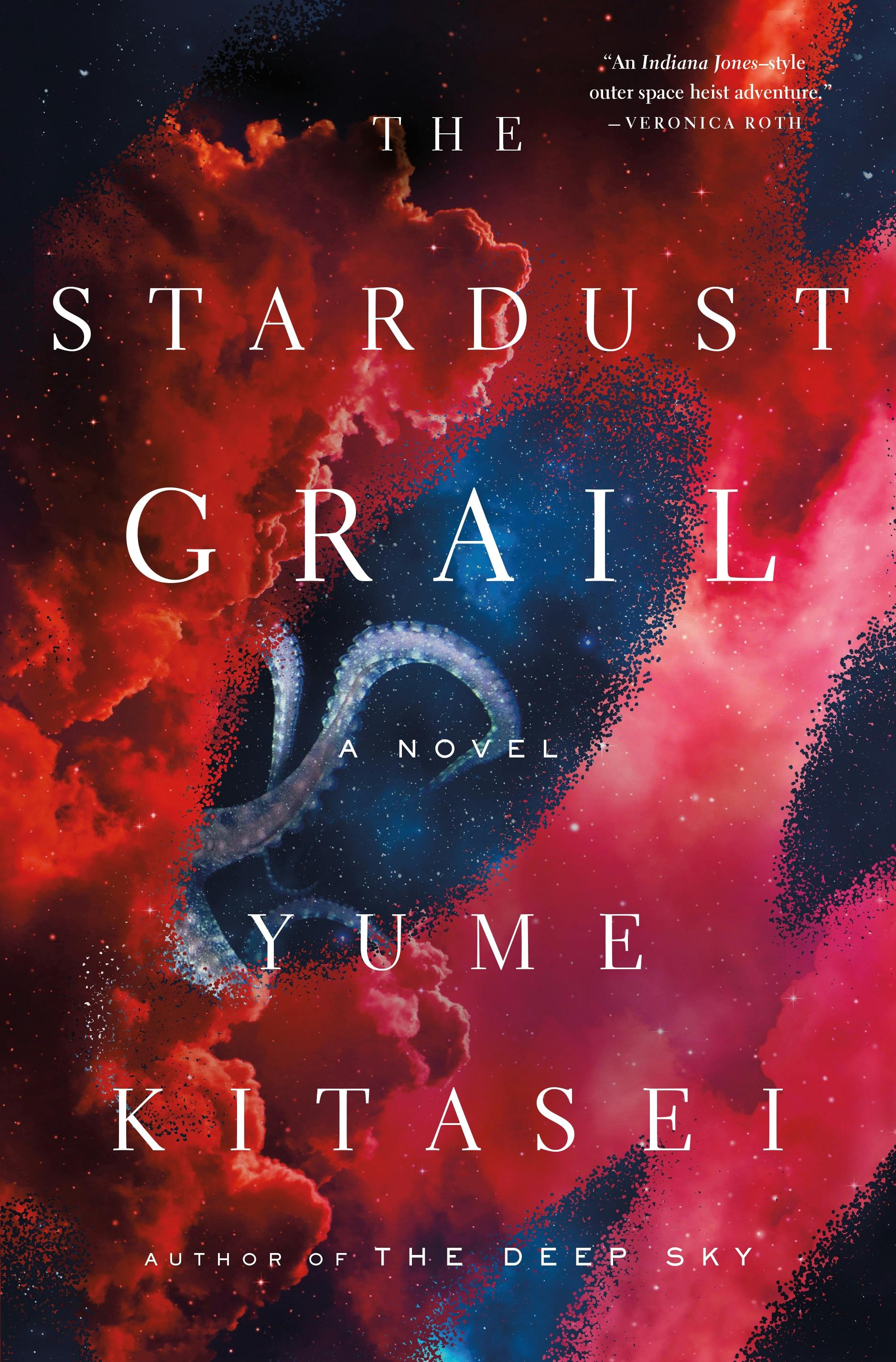
The Stardust Grail
Former art thief Maya Hoshimoto is trying to settle into graduate school on Earth when her old friend Auncle asks her to find the Stardust Grail, an artifact that may save the Frenro from extinction.
About
Spoiler notice: Spoilers for Maya’s past as an artifact thief, the mission she accepts, the competing search for the Grail, and the central choice facing her crew. The ending is not described.
Maya Hoshimoto is trying to make a life on Earth when we first meet her, but the university archive where she works is full of reminders that she has lived elsewhere. At Princeton, she helps examine objects collected from other worlds, and she can see what the specialists around her miss: an apparently valuable Frenro sculpture is a false construction, while a fragment of a settler-made data chip carries a history she knows too well. Her former life as a thief is hidden from her colleagues. So is the gap between their comfortable academic world and the off-world settlement where she grew up. The opening makes her expertise feel practical and personal at once.
That routine breaks when Auncle, Maya’s old friend and former partner in the artifact trade, asks her to take on one last theft. The object they are seeking is called the Stardust Grail. It could help Auncle’s people reproduce and preserve the Frenro, but the same choice could put Earth and humanity at risk. The Grail has not been seen in living memory, and Maya’s unsettling visions of possible futures make the mission harder to read. The job is not simply a matter of locating a priceless relic and getting away with it. Maya must decide what responsibility attaches to an object when the survival of different peoples may depend on who controls it.
Auncle is not a human guide translated into alien form. The Frenro are physically and culturally distinct from humans, and Maya’s long relationship with Auncle does not erase what she still cannot understand. Their friendship gives the mission an intimate centre: saving Auncle’s people is not an abstract act of charity, but a commitment to someone whose history and needs do not fit neatly into human categories. At the same time, affection can complicate judgment. Maya has to ask whether returning an object to a community, protecting it from outsiders, or using it to preserve a species are always the same kind of choice. The book lets loyalty and uncertainty travel together.
The search grows into a crewed journey through a far-future universe of separate worlds, unfamiliar life, old ruins, and contested histories. Auncle’s return draws Maya away from her university refuge, and other people join the effort as the search expands. Their route follows clues left by a human explorer who disappeared long ago, while competing parties pursue the same artifact. The scope shifts from the small rooms of an archive to a much larger map of interplanetary encounters. That movement gives the heist its adventure shape, but every new place also asks Maya to reconsider what she thinks she knows about the people who made, used, or now claim its objects.
The Grail matters to more than Maya and Auncle. Earth’s military coalition wants it for a different purpose, and the connections that allow travel between planets are weakening. The same device could therefore mean continuity for one people and security for another, while those who hold institutional power can describe possession as preservation or necessity. Maya’s crew is trying to act with care in a contest where their opponents may have different resources and priorities. That pressure sharpens the novel’s questions about museum collections and archaeological recovery: who has the authority to remove an object, who gets to tell its history, and what happens when preserving one civilization changes the fate of another.
The story’s concerns with first contact and colonialism are grounded in differences that persist among humans as well as between humans and aliens. Maya has Japanese heritage and grew up off-world, so Earth does not automatically feel like home, and neither does a shared species make every human culture interchangeable. An off-world settlement can retain an inherited national identity while developing customs of its own, and alien societies are also divided by the places in which they have developed. These details make the universe feel inhabited by communities rather than by a single humanity confronting a collection of interchangeable aliens. Meeting across worlds can produce knowledge and intimacy, but it also leaves footprints that the people with greater power may be least likely to notice.
Maya’s visions make the uncertainty more than a question of interpreting other people’s intentions. An extraterrestrial pandemic known as the Infection left some surviving humans with the Frenro ability to dream across space and time, glimpsing possible futures. The Grail appears in Maya’s dreams, making the search personal before she can know where it will lead. Knowledge does not give her a simple instruction to follow. Protecting Auncle, recovering an object and protecting humanity pull at different obligations, and success at a theft cannot settle all of them. The quest keeps returning to the possibility that care for another living being may require admitting the limits of one’s understanding. Maya can be skilled enough to cross worlds and recognize their stolen treasures while still being uncertain about what she owes the people who live there.
Book details
- Author
- Yume Kitasei
- First published
- 2024
- Series
- No series listed
- Subgenre
- Space opera, First contact, Adventure fiction
- Tags
- No tags for this book.
Review
Editor profile
Baby Bat
Goodreads and social links will be added soon.
- Goodreads — link coming soon
- Social media — link coming soon