
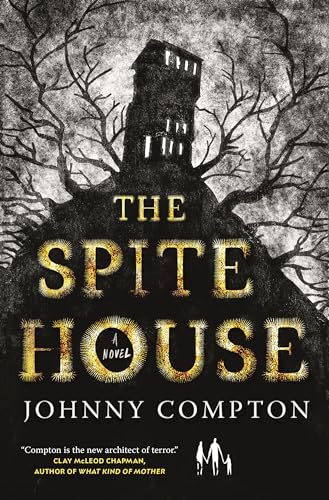
The Spite House
Eric Ross is on the run with his daughters, Dess and Stacy, from a mysterious past that has kept them moving.
About
Spoiler notice: Discusses family circumstances, the Masson House assignment and supernatural premise. It does not disclose the ending.
The Spite House begins with a family trying to make a life while staying difficult to find. Eric Ross has left Maryland with his daughters, Dess and Stacy, and the opening shows the ordinary pressures behind that flight: unstable work, motel rooms, limited money and the repeated work of starting over. He has a history in cybersecurity, but his current jobs are informal and precarious. The book makes the family’s circumstances concrete before the Masson House becomes their destination. Eric has to weigh every opportunity against the possibility of being cheated, exposed or forced to move again. When an advertisement offers a large payment to stay in a reputedly haunted Texas house and keep a record of what happens there, the promise is practical as well as uncanny. It could give the family time, money and a place to stop. That mixture gives the premise its tension: the offer seems almost impossibly useful because the family’s alternatives are so narrow.
The Masson House sits in Degener, Texas, where local stories have made it notorious. The job is to live there and document paranormal activity; previous caretakers have reportedly been driven away by its horrors. Eric is not looking for a ghost-hunting adventure. He is looking for work he can accept without references and a roof his daughters can share. The difference matters. The house’s reputation is part of the offer, but it does not cancel the family’s immediate needs. Eric considers the possibility that the job is fraudulent and the possibility that the haunting is real, measuring both against the cost of remaining where they are. He decides to apply before consulting Dess, knowing she may object. The decision makes his care for his daughters inseparable from his willingness to choose for them. A father trying to protect his family can still keep information from them or mistake urgency for certainty.
The opening chapters also give Dess room to interpret their situation for herself. She is older than Stacy and has spent months living out of motels, repeating familiar routines until television and limited reading no longer offer much escape. She notices that her father is absorbed in a new plan, and the reader sees the gap between his private calculations and what he tells his daughters. Her care for Stacy appears in small gestures, including the idea of going out for pancakes when money is scarce. Stacy, meanwhile, makes a coloring book from spare paper and works patiently at her drawings. These moments make the girls more than reasons for Eric’s decisions. They have their own habits, frustrations and ways of supporting one another. The changing attention between Eric and Dess gives the family’s situation more than one angle: his desperation is real, but it is not the only experience that defines the move.
Compton’s official opening excerpt establishes the family’s vulnerability through specific material details rather than a general statement that they are struggling. The motel’s “complimentary office” is a small closet with a slow computer. Eric has a prepaid phone, keeps notes while speaking to the prospective employer and budgets for the chance that a job will go unpaid. The novel’s first pages also set his present choices beside family history. His grandfather Frederick was physically imposing and known for intimidating people; Eric remembers both the power and the unease attached to that reputation. When employers shortchange him, Eric sometimes uses a threat to collect what he has earned, then worries that he cannot keep relying on that tactic. The Masson House opportunity therefore presses on an existing conflict: how far can he go to provide for his daughters without repeating the models of force and secrecy he has inherited?
The title points to a house built or shaped as an act of spite, and Compton has described the real-world idea as the spark that joined his existing haunted-house premise. In an interview with the Los Angeles Public Library, he explained that his initial research found spite houses largely absent from ghost lore and fiction. The concept supplies an emotional history before the supernatural question is answered: resentment has already taken architectural form. The novel’s setting also connects a family on the move with a property whose past is not fully visible to them. The publisher’s description presents Eric as drawn to the house’s secrets because he hopes they may help him understand the uncanny force that has kept his own family moving. The two mysteries consequently face in opposite directions. Eric wants to know what happened to the house, while the house’s offer places his family inside its reach.
The setup holds practical danger and supernatural uncertainty together. Eric’s family needs money and stability; the Masson House promises both, but only on terms that require them to remain in a place already associated with fear. The publisher’s synopsis describes the task as recording what happens and warns that the house has driven earlier caretakers away. It also frames the story around grief, death and a father’s love. Those elements give the haunted-house premise a family scale: the danger matters because the people exposed to it depend on one another, and because their histories accompany them into the house. The opening pages invite a question rather than settle it: whether the house can explain what follows Eric and his daughters, and whether facing one haunted place will bring them closer to safety or make their circumstances worse. This account covers the published premise and the official opening excerpt; it does not reveal the ending.
Book details
- Author
- Johnny Compton
- First published
- 2023
- Series
- No series listed
- Subgenre
- Gothic horror, Haunted house, Modern horror
- Primary genre
- Horror
- Tags
- No tags for this book.
Review
Editor profile
Baby Bat
Goodreads and social links will be added soon.
- Goodreads — link coming soon
- Social media — link coming soon