
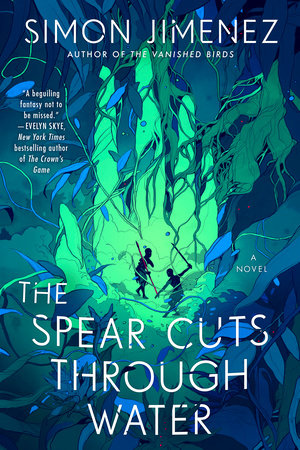
The Spear Cuts Through Water
For centuries, the Moon Throne has ruled through an emperor and his sons, the Three Terrors, who draw power from a god imprisoned beneath their palace.
About
Spoiler notice: Spoiler-light account: this page discusses the novel's framing device, premise and central journey, but avoids later revelations and the ending.
The Spear Cuts Through Water is an epic fantasy built around a five-day journey and the act of telling a story. Its central premise follows Jun, a guard marked by guilt, and Keema, an outcast looking towards an uncertain future. Together they help an ancient goddess escape royal captivity and travel with her across a broken land. The goddess is fleeing her own children, the triplet rulers known as the Three Terrors, and the journey becomes part of a struggle against the Moon Throne. That description gives the book a recognisable adventure shape: companions, pursuit, a dangerous passage and a political order that must be challenged. Jimenez’s novel also places that adventure inside a more unusual structure, where the story reaches the reader through memory, performance and the voices of other people.
The book opens in a remembered relationship between a young listener and his grandmother. She tells him tales of a faraway country, including one about the Inverted Theater, a place suspended between worlds. The publisher’s excerpt presents these memories in second person, addressing the listener as “you”; the author’s discussion guide describes an unnamed narrator being carried to the Theater, where stories from across time and space are performed. The Land arrives through a story someone has chosen to tell, and through a listener whose connection to the teller gives it personal weight. It is reasonable to read the frame as asking how inherited stories shape a person’s idea of home and history; that is an interpretation of the structure, rather than a claim about a single declared answer.
Within the tale being performed, the Moon Throne has ruled for centuries. The emperor and his sons maintain their power through abilities inherited from the imprisoned god beneath their palace, while the countryside and its people bear the consequences. The goddess’s escape changes the balance: Jun and Keema become her companions as she seeks freedom and a way to end the dynasty’s rule. The premise links a close group’s immediate task with a much larger political condition. Their aim is not simply to cross a landscape; their passage carries the possibility of changing who holds power and what that power rests upon. The official description calls the route a pilgrimage and stresses its danger, which suggests a journey with spiritual and political dimensions at once. The account here stays with that premise and does not fill in unverified stops, confrontations or outcomes along the road.
Jun and Keema enter the story from different positions. The publisher identifies Jun as a guard burdened by his past and Keema as an outcast looking for a future. These short descriptions make the pair’s contrast legible without reducing either character to a fixed role: one has been part of an institution tied to the Moon Throne, while the other stands outside its acceptance. They are both described as warriors, but the novel’s setup places their personal histories beside their shared responsibility to the goddess. The publisher’s book-club guide also asks readers to consider how ostracism shapes the travellers and how relationships affect their growth. That makes belonging more than a background fact in the official reading material. The available sources support discussing belonging and relationships as central concerns, but do not justify inventing a sequence of character decisions or a detailed account of their bond.
The divine figures are also defined by unequal power. The Moon Throne’s authority depends on a god kept beneath the palace, and the goddess who escapes is pursued by the children who would return her to that confinement. The author’s discussion questions point to other gods in the world, including a tortoise god and a river spirit, and ask how divine power has been diminished or controlled by humans. That detail broadens the premise beyond a single rescue: the world’s political order reaches into its relationship with the sacred. It also makes the captivity of the goddess part of a larger pattern worth noticing. The book’s questions invite readers to consider what these portrayals mean, rather than providing one prescribed interpretation. A cautious reading is that the novel puts authority, inheritance and the treatment of living powers into conversation; it would go too far to claim that the materials settle precisely what the author intends each god to represent.
The Inverted Theater gives the book a way to hold several kinds of storytelling together. The excerpt describes the Moon and Water creating a stage between worlds, where performances across the ages can be hosted; the discussion guide asks about the frame, the map of the Land as dreamt by the Eighth Emperor, and the voices of the dead. These are concrete signs that the story is interested in how a tale changes when it is remembered, staged, mapped or carried by many voices. The grandmother’s story is intimate and sensory, grounded in a shared ritual between generations, while the Theater expands that exchange into a place where different eras can meet. The map’s attributed perspective also implies that geography can carry someone’s imagination and authority within it. Those connections are interpretation, but they follow from the book’s documented devices and questions, not from a claim to know every answer the novel offers.
Jimenez described the novel as a standalone epic fantasy, intended as a complete story rather than a launch point for a sequel or expanded universe. He said he planned it near the end of 2018 and finished editing in March 2022. The publisher identifies it as his second book after The Vanished Birds and gives its publication date as 30 August 2022. The facts place it as a self-contained work, even though its frame reaches across time and its world contains many stories. This page focuses on the documented setup and narrative frame. It does not reveal the pilgrimage’s conclusion or claim to reproduce the experience of reading the complete novel.
Book details
- Author
- Simon Jimenez
- First published
- 2022
- Series
- No series listed
- Subgenre
- Epic fantasy
- Primary genre
- Fantasy
- Tags
- No tags for this book.
Review
Editor profile
Baby Bat
Goodreads and social links will be added soon.
- Goodreads — link coming soon
- Social media — link coming soon