
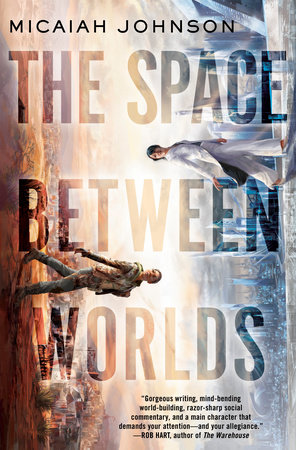
The Space Between Worlds
In a future where travel between parallel Earths is possible only when a traveller’s counterpart is dead, Cara’s many lost counterparts make her unusually valuable to the Eldridge Institute.
About
Spoiler notice: Spoiler-light discussion below: it describes the premise and early setup without revealing the novel’s later turns or ending.
In Micaiah Johnson’s debut, travel between parallel Earths has become a working technology, but it depends on an unsettling rule: a traveller cannot enter a world where their counterpart is still alive. That limitation turns survival into a map of possible destinations. Cara, who grew up in the wasteland settlement of Ashtown, has counterparts who died in many different ways. On Earth Zero, the world that anchors the Institute’s programme, her own survival makes her an unusual resource. The novel begins with a science-fiction premise that is easy to grasp and hard to treat as neutral. Each successful journey depends on another version of the same person having failed to survive, and the institution that organises those journeys has an interest in the pattern that made Cara eligible.
Cara works for the Eldridge Institute, which sends traversers across worlds to collect information. Her position gives her access to places and security that would otherwise be closed to someone from Ashtown. She lives in Wiley City, a wealthy settlement protected from the wastes by walls, and works with Dell, the handler who oversees her assignments. Those changes offer real material advantages, but they do not erase the social boundary between the city and the people beyond it. Cara moves through an institution that values a quality tied to her vulnerability: she can go where most people cannot because her counterparts are absent. The job offers a route towards citizenship and a more secure future, while also making the terms of that welcome difficult to ignore.
On Earth 197, Cara waits at a mountain base while a stationary port transfers her collected files to a mobile device; she must carry it back to Earth Zero herself. The records include population and temperature fluctuations, and can extend to market data that would reveal future stock prices on a future Earth. Cara’s memory of this Earth’s counterpart is domestic rather than abstract: a one-room shack, a sheet-metal roof, a concrete floor and a mattress shared with her mother. In Wiley City, childhood mortality has been eliminated and common viral illnesses largely eradicated through vaccination, helping explain why wealthy residents have surviving counterparts where Cara does not. The Institute's formal job title for her work also sits beside a degrading nickname used off the record.
Cara’s relationship with Dell adds an intimate dimension to that imbalance. Dell is both her handler and someone with whom she flirts, so affection and workplace authority occupy the same space. Cara’s hopes for a place in Wiley are entangled with this relationship and with her wish to be recognised as more than a useful exception. That arrangement leaves room for attraction and uncertainty at once: Dell is close enough to matter personally, but her role is also part of the structure that assigns Cara’s work and mediates her access. The novel does not separate private feeling from the conditions around it. A relationship develops inside a system that can grant comfort and opportunity while preserving a clear difference in status between the person who travels and the people who direct the travel.
The travelling rule also gives the book a practical source of suspense. A destination is available only when its Cara is dead, so an unexpected death among the few remaining counterparts changes the range of places she can reach. When one such death raises questions, Cara’s assignments take on a new significance and draw her toward a world that connects with her own past. The published descriptions establish that this discovery opens a larger threat involving more than one Earth; the account here stops before those revelations. Even at the level of setup, the premise makes every apparent opportunity unstable. A new route can be created by loss, and the information gathered on another world may matter to people who would prefer to control what Cara learns.
Johnson uses a speculative mechanism to keep questions of identity and belonging attached to action. Cara is not simply comparing alternate versions of a familiar city; she is working within a system that turns difference into a qualification and then places conditions on the security it offers. Her movement between Ashtown and Wiley City makes the divide visible in daily life, while the existence of other Caras keeps survival from feeling like an abstract statistic. The setup also shifts the usual fantasy of limitless choice: for Cara, access to another Earth is rationed by a death elsewhere, while institutional access to that possibility is concentrated in the people running the programme. The story’s central tension comes from the mismatch between what the Institute calls an opportunity and what Cara must carry in order to use it. Its premise supports a thriller’s forward pull, but it also keeps attention on the institutions, relationships and histories that shape which people are allowed to move freely—and what their movement is expected to provide.
Book details
- Author
- Micaiah Johnson
- First published
- 2020
- Series
- No series listed
- Subgenre
- Dystopian, Post-apocalyptic
- Primary genre
- Sci-Fi, Literary Fiction
- Tags
- No tags for this book.
Review
Editor profile
Baby Bat
Goodreads and social links will be added soon.
- Goodreads — link coming soon
- Social media — link coming soon