
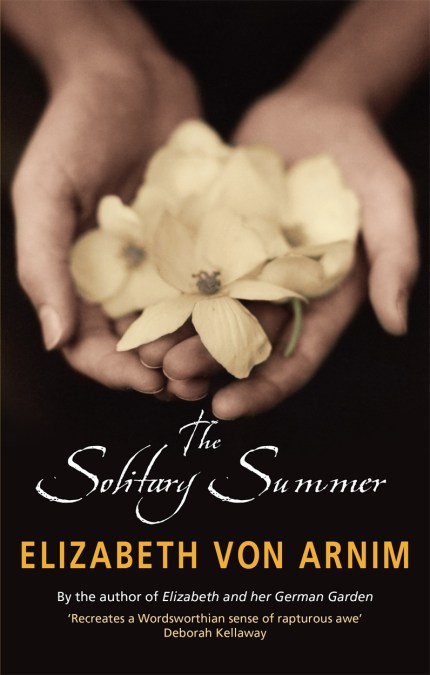
The Solitary Summer
A woman announces that she will spend the summer without visitors, giving her days to the garden, the countryside and her books.
About
Spoiler notice: This overview discusses village episodes, the military visit and the final conversation about the narrator’s summer.
A summer without visitors sounds like a small ambition, but the narrator of The Solitary Summer treats it as an opportunity to recover possession of her days. In the opening entry, dated May 2, she tells her husband that she intends to spend the coming months with the garden, the surrounding countryside and her books. She hopes that freedom from social obligations will give her inner life room to develop. Her husband, whom she calls the Man of Wrath, predicts boredom and worries about damp feet and sunburn. Their conversation establishes the book’s intimate, teasing voice. Published in 1899, it follows a fictionalized diarist through a season of observations and interruptions, with the disagreement over solitude returning at the end to measure what those months have actually meant.
The places she chooses for reading make that solitude tangible. A hollow in a rye-field and a pond offer a morning retreat, while the library becomes a different world after the lamps are lit. She believes that books reveal different qualities according to the surroundings in which they are opened. Thoreau belongs outdoors; Boswell and Johnson are companions for the comfort and conversation suggested by an evening indoors. Goethe has a particular sheltered garden seat. These preferences lead into reflections on happiness, language and the difficulty of putting a strong feeling into words. The passages also make reading an activity carried out by a particular person at a particular hour, affected by lunch, weather and the changing willingness of her mind to attend.
The garden supplies a continuing history of its own. It has not simply arrived in its present condition, ready to reward anyone who wanders through it. The narrator remembers unsuccessful appointments and her frustration with gardeners whose willingness exceeded their knowledge. A more capable head gardener offers a different working relationship, while her own opinions remain vigorous and sometimes unreasonable. Flowers, weeds, paths and neglected corners all become subjects for argument. Her declared wish to be idle coexists with an exacting interest in how the place should look. As the season changes, the same ground gives her new things to notice: growth, scent, colour, the effects of rain and the work that must be done before flowers have finished seeding. Pleasure here depends partly on attention and partly on other people’s labour.
Nor does refusing invitations remove family life. Her three daughters, known as the April, May and June babies, bring their questions, lessons and discoveries into the garden. They collect snails, repeat religious stories and move between the languages used around them, sometimes with consequences their mother finds comic and sometimes with unexpected hurt feelings. One daughter’s tears during an attempted French conversation interrupt the narrator’s confidence that she understands what the children have learned. Their company gives these pages a domestic bustle quite different from the expansive reflections of her solitary walks. A separate early-morning excursion, when she rises before the household and watches the sun appear, shows why an interval of quiet can feel so precious even to someone surrounded by affection.
Beyond the garden, village visits expose forms of life that her comfortable household cannot make equivalent to its own. She observes rooms, work, money and the local customs surrounding marriage, including couples who have children before they can afford to establish a home. The pastor’s denunciations have little effect where neighbours do not share his sense of disgrace. In one episode a young groom is desperate because the woman he intends to marry has become overwhelmed by their situation. The narrator and the Man of Wrath consider what can be done, eventually arranging furniture and accommodation. Her sympathy challenges the pastor’s condemnation, although her descriptions still carry the assumptions of her social position. The incident connects her abstract reflections about kindness with the practical matter of finding somewhere for two people to live.
September brings a much larger invasion of her carefully protected time. Military manoeuvres fill the farm with men and horses and the house with officers, servants and meals that seem to be needed at every hour. The narrator notices the visual splendour of uniforms, but their wearers pursue her into the garden and propose activities she would much rather avoid. Preparing accommodation and feeding everyone disrupts the ordinary running of the estate. The passage makes the cost of this compulsory hospitality visible beneath its entertaining surface. An additional recollection of an awkward young lieutenant turns polite conversation into an endurance exercise. Having tried to make herself unavailable to ordinary callers, she discovers that an official demand can bring a whole temporary society to her door.
The October 1 entry returns to the conversation with which the book began. The narrator challenges the Man of Wrath to admit that his prediction of boredom was wrong. He points to the officers as a possible explanation for her surviving the summer; she considers their visit an interruption of her happiness. When he asks whether her soul has grown, she cheerfully admits that it has not. That answer keeps the ending from becoming a solemn account of self-improvement. She has enjoyed herself, watched closely, argued, read and remained involved with people despite her intentions. Their exchange ends in affectionate proximity, without settling their disagreement about women or solitude. The season’s value survives the failure of its grander promise: she does not need to claim a transformed character to recognise that the months have been happy.
Book details
- Author
- Elizabeth von Arnim
- First published
- 1899
- Series
- No series listed
- Subgenre
- Literary fiction
- Primary genre
- Literary Fiction
- Tags
- No tags for this book.
Review
Editor profile
Baby Bat
Goodreads and social links will be added soon.
- Goodreads — link coming soon
- Social media — link coming soon