
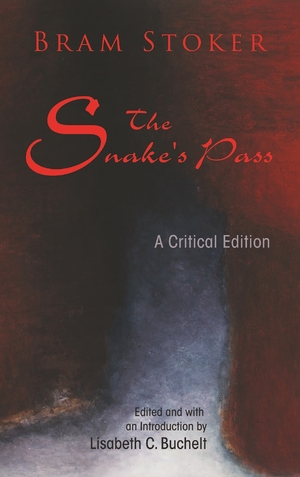
The Snake’s Pass
English traveller Arthur Severn arrives in western Ireland, where a dramatic landscape comes with stories of Saint Patrick, a lost crown and concealed French treasure.
About
Spoiler notice: This overview discusses the moving bog, the deaths during the catastrophe, the discovery of the treasure and the wedding at the ending.
The Snake’s Pass begins with Arthur Severn looking across a western Irish landscape as a storm approaches. The narrow valley, dark water, mountains and Atlantic coast seize the imagination of an English traveller who has only recently begun to experience the possibilities his comfortable circumstances provide. His driver Andy supplies names and observations that connect the view to a place already inhabited, remembered and argued over. First serialized in 1890, Bram Stoker’s novel brings romance, travel, adventure and local storytelling together. Its landscape is never merely a scenic setting for events elsewhere. The ground contains property, concealed objects and physical dangers, and the different ways people understand it determine what they desire, fear and attempt.
Stories heard in the district give the Snake’s Pass an older significance. Saint Patrick, the King of the Snakes and a lost golden crown belong to a narrated legend, while another account concerns treasure associated with the French. Stoker allows these tales to shape expectation without requiring every reported marvel to become a literal event. Dick Sutherland, whose engineering knowledge offers another way to examine the terrain, considers the relation between water, limestone and the stories a changed landscape might produce. The moving bog is particularly important because it can be understood as both an uncanny presence and a material hazard. What lies beneath an apparently familiar surface becomes a question for the storyteller, the investigator and the person who hopes the next discovery will make him rich.
Money already gives Black Murdock a more immediate means of controlling the place. His dealings with Phelim Joyce show how a financial obligation can become the opportunity to seize land rather than accept repayment. Joyce arrives with the money but too late for Murdock’s purposes, and an appeal on behalf of his children fails to soften the demand. The conflict brings dispossession into Arthur’s developing knowledge of Irish affairs. Property boundaries and legal claims affect where a family can live, while the desire for treasure makes particular ground valuable for reasons that are not openly shared. Murdock’s pursuit of the remaining Cliff Fields becomes a sustained threat, linking private grievance, financial power and the temptation to treat other people’s needs as obstacles to acquisition.
Arthur’s attachment to Norah Joyce makes those conflicts personal. She is not simply an appealing figure glimpsed within a picturesque countryside; her family’s situation, her choices and her courage increasingly shape the action. His friendship with Dick creates another difficulty when he realizes that the woman his friend loves is the same woman he himself wants to marry. An intended act of generosity involving land becomes more complicated once that knowledge is available. Arthur must decide how to explain his motives without concealing the feeling that has changed them. Dick’s continuing assistance makes loyalty a practical element of the story, expressed through work and trust rather than only through declarations. The romance develops within a network of obligations that money can influence but cannot settle by itself.
The investigations around Murdock’s property keep the treasure and land disputes moving towards a physical crisis. Instruments, surveys and scrutiny of the bog supply knowledge that greed does not necessarily permit its owner to use wisely. Dick notices the danger of a house standing in the bog’s possible path, and warnings acquire force as weather and ground conditions change. Murdock’s hostility also extends to Norah and the relationship she has chosen, so the approaching danger combines human violence with an unstable landscape. During the storm, he strikes her and runs. Arthur reaches her but becomes trapped himself, and it is Norah who pulls him onto firm rock. Her rescue reverses any assumption that wealth or the status of a visiting gentleman makes him the person always able to save others.
The catastrophe sweeps away Murdock’s house and kills him; Moynahan also dies. In daylight the survivors examine the ravine exposed by the shifting mass, tracing the course of the water and the destruction left behind. What had seemed a concealed and uncertain depth has become a visible channel through the hill. A cave yields the chest and the golden crown, bringing the competing stories into contact with objects that can be handled and inspected. Dick offers a geological explanation connecting an earlier lake, the opening of a channel and the changed level of the water. The discovery gives the legend a material starting point without making the King of the Snakes a creature the narrative has actually produced. Wonder survives alongside an effort to understand what happened.
The final chapter also carries the romance beyond the excitement of survival. Norah asks for time to pursue schooling before marriage, wanting to enter Arthur’s social world without fearing that she will discredit him. The resulting two-year separation takes her through further education, including Dresden and Brighton, while he respects the limits they have agreed upon. At the place where she saved him, a memorial records her courage and the history of the mountain. Their wedding at Hythe is deliberately quiet, with Dick as best man and Andy among the friends who share the celebration. Italy awaits as a destination they will experience together. The ending gives the couple the confident happiness Arthur’s account has sought, after danger has exposed both the vulnerability beneath the land and the strength he finds in Norah.
Book details
- Author
- Bram Stoker
- First published
- 1890
- Series
- No series listed
- Subgenre
- Classic adventure, Literary fiction
- Primary genre
- Adventure, Literary Fiction
- Tags
- No tags for this book.
Review
Editor profile
Baby Bat
Goodreads and social links will be added soon.
- Goodreads — link coming soon
- Social media — link coming soon