
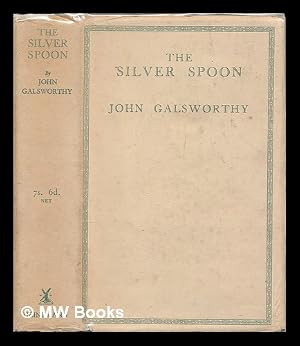
The Silver Spoon
In 1920s London, Fleur Mont’s ambitions for a fashionable social life become entangled in a quarrel with Marjorie Ferrar.
About
Spoiler notice: This overview discusses the libel case, its consequences and Fleur’s departure at the ending.
The Silver Spoon takes the Forsyte family into a London where fashionable conversation and public argument move quickly, but old anxieties about possession remain remarkably persistent. The novel opens in the autumn of 1924 with the American Francis Wilmot arriving at Fleur Mont’s house in Westminster. Its gold and silver furnishings impress him before he has properly met his hostess; her baby and a determined little dog make the room a household as well as a display. John Galsworthy uses that combination throughout the story. Marriage, parenthood and affection continue inside lives organized around reputation, money and influential company. Fleur wants a successful place in this world, her husband Michael wants useful public work, and her father Soames wants to protect her from anything he can recognize as a threat.
As the second novel of A Modern Comedy, following The White Monkey, the book continues relationships whose history matters to their present conduct. Fleur is Soames Forsyte’s daughter, now married to Michael Mont and mother to Kit. Michael’s parliamentary interests increasingly compete with the social life in which she expects him to participate. Soames, meanwhile, interprets new manners through older habits of caution, ownership and family loyalty. He can find the fashionable company ridiculous without becoming indifferent to its power to hurt his daughter. Francis Wilmot’s visit introduces another perspective on this carefully arranged environment, with his attachment to an inherited American home answering, in a different register, the English characters’ feelings about their own families and possessions.
The quarrel at the centre of the novel begins with Marjorie Ferrar’s disparagement of Fleur in Fleur’s own house. Soames intervenes, and the exchange expands through letters, gossip and wounded pride until it becomes a libel action. What could have remained an unpleasant evening acquires lawyers, witnesses and a public audience. Marjorie’s relationship with Sir Alexander MacGown complicates her position: the action concerns a reputation she must defend before somebody whose expectations do not necessarily resemble those of her usual company. Attempts to settle meet the obstacle of apologies that neither side wants to offer on the other’s terms. Galsworthy follows the practical machinery of a dispute while showing how quickly the participants lose the freedom to stop something they helped to start.
Michael’s political work extends the novel beyond this increasingly expensive struggle over standing. He takes up Foggartism, a programme associated with population, emigration and the country’s future, but encounters the ease with which an unfamiliar proposal becomes an entertaining topic rather than a serious undertaking. His visit to the impoverished Bergfeld household makes national policy painfully particular. Their insecure position does not fit a convenient scheme for sending people elsewhere, and the wife’s sewing barely sustains them. Michael can give money without finding an adequate solution. Conversations about the future sit alongside people who need help immediately, and his efforts remain vulnerable to mistakes and opposition. His political opinions belong to a character struggling to act; the novel does not require the reader to accept them as a reliable prescription.
The case also reaches into Fleur and Michael’s marriage. Her visits to Francis Wilmot during his serious illness have been made without telling Michael, creating material that an opposing side can turn towards scandal. Soames sees the danger and considers concealment a practical defence. Michael’s account of the marriage reveals a different difficulty: he hesitates to discuss the public concerns that occupy him because he thinks Fleur will find them boring. She senses a withdrawal whose cause is not another romance. Their failure to share what matters leaves both open to misunderstanding. Affection is still present, but it does not automatically supply a common purpose or prevent the secrecy that makes an innocent action look compromising when examined by hostile strangers.
In court, Sir James Foskisson turns the questioning of Marjorie into an attack on the moral independence of her circle. Her refusal to answer an intimate question makes the action increasingly dangerous for her, and her representatives move towards settlement. Yet success for Fleur’s side does not produce the social result she wants. The defence has associated her with a performance of moral superiority that her fashionable acquaintances resent and ridicule. Michael understands why a method effective with judge and jury can be damaging among people who prize the appearance of freedom from prejudice. Soames finds this outcome bewildering. The instruments he trusts have protected his daughter in one setting while making her life harder in another, exposing the limits of treating reputation like property that can simply be secured.
Fleur eventually wants to travel around the world, but Michael decides that he cannot abandon his parliamentary work while the House is sitting. Soames unexpectedly agrees to take her himself, uprooting a life deeply attached to familiar rooms, pictures and the English river. At their departure Michael is left with affection, uncertainty and a commitment whose effectiveness remains doubtful. Seeing former soldiers playing music in shabby clothes strengthens his resolve to keep trying rather than withdrawing into private disappointment. The final scene returns to the nursery, where Kit makes a mess with his silver spoon. The object gathers together inherited comfort, indulgence and the difficulty of learning what to do with advantages. The separation has begun; the novel does not pretend that either the marriage’s difficulties or England’s problems have already been solved.
Book details
- Author
- John Galsworthy
- First published
- 1926
- Series
- A Modern Comedy, book 2
- Subgenre
- Literary fiction, Modern classics
- Primary genre
- Literary Fiction
- Tags
- No tags for this book.
- Reading order
- Also on this shelf: The White Monkey (book 1)
Review
Editor profile
Baby Bat
Goodreads and social links will be added soon.
- Goodreads — link coming soon
- Social media — link coming soon