
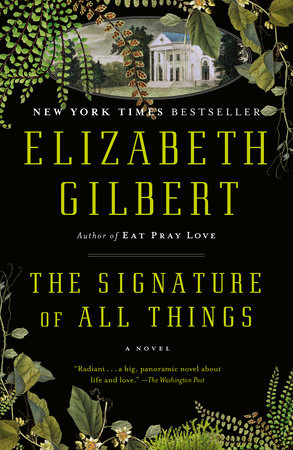
The Signature of All Things
Across the eighteenth and nineteenth centuries, the Whittaker family rises from Henry Whittaker’s beginnings in England to great wealth in Philadelphia.
About
Spoiler notice: Spoilers include Alma’s family background, botanical studies, evolving ideas about life, relationship with Ambrose Pike and some travel destinations. Major later developments and the ending are withheld.
Elizabeth Gilbert’s novel follows the Whittakers across the eighteenth and nineteenth centuries, with its central life beginning in Philadelphia in 1800. Henry Whittaker, Alma’s father, is born poor in England and builds a fortune through the South American quinine trade. His wealth gives the family access to an expansive estate and to the materials, books and connections that shape Alma’s education. That inheritance matters, but the novel’s attention settles on what Alma does with the intellectual world around her. She grows into a botanist with a formidable appetite for observation, and the book follows a woman whose opportunities are unusually broad while her work remains tied to the home and family that made them possible. The family story supplies scale; Alma’s patient attention to plants gives it a distinctive center.
Botany here is more than a profession or a decorative period detail. Gilbert has said that moss offered Alma a subject she could study for decades without leaving her father’s Philadelphia estate. Under close observation, this small field becomes a world of intricate forms and processes. Alma’s sustained work brings her toward the question of how life changes, making scientific inquiry a source of plot as well as a daily practice. The novel asks what prolonged attention can reveal: a patch of ground may appear modest until one looks carefully enough to recognise the complexity within it. This scale gives the story a particular rhythm. Large questions about nature and time emerge through the close study of living things that most people might pass without noticing.
Alma’s scientific outlook meets a different account of nature through Ambrose Pike. He paints orchids and is drawn toward spiritual, divine and magical explanations, while Alma approaches the world through clear-minded observation. Their attraction does not erase that difference; it gives the novel a way to place competing forms of understanding beside one another. Both are concerned with what lies beneath appearances, though they arrive at that concern by different routes. The book’s title points toward an old idea that the design of plants might encode their uses, a belief Gilbert discusses as part of the novel’s intellectual setting. Against it, Alma’s botanical discipline raises questions about evidence, interpretation and the limits of what any method can explain.
The novel ranges well beyond the Whittaker estate. Its settings include London, Peru, Philadelphia, Tahiti and Amsterdam, and the movement between them places private study within a broader history of travel, commerce and the collecting of knowledge. Gilbert has described researching Tahiti for its climate, landscape and physical details, while the story itself gives Alma reasons to encounter places beyond home. Geography therefore does more than enlarge the canvas. It connects the work of looking closely at plants with the routes by which specimens, information and wealth circulate. The journey across continents also lets the book shift in scale, from a small botanical subject to a life shaped by distant histories and changing environments.
Time is another of the novel’s expansive settings. Alma is born near the turn of the nineteenth century and lives through an era in which older assumptions about science, religion, commerce and class meet new arguments and discoveries. Gilbert presents this transition through a fictional family rather than a survey of intellectual history. The consequences reach into ordinary arrangements: who owns resources, who is able to study, whose ideas can travel, and how people understand their place in the natural world. The result is historical fiction interested in the making of knowledge, including the way scientific explanations develop alongside spiritual beliefs and social expectations. Alma’s long life gives those changes room to accumulate without reducing them to a single breakthrough or a simple contest between certainty and faith.
The book’s scale can be felt in its many fields of interest: family wealth, botanical work, romantic attachment, global exploration and the history of ideas. Yet those strands repeatedly return to a shared problem—how to interpret the visible world and decide what it means. Alma’s work rewards precision, while the people around her bring desires and beliefs that cannot be settled by observation alone. Gilbert’s interview about the novel stresses that scientific questions of how life works do not automatically answer why life exists or why people seek the divine. That tension gives the story room for both intellectual ambition and uncertainty. Knowledge grows, but it does not make human longing disappear.
The Signature of All Things is therefore a literary historical novel built around a botanist’s sustained curiosity. Its heroine’s study of moss and her movement toward questions of evolution anchor a broader story of family, love and travel. Gilbert joins intimate attention to an unusually wide span of years and places, while keeping inquiry itself at the heart of the narrative. The book’s interest lies in the labor of looking, comparing and revising one’s understanding, as well as in the spiritual hopes that persist beside that labor. Readers drawn to historical novels about science may find its natural history especially central; those coming for family and relationship may find those threads set within a larger meditation on how people search for order in a living, changing world.
Book details
- Author
- Elizabeth Gilbert
- First published
- 2013
- Series
- No series listed
- Subgenre
- Literary fiction, Literary historical fiction
- Primary genre
- Literary Fiction, Historical Fiction
- Tags
- No tags for this book.
Review
Editor profile
Baby Bat
Goodreads and social links will be added soon.
- Goodreads — link coming soon
- Social media — link coming soon