
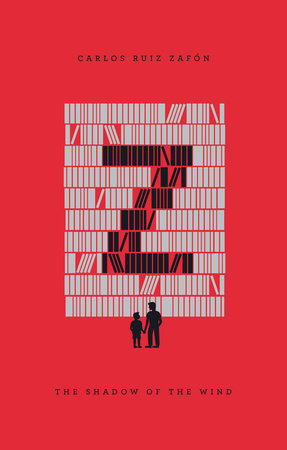
The Shadow of the Wind
In postwar Barcelona, young Daniel Sempere is taken by his bookseller father to the Cemetery of Forgotten Books, where he chooses a novel by the obscure Julián Carax.
About
Spoiler notice: This overview covers Daniel’s discovery of Julián Carax’s novel, the early stages of his search, and the book’s main narrative and historical concerns. It avoids the later revelations about Carax’s life, the resolution of the central mystery, and the fates of the principal characters.
The Shadow of the Wind begins in Barcelona in 1945, as the city lives with the aftermath of the Spanish Civil War. Daniel Sempere, still a child and grieving his mother, is brought by his father, a bookseller, to the Cemetery of Forgotten Books: a hidden archive where endangered or neglected volumes are kept. Daniel chooses a novel by Julián Carax, a writer he has never heard of, and becomes absorbed in the story. When he tries to find Carax’s other books, he learns that somebody has been tracking them down and destroying them. The search begins as curiosity about a writer and his work, but it opens onto a history that Daniel cannot keep at a safe distance. The novel’s central device is at once simple and expansive: a reader follows a book into the life of the person who made it.
That device gives the novel a layered shape. Daniel’s investigation moves through bookshops, homes, streets, and memories, connecting the people he meets with the story of Carax. The book within the book is not a decorative puzzle; it changes what Daniel wants to know and becomes a point of contact between lives separated by time. As he asks questions, each answer points toward another person’s recollection or withheld knowledge. The movement resembles a mystery, though its pace leaves room for digressions, relationships, and the texture of the city. Readers encounter Barcelona not through a guide’s overview but through Daniel’s growing map of places tied to books, family, friendship, danger, and the past.
Barcelona is more than scenery in this structure. The story looks back from the postwar years toward the city of earlier decades, and those different periods carry different pressures. Family position, reputation, money, and political authority shape what characters can say or do. Daniel is learning about a writer whose life belongs to an earlier Barcelona, while he is also coming of age in a society marked by the recent conflict and its continuing effects. The book does not treat history as a finished backdrop. Private decisions and public power meet in ordinary places, and the consequences of older events continue to be felt by people who did not choose them. The city’s atmosphere grows from this overlap of intimate lives and unresolved history.
The novel’s interest in books extends beyond the pleasure of reading. The Cemetery offers a concrete image of preservation: a place where a work can survive even when its author is obscure or its audience has disappeared. Carax’s destroyed books turn that refuge into a question about who gets to determine what remains available. Daniel’s curiosity sets him against deliberate erasure, but preservation does not mean that a text explains itself. A book can keep a story alive while leaving readers to reconstruct the circumstances around it. Zafón uses this gap between a work and its history to build suspense and to reflect on the fragile passage of memory between people. In this sense, the novel is concerned with reading as an act of attention: to a page, to its maker, and to those whose lives surround it.
The investigation also makes room for companionship and comedy. Daniel’s father and the people around the family bookshop give the story a social centre, while his encounters beyond that circle bring new voices into the search. Friendship changes the way he moves through the city and what he is able to face. The novel’s cast does not remain inside a single register: tenderness, romantic longing, wit, menace, and sorrow can sit close together. That range reflects the way Daniel’s understanding grows. He begins with fascination for a novel, but his search involves living people with their own motives, histories, and limits. The mystery therefore develops alongside a coming-of-age story, in which knowledge about another person complicates rather than replaces the young reader’s sense of himself.
The work combines literary mystery, historical fiction, romance, gothic suggestion, and a broad social cast. Its structure allows one story to contain other stories, while returning to the image of the reader who tries to learn how a book came into being. The frame can support suspense without requiring every question to be merely a clue. It also lets the novel consider how stories alter the people who encounter them: Daniel’s interest in Carax becomes a way of thinking about memory, loss, desire, and the uses of imagination in a difficult period. Zafón has described the book as bringing together several genres and as a story made from many stories. That description fits its design, in which the investigation widens as the number of lives connected to the vanished writer becomes clearer.
As the opening novel of The Cemetery of Forgotten Books, The Shadow of the Wind establishes a world in which books can be objects of affection, evidence, refuge, and conflict. Its most persistent questions follow from Daniel’s initial choice: what does it mean to protect a story, how does a reader approach the life behind a work, and what happens when the past is kept out of view? The answers unfold through relationships and a mystery rooted in Barcelona’s history, rather than through abstract argument. The novel’s scope grows beyond one boy’s discovery, yet the act of choosing a book remains its emotional starting point. From there, Daniel’s search links literature and memory with the risks involved in recovering stories that other people would prefer to disappear.
Book details
- Author
- Carlos Ruiz Zafón
- First published
- 2001
- Series
- The Cemetery of Forgotten Books, book 1
- Subgenre
- Historical mystery, Post-war fiction, Literary fiction
- Primary genre
- Literary Fiction, Mystery & Thriller, Historical Fiction
- Tags
- No tags for this book.
- Reading order
- This is the only The Cemetery of Forgotten Books title on the shelf right now.
Review
Editor profile
Baby Bat
Goodreads and social links will be added soon.
- Goodreads — link coming soon
- Social media — link coming soon