
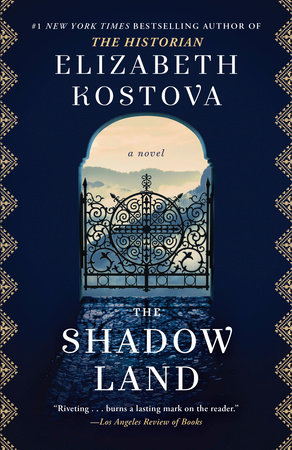
The Shadow Land
In 2008, Alexandra Boyd arrives in Sofia hoping distance will help her live with the loss of her brother.
About
Spoiler notice: This overview covers Alexandra’s mistaken possession of Stoyan Lazarov’s ashes and the early direction of her search. It discusses the novel’s historical setting and major concerns without revealing the outcome of the journey, the full account of Lazarov’s life, or the resolution of the central mystery.
The Shadow Land opens in Sofia in 2008, where Alexandra Boyd has come from the United States hoping that life abroad will help her bear the loss of her brother. A brief encounter with an elderly couple at a taxi becomes an unexpected responsibility: Alexandra discovers she has taken a bag that belongs to them, and inside it is a carved box holding the ashes of Stoyan Lazarov. Her first aim is practical and humane. She wants to find the family and return what has been lost. Yet the name on the box leads her toward the story of a person she never knew, and a country whose history she is only beginning to understand.
This small accident gives the novel its investigative frame. Alexandra follows the clues available to her, and the journey takes shape through conversations, changing locations, and accounts of the past. Bobby, the taxi driver who accompanies her, becomes an important partner in the search. Their route connects urban streets with Bulgaria’s wider landscape, while the people they meet offer partial, sometimes difficult knowledge. The plot moves as a road mystery, but each new lead also changes the scale of the question. What begins as the return of a family’s keepsake becomes an inquiry into how a life was shaped by political forces and how its story might be recovered.
The novel moves between Alexandra’s present and the history attached to Lazarov. He was a gifted musician whose career was broken by political oppression; learning about his life draws the investigation into Bulgaria’s twentieth century, including the upheavals surrounding the Second World War and the Communist period. These sections give the past its own narrative weight rather than treating it as a compact explanation for present events. The reader encounters history through personal testimony, memory, and the effects that remain visible in later generations. The shifts in time make the search feel less like a straight line toward one answer and more like a series of encounters with lives that history has interrupted. Each account can clarify something while also revealing how much remains unknown to Alexandra. Kostova’s structure asks how a private life can carry the pressure of public events long after the immediate danger has passed.
Music offers one of the novel’s central ways of thinking about what can survive. Lazarov’s musicianship is not simply a detail from his earlier career: it gives form to a life interrupted by coercion and to the creative identity that repression tried to diminish. The book follows the traces left by a person who is no longer able to speak directly in the present. An urn, a name, and the recollections of others become starting points for reconstruction. In this way, the investigation is also about the limits of what can be restored. Recovering a history does not undo what happened, but it can resist the silence that would otherwise become the final record.
Alexandra’s own grief gives this search an intimate counterpoint. She travels because she is trying to find a way forward after a family loss, but the task she takes on directs her attention outward, toward strangers and a place she does not yet know. Her unfamiliarity with Bulgaria matters: she cannot interpret every custom or history on her own, and she must depend on other people’s knowledge. That dependence makes the journey social as well as geographical. Bobby’s experience and the accounts Alexandra encounters complicate any simple outsider’s view, while the country’s different regions make the route feel like an unfolding portrait rather than a single fixed setting.
Kostova’s own comments about the book describe it as shaped by long visits to Bulgaria and research into its past, and that combination is reflected in the novel’s form. It brings together the forward motion of a search, the slower work of historical recovery, and sustained attention to place. The contemporary thread supplies urgency: Alexandra must decide what to do with the ashes and how far to follow the trail. The historical thread widens the frame, showing how political power enters personal relationships, work, art, and memory. Instead of separating these modes, the novel lets them meet in the same journey.
The result sits across literary fiction, historical fiction, and suspense. Its central mystery offers a clear reason to keep moving, while the many linked accounts give the story a broader reach than a single puzzle. The landscape and cultural detail are part of the narrative’s method: travel exposes gaps in Alexandra’s knowledge and creates the conditions for new stories to emerge. At the same time, the book remains attentive to loss, artistic life, and the difficult passage from private memory to shared history. Its guiding question is not only where Lazarov’s family can be found, but what it means to carry someone else’s story responsibly once it has come into your hands.
Book details
- Author
- Elizabeth Kostova
- First published
- 2017
- Series
- No series listed
- Subgenre
- Historical mystery, Literary fiction, Historical fiction
- Primary genre
- Literary Fiction, Mystery & Thriller, Historical Fiction
- Tags
- No tags for this book.
Review
Editor profile
Baby Bat
Goodreads and social links will be added soon.
- Goodreads — link coming soon
- Social media — link coming soon