
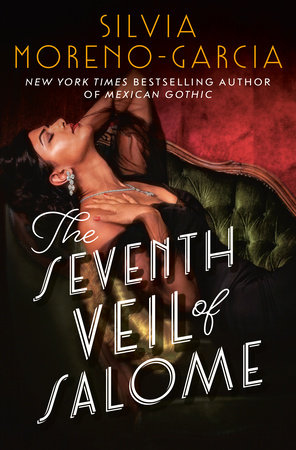
The Seventh Veil of Salome
In 1950s Hollywood, a director casts Mexican newcomer Vera Larios as Salome in a major historical film.
About
Spoiler notice: This overview covers the setup and parallel narrative strands. It does not disclose the outcome of the film production, the rivalry, or the novel's ending.
In 1950s Hollywood, a studio is preparing a lavish film about Salome, the ancient princess whose story has long attracted artists. The coveted part can make a performer a star, and the production has struggled to find its lead. The director finally chooses Vera Larios, a young Mexican actress little known to the industry. Her unexpected casting changes the course of the film and the fortunes of the women around it. Vera arrives in a business where image and opportunity are tightly controlled, and a major role can bring attention while exposing its holder to scrutiny. The novel follows the making of the picture as a drama in its own right, with the set, studio and publicity shaping what its participants can hope to achieve.
Vera's sudden visibility unsettles Nancy Hartley, a bit player whose acting career has stalled. Nancy wanted the Salome role and sees Vera's success as a chance taken from her. Their rivalry becomes a central thread, linking ambition to the unequal ways women seek work and recognition in the studio system. The women do not approach the industry from the same position: Vera is new to Hollywood, while Nancy knows its routines but has not gained the status she wants. Each tries to move toward a different future as gossip, scandal and competition tighten around the production. The book follows their conflict through the pressures of performance, reputation and a workplace in which the people making a film also become part of its spectacle.
The novel gives the ancient Salome her own strand. In the first-century setting, she is a princess caught in the power struggles of her family and court. Her stepfather Herod's rule and the demands of her position weigh against private desires, including her attraction to a prophet who foresees danger for Herod. Salome is not simply a figure in a screenplay: her life and choices develop alongside the twentieth-century women portraying or competing over her image. The two timelines set court politics beside studio politics. Both worlds have hierarchies, audiences and consequences, though their customs differ, and their connections emerge through questions of duty, agency and the stories told about women.
A third perspective comes from the film's production and the people working around its stars. Shifting viewpoints give space to several participants in the Hollywood story rather than keeping the reader only with Vera or Nancy. The production is a large undertaking, shaped by the director's decisions and the labor of performers and crew; the film's progress supplies a shared point around which ambitions and conflicts gather. The movie becomes a meeting place for private motives. Attention moves between rivalries, professional calculation and the public image the studio wants to create. The result is a story about filmmaking as work as well as glamour, with the spectacle on screen connected to negotiations and tensions behind the camera.
The historical setting matters because the characters pursue success in a culture that limits who controls a public image. Vera is a Mexican newcomer cast in a prominent role, and her rise brings admiration as well as envy. Nancy's response is shaped by stalled prospects and the conviction that the part should have been hers. The novel uses their contrast to examine competition inside an industry where women can be displayed, judged and replaced. Their experiences do not reduce to a simple contest between a good newcomer and a bad rival: each has reasons for wanting more than her current position. As the film advances, their choices affect their work and the relationships formed around it.
The Hollywood and ancient strands reflect on performance: Salome is interpreted for a twentieth-century audience even as the novel gives her a history beyond that interpretation. A role, reputation and public story can each conceal a person's more complicated aims. The film's version of Salome offers the Hollywood characters a symbol to argue over, while the ancient court chapters give the princess a separate dramatic life. This arrangement attends to the distance between a woman and the image others make of her. It also shows how ambition can be shaped by duty, desire and fame in very different societies. Suspense grows from those intersecting pressures and from the competing plans the characters bring to them.
The Seventh Veil of Salome is a historical novel about a Hollywood production and the people whose lives become bound to it. Its central movement follows Vera's arrival as Salome and Nancy's attempt to reclaim the opportunity she believes she lost, while a parallel account develops the ancient princess's family and political circumstances. Multiple perspectives widen the frame beyond either actress and trace how individual ambitions meet institutional power. The film's progress connects the stories without making their settings interchangeable: the Hollywood studio and Herod's court remain distinct worlds. Across them, the novel considers the costs of public attention, the making of a star and the tension between a role assigned by others and a life a woman wants to direct herself.
Book details
- Author
- Silvia Moreno-Garcia
- First published
- 2024
- Series
- No series listed
- Subgenre
- Historical fiction, Literary historical fiction
- Primary genre
- Historical Fiction, Literary Fiction
- Tags
- No tags for this book.
Review
Editor profile
Baby Bat
Goodreads and social links will be added soon.
- Goodreads — link coming soon
- Social media — link coming soon