
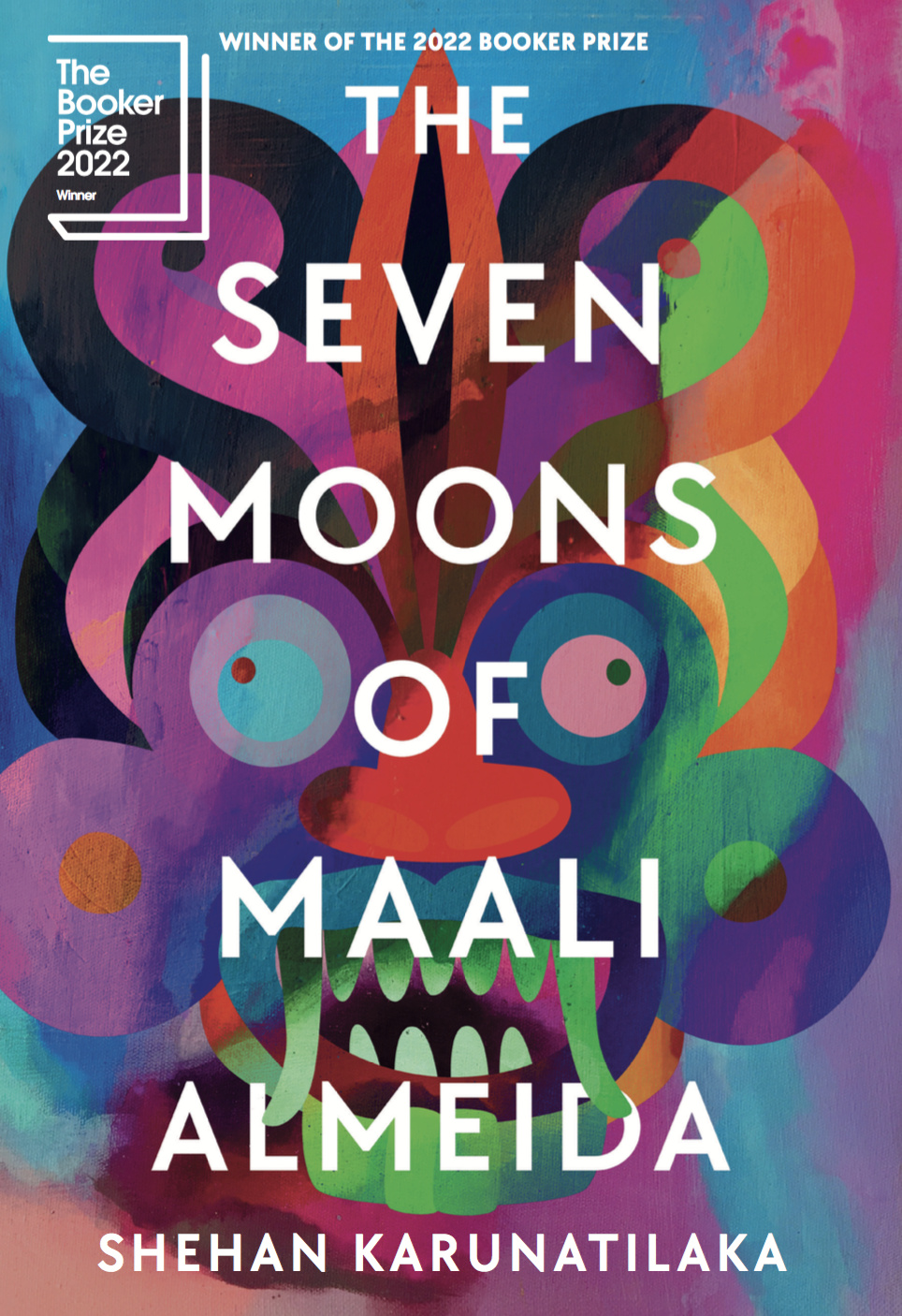
The Seven Moons of Maali Almeida
Set in Colombo in 1990, this Booker Prize-winning novel follows Maali Almeida, a war photographer who wakes dead with no clear account of who killed him.
About
Spoiler notice: Discusses the opening setup, Maali’s meeting and friendship with Jaki, his photography work, and the seven-moon mission; it does not disclose the ending.
The novel begins with a body that Maali cannot remember inhabiting. Now dead, he experiences memory through physical aftershocks: sweat, itching, nausea and the stubborn illusion of a corpse that is no longer his to command. The afterlife feels less like a clean release than a badly understood condition, with bodily sensations intruding on death. Maali has no settled explanation for what happened to him. His body lies in Beira Lake, and he has seven moons to contact the two people he loves most and direct them to photographs. The mystery of his death starts alongside a practical problem: he must understand this unfamiliar place quickly enough to act. The supernatural conceit stays close to pain, uncertainty and unfinished business.
The narrative then folds backward to Maali’s meeting with Jaki at the Hotel Leo casino. He returns from a tour of the Vanni, disturbed by slaughter he has photographed, but the scene first catches him at a table, noticing that Jaki is losing at baccarat. His instinct is to turn the moment into arithmetic. He explains the odds and points out that a player can win a hand and still follow a losing strategy. Jaki, who has come to relax rather than do sums, pushes back against his need to control the game. Their exchange introduces a voice that is quick, observant and sharp with itself. The casino is not just colourful background: gambling gives Maali a language for risk, while his camera work has already made risk part of how he moves through Colombo.
The book makes that connection explicit when Maali’s memories return to the photographs. He has sold images from the Vanni to the Associated Press and received a cheque, but money does not cancel what the work has shown him. At Jaki’s home, she becomes more interested in the pictures than in his lecture about casinos; she tells him that the photographs could get him killed. Maali answers with another joke, measuring one danger against another. That dry exchange lets fear enter without changing the characters into mouthpieces for a theme. Jaki can see a consequence Maali would rather calculate away. The story’s larger mission grows from this tension: the photographs are evidence with political force, but they are also objects kept in a private space, under a bed, among the details of a life that Maali has not finished living.
Jaki and Maali develop a friendship that makes room for what each of them needs. She is a young woman working mornings at the Sri Lanka Broadcasting Corporation and living with relatives; the extract shows her discomfort with an uncle who enters her room without knocking. Maali advises her to put a lock on the door, while she keeps him from returning constantly to the things he witnessed in the war zone. She brings him into parties, suggests schemes, and eventually proposes that they become flatmates. The arrangement gives each a shield in social situations, and it allows the novel to show intimacy without pretending that their relationship follows an expected romantic script. The two trade help, teasing and company. Jaki’s role matters because the mission in the afterlife is not an abstract assignment: Maali’s chance to reach the living depends on bonds formed through these particular, imperfect acts of care.
The narration’s second-person address keeps Maali’s past close while preserving a little distance from it. Its repeated ‘you’ makes Maali both the person remembering and someone being addressed. That form suits a character looking at his choices from outside his former body. It also lets the prose move rapidly between present sensations, a remembered casino conversation, the Vanni, and the people who surround him. The quick shifts do not smooth away confusion. They reproduce a mind sorting through its attachments and unfinished actions. Maali’s voice can be irreverent about himself and angry about what he has seen, without turning the violence of the setting into a simple joke.
Colombo in 1990 gives those personal scenes a dangerous civic backdrop. Maali works as a war photographer, assigned to photograph captured arsenals and covering a bombing. Death squads, suicide bombers and hired gunmen make the list of possible killers long. The book does not treat this setting as distant history separate from the people in the flat or at the casino. Political violence shapes where Maali travels, what he records, what Jaki fears the photographs might do, and what the two of them can safely say about their lives. The danger is not atmospheric decoration around a whodunnit; it is the circumstance that makes recording evidence and getting it to others matter.
The seven-moon limit gives the novel a firm frame for an afterlife that is described as bureaucratic and rule-bound. Maali has a finite opportunity to reach the living, identify what happened to him and guide Jaki and Dilan toward the photographs. That deadline turns grief, desire and political responsibility into linked questions: whom does he try to reach first, what can he reveal, and what can the images accomplish once they leave his keeping? The novel’s movement between a surreal afterlife and recognisable Colombo allows jokes and horror to occupy the same space. Its opening remains focused on a small circle of people and a specific cache of photographs, even as the stakes widen toward the country’s recent violence. The result is a literary mystery whose supernatural device keeps returning to tangible things: a body, a camera, a locked door, a stack of pictures and the people who might still act on them.
Book details
- Author
- Shehan Karunatilaka
- First published
- 2022
- Series
- No series listed
- Subgenre
- Literary fiction, Magical realism
- Primary genre
- Literary Fiction, Mystery & Thriller
- Tags
- No tags for this book.
Review
Editor profile
Baby Bat
Goodreads and social links will be added soon.
- Goodreads — link coming soon
- Social media — link coming soon