
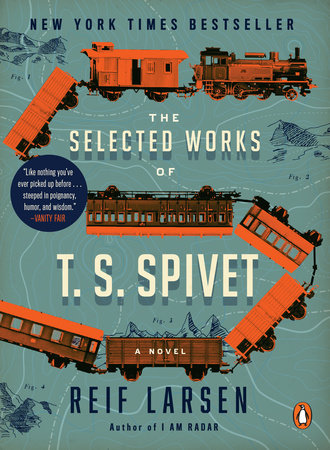
The Selected Works of T. S. Spivet
Twelve-year-old T.
About
Spoiler notice: Spoilers cover the Smithsonian award, T. S.’s departure from Montana and the family-history material that shapes his journey. The ending and the outcome of his trip are not disclosed.
Twelve-year-old T. S. Spivet has a habit of turning whatever catches his attention into a map. A conversation around the dinner table can become a diagram; so can a room, a landscape or some passing curiosity. He lives with his family on the Copper Top Ranch near Divide, Montana, where this close observation sits uneasily alongside the routines and expectations of ranch life. When the Smithsonian calls to tell him he has won the Baird Award, his private work suddenly points beyond home. The invitation asks him to travel to Washington, D.C., and accept recognition from an institution he has only known at a distance. The announcement gives the novel its clear starting direction, but the question underneath is less straightforward: what does a very bright child believe he can learn by leaving the people who know him best?
T. S. sets off before dawn, intending to travel east by freight train. He brings the habits of a field researcher with him, observing the places he passes and recording his impressions in charts, sketches and notes. His attention can settle on a geographic feature one moment and an everyday oddity the next. Rather than treating the journey as a string of stops, the book lets his notes show the workings of a mind trying to sort experience into categories. He wants the world to make sense, and drawing gives him a way to hold details still long enough to study them. Yet each new place also supplies evidence that resists neat arrangement. His trip becomes an education in the difference between naming what he sees and understanding what it means.
The printed page is part of that experience. Maps, diagrams and marginal notes sit beside the main text, so the reader moves between T. S.’s account and the material he makes around it. Those additions are more than decoration: they extend his voice, carrying observations and associations that do not fit the straight line of a conventional travel narrative. Larsen has said that he first wrote the novel without illustrations, then began to imagine the page itself as a map, with the marginal material connected to the main text. That design suits a narrator who is always trying to find a route through complexity. A diagram promises order, but the book’s visual form also gives digressions room to wander. Reading becomes a small act of navigation, with attention shifting across the page as T. S.’s attention shifts across the country.
Travel pulls T. S. farther from the ranch while the story gradually gives more weight to what he has left there. His family is not reduced to a background he can simply outgrow. The habits and relationships of home shape how he interprets other people, even when he cannot see those connections clearly. A piece of family history in his luggage opens a route into earlier generations and the long westward movement that preceded his own. The book lets this history complicate his sense of where he belongs. Looking backward does not stop the forward journey; it changes the questions T. S. carries with him. The farther he goes, the harder it becomes to treat the ranch as a point on a map that he can leave behind without consequence.
The novel also plays with the trust we place in records. T. S. approaches the world with scientific curiosity and painstaking attention, but a map is still a selection: it shows some relationships clearly and leaves others beyond its borders. His notes can preserve an encounter without explaining it, and family stories can reveal a past while making its silences more noticeable. As the journey brings him toward Washington and the award ceremony, he finds that recognition does not automatically offer companionship or clarity. Institutions have their own ideas about what counts as achievement. T. S.’s keen eye lets him notice the distance between being welcomed into a prestigious place and feeling understood there. The discoveries that matter most resist the kind of tidy summary he is best at making.
That tension gives the book its coming-of-age shape without turning it into a simple story of a child discovering that adults are wrong. T. S. is already capable, but capability is not the same as knowing how to live with uncertainty. He can describe a route, collect evidence and make an image, yet the meanings of family, loss, loneliness and affection do not resolve like a measurement. The novel keeps those emotional questions close to the adventure: a boy crosses a continent, and the distance he travels changes the way he sees the people at home. His curiosity remains a source of delight, while its limits give the story room to become more tender. Each act of mapping draws a boundary around what he knows and hints at what he has not yet learned to see.
The Selected Works of T. S. Spivet is built for readers who enjoy following ideas as they branch across a page. Its cross-country premise gives the story momentum, while its illustrated form lets observation and plot occupy the same space. Montana, the freight line and Washington are not just points on a route; they mark stages in T. S.’s changing account of himself and his family. The book’s questions stay grounded in his particular habits: when can careful attention bring someone closer to understanding, and when does it simply create a more elaborate record of what remains unknown? Larsen’s debut turns that puzzle into the shape of the novel itself. The result is a travel story in which looking closely matters, but learning what to do with what one sees matters more.
Book details
- Author
- Reif Larsen
- First published
- 2009
- Series
- No series listed
- Subgenre
- Literary fiction, Adventure fiction, Coming-of-age
- Primary genre
- Literary Fiction, Adventure
- Tags
- No tags for this book.
Review
Editor profile
Baby Bat
Goodreads and social links will be added soon.
- Goodreads — link coming soon
- Social media — link coming soon