
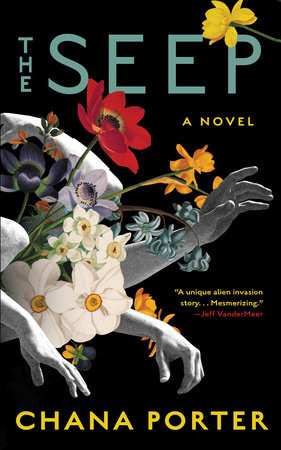
The Seep
After a gentle alien invasion transforms human society, Trina FastHorse Goldberg-Oneka and her wife Deeba live within a world shaped by radical connection and new possibilities.
About
Spoiler notice: Major premise spoilers follow, including Deeba’s choice, Trina’s grief, and her attempt to save a boy. The novel’s ending is not described.
Chana Porter begins The Seep with an invasion that does not follow the familiar pattern of an enemy arriving to conquer, destroy or demand surrender. The entity called the Seep changes human life through connection: barriers and hierarchies break down, capitalism falls, and imagination becomes a practical force. The novel asks what happens after a world-changing event that appears to solve the problems speculative fiction usually treats as inevitable. Its central tension is not a military campaign against an alien power. It is the more intimate question of how people keep making choices, and understand themselves, when the conditions around them have been remade in the name of universal connection.
Trina FastHorse Goldberg-Oneka is a fifty-year-old trans woman living within this changed society. She and her wife, Deeba, share in the Seep’s apparently blissful utopia, where the old limits on what can be imagined or achieved have fallen away. That premise places a particular person and relationship at the centre of an immense social transformation. Trina is not introduced as a representative tasked with explaining a political system; the story follows the effect of that system on her life. The scale of the invasion and the scale of a marriage therefore remain joined. A society may be altered everywhere, but its meaning is still felt through the decisions people make with and about one another.
The Seep’s promise of connection also complicates the idea that a perfect society must make its inhabitants content. Deeba begins to imagine being reborn as a baby, an option made possible through Seeptech. She chooses a new existence, and Trina is left devastated. The choice matters because it is described as Deeba’s own imagined possibility, not as a conventional attack or a simple loss imposed by an outside enemy. A world in which possibilities can be realised still contains decisions whose consequences are painful for someone else. The novel’s premise makes freedom expansive, while its central relationship shows that freedom cannot guarantee that two people will want the same future.
Deeba’s departure changes the story’s focus from shared happiness to the work of living after a relationship has been transformed. Trina’s grief is not presented as a problem the utopian environment can simply correct. She is heartbroken and enters an alcoholic binge, details that place emotional distress inside a world otherwise described through connection and possibility. This contrast gives the speculative premise a human measure. It asks whether a society can make room for feelings that do not fit its broad promise of improvement, and whether moving forward means accepting change before one is ready. Those questions emerge from Trina’s loss rather than from an abstract debate about whether utopia is good or bad.
The book then gives Trina an unexpected direction through a lost boy she encounters. She follows him and undertakes a quest in an attempt to save him from the Seep. The effort brings her into conflict with one of the entity’s most avid devotees and keeps the story tied to a particular encounter rather than a general argument about the new order. Trina’s own vulnerability and her attempt to protect someone else now occupy the same narrative line. The movement from bereavement toward action does not erase the loss that started it; it gives her something urgent to do while she confronts the void Deeba has left behind.
This structure lets the novel examine benevolence without assuming that good intentions settle every question. The Seep is described as gentle, and the social changes it brings can be imagined as liberation from entrenched barriers. Yet the title entity also becomes the force from which Trina tries to save the boy. That tension leaves room for uncertainty about what connection means when an individual does not want the outcome others regard as better. The narrative’s questions concern agency as much as power: who decides what counts as a fuller life, how much difference can a shared consciousness tolerate, and what responsibilities remain when nearly anything can be made possible?
Porter’s setup also links identity to a world that has changed its assumptions about social hierarchy. Trina’s life as a trans woman is part of the novel’s stated central character description, while the Seep’s arrival is associated with the breaking of barriers. The premise invites readers to consider what happens to identity when the structures that once constrained people are altered, and whether selfhood depends only on those structures. These are questions raised by the situation, not a claim that the story supplies a simple answer. The novel keeps them close to grief, partnership and care, so its speculative ideas remain attached to what people want from their own lives and from one another.
The Seep is therefore built around a productive contradiction: humanity has entered a seemingly utopian future, but its people remain capable of longing for different things, suffering change, and struggling to decide what should happen next. Trina’s journey connects first contact, technology and social transformation to the familiar difficulty of losing someone and continuing to act. Porter’s publisher describes the book as an elegy of love and loss, and that emphasis fits the route from Deeba’s decision to Trina’s quest. Rather than treating utopia as a final answer, the novel uses it as a setting in which questions of autonomy, attachment and moving on become newly visible.
Book details
- Author
- Chana Porter
- First published
- 2020
- Series
- No series listed
- Subgenre
- First contact
- Primary genre
- Sci-Fi
- Tags
- No tags for this book.
Review
Editor profile
Baby Bat
Goodreads and social links will be added soon.
- Goodreads — link coming soon
- Social media — link coming soon