
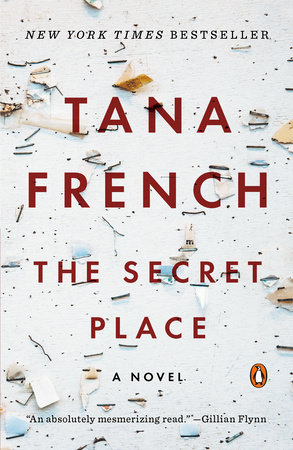
The Secret Place
A year after sixteen-year-old Chris Harper is found murdered at a Dublin girls’ school, Holly Mackey brings Detective Stephen Moran a photograph marked with a claim to know who killed him.
About
Spoiler notice: Spoilers are limited to the premise and opening setup: the unsolved murder of Chris Harper, the photograph Holly brings forward and the reopening of the investigation. Later discoveries, the killer’s identity and the ending are not disclosed.
The Secret Place opens with a case that has already gone cold. A year earlier, sixteen-year-old Chris Harper was murdered on the grounds of St Kilda’s, a girls’ boarding school in Dublin. The investigation produced no answer. Then Holly Mackey, a pupil at the school, brings Detective Stephen Moran a photograph of Chris carrying a message that someone knows who killed him. The photograph gives Moran a route into a case that may also move his police career forward: he works in the Cold Case unit and hopes to join Dublin’s Murder Squad. He asks Detective Antoinette Conway, who has been investigating the murder, to let him work alongside her. The publisher’s description places Holly’s father, fellow detective Frank Mackey, in the background of the inquiry too.
The first setting is not a public street or an unfamiliar house but a school whose routines and social boundaries have had time to harden around the crime. St Kilda’s is an exclusive institution, and the story’s investigators enter it as outsiders with different reasons to be uncomfortable there. The Guardian and the Irish Times both describe the class distance between the detectives and the school’s privileged environment. That difference matters to the investigation: the officers are not simply collecting statements in a neutral space. They must work through an institution protective of its reputation, while students already know one another’s loyalties, rivalries and private histories. The school becomes a contained social world whose ordinary rules shape what can be said and to whom.
The book is the fifth novel in French’s Dublin Murder Squad series. The series connects its cases through a changing cast of investigators rather than following one detective in every volume. In a Penguin Random House interview, French explains that she wanted to bring Stephen forward after introducing him in Faithful Place. She describes him as a people-pleaser whose ambition is bound up with uncertainty about who he is; those qualities made him a natural observer for a story about teenagers negotiating identity and influence. Returning readers may recognize that connection, but the publisher’s Q&A says the linked-book structure does not prevent someone from beginning with this volume. The central case remains clear: Moran and Conway are trying to establish what happened to Chris and whether the new clue can be trusted.
French gives the investigation two time frames. In the present, Moran and Conway return to St Kilda’s to question the pupils after the photograph appears. In the preceding year, sections follow Holly and three of her friends as their lives approach the murder. The Guardian identifies the two strands as Moran’s present-day account and Holly’s group in the past; the Irish Times names the friends as Selena, Rebecca and Julia. That arrangement makes the case a problem of perspective as much as evidence. The detectives hear accounts after the fact, while the earlier strand gives the reader a view of the relationships that existed before Chris died. The timelines create different kinds of uncertainty: what the police can establish through questioning, and what the girls themselves understood while events were unfolding.
The photograph belongs to a particular feature of school life. St Kilda’s has a noticeboard called the Secret Place where pupils can post anonymously. French has said in the publisher interview that the idea grew from hearing about PostSecret, a site where people share secrets anonymously. She was interested in the conflicting wish to keep a secret and to be known, and in how intensely those impulses can be felt during adolescence. Turning an anonymous board into the route by which information about a murder reaches the police brings those impulses into the plot. A message can be a confession, an accusation, a provocation or a bid for attention; at the start, its author and purpose are unknown. The device lets the book ask what anonymity reveals and what it conceals without immediately settling either question.
The title also describes the private social worlds that the investigation must enter. The publisher synopsis points to Holly’s close-knit friends, a rival clique and a web of relationships connecting the pupils to Chris. The Guardian’s account of the structure emphasizes the sharp divides and alliances among the girls, while French’s Q&A frames the novel’s broader concern as the struggle over who gets to define a person: friends, authority, media images or one’s own judgment. Those ideas give the teenage strand weight beyond clue delivery. The girls are not simply a row of suspects for two detectives to sort; their bonds affect how they interpret events and what they might be willing to tell an adult. The police strand tests those bonds from outside, under the pressure of formal questioning.
Moran and Conway bring different temperaments to the case. French’s interview explains why Moran’s social accommodation and ambition suit this story; independent accounts describe Conway as the detective already attached to it and note friction between the investigators. They must cooperate while carrying their professional interests and judgments into the school. An answer’s content matters, but so do the conditions in which it is given: who is present, which friendship is at stake and what the speaker thinks the detectives want to hear. The process raises these questions without proving what any one answer means.
The Secret Place combines a murder investigation with a close study of how a small community protects its internal order. Its Dublin setting crosses the social distance between detectives and a prestigious school, then moves between the public inquiry and pupils’ self-contained lives. Moran links this volume to the series, while Conway remains central to the police work. French’s account of the idea points to the tension between privacy and recognition; the anonymous board makes that tension concrete. This introduction covers the starting case and dual timeline, leaving the evidence gathered during the inquiry, the truth of the photograph’s message and the resolution of Chris Harper’s murder open.
Book details
- Author
- Tana French
- First published
- 2014
- Series
- Dublin Murder Squad, book 5
- Subgenre
- Police procedural, Psychological thriller
- Primary genre
- Mystery & Thriller
- Tags
- No tags for this book.
- Reading order
- Also on this shelf: In the Woods (book 1), Faithful Place (book 3)
Review
Editor profile
Baby Bat
Goodreads and social links will be added soon.
- Goodreads — link coming soon
- Social media — link coming soon