
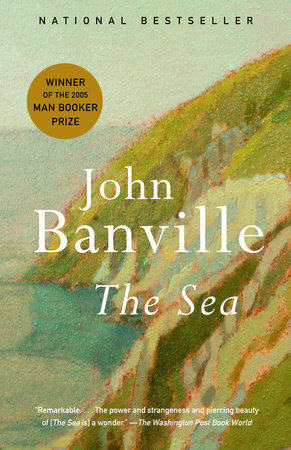
The Sea
After the death of his wife, retired art historian Max Morden returns to Ballyless, the Irish seaside town where he spent a childhood holiday.
About
Spoiler notice: Spoilers: this About discusses the novel’s childhood and present-day storylines and their thematic connection, but does not reveal the late plot revelation or ending.
The Sea opens after a loss that has altered the shape of Max Morden’s life. Recently widowed, the retired art historian returns to Ballyless, the Irish seaside town where he spent a childhood holiday, and stays near the place where he once encountered the Grace family. The return brings two kinds of distance into view: the years separating the adult Max from the boy he was, and the emotional distance between what happened then and what he can bear to remember now. He comes to cope with his wife’s death and finds himself back at the site of his first experience of love and death. The novel’s central movement is inward: a journey through recollection, not a quest that promises to settle grief neatly.
Max’s account moves between the present and the summer of his childhood. In Ballyless he had been eleven when he met the Graces, a wealthy family who seemed to belong to a world beyond the one he knew with his parents. The twins, Chloe and Myles, became the focus of his attention, and the older Max looks back on the intensity and uncertainty of that attachment. The two time periods do not sit apart as separate episodes. The adult narrator’s return is continually interrupted and illuminated by what he remembers, while his memories are shaped by the bereavement he is carrying in the present. That structure lets the book examine how an earlier experience can remain active long after its details have become difficult to hold steadily.
Memory in this novel is not presented as a transparent record. Max narrates from within grief, and the reader encounters his past as it comes to him: in returns, associations and reconsiderations rather than as a clean chronological account. The story moves between present-day Ballyless, Max’s life with Anna and his childhood, leaving the reliability of his account open to question. That uncertainty matters because Max is trying to understand his own history, not simply report it. A recollection may preserve an image with great vividness while leaving its meaning unsettled. The result is a narrative in which remembering is an action with consequences: each return alters the balance between what Max knows, what he feels and what he can explain.
The adult strand gives the childhood memories a distinct emotional pressure. Max has recently lost Anna after her long illness, and his mourning is complicated by the fact that their marriage was not always happy. The book does not reduce bereavement to a single lesson or a smooth process of recovery. Instead, Max’s present sorrow sits beside older attachments and earlier knowledge of mortality, so that one loss calls up another without making them identical. Anna is not merely a device that sends him back to Ballyless; she remains part of the history he is trying to take in. His reflections on her final days mingle with formative experiences from his youth. The novel therefore approaches grief through the persistence of a life shared, including its silences and its less-than-simple parts.
The Grace family’s wealth and social ease sharpen the differences Max notices between their world and his own. As a boy, he is drawn to their household and to the adults and children who seem at once compelling and difficult to read. Banville has said that the distance between the Graces and Max’s parents was intended to heighten the poignancy of the young Max’s feelings, rather than to serve as broad social commentary. That comment offers a useful boundary for reading the class contrast: it shapes the boy’s sense of fascination and separation, but it does not turn the novel into a survey of Irish society. The child sees the Graces from below, through partial knowledge and desire; the adult remembers them with the awareness that time has changed both his view and the world he is looking back toward.
The sea and the surrounding landscape give these memories a physical setting. The coast is where Max’s childhood and adult returns meet, but the water also resists being reduced to a tidy emblem. Banville has discussed the importance of how things look in his fiction, saying that the beauty of appearances can matter as much as the people in the foreground; the Booker guide connects that attention to landscape with this novel. In The Sea, looking is bound up with remembering: a place can be present to the senses while carrying associations from a different time. The title’s element is both part of the setting and a reminder of forces that exceed Max’s ability to arrange experience into a stable story. Its changing presence suits a book concerned with the way the past returns without becoming fully controllable.
The novel won the 2005 Booker Prize, and its form helps explain why it is remembered as a book about memory as much as a story of bereavement. The prose stays close to Max’s acts of noticing and recollection, so that description, reflection and narrative movement work together. Banville has said that The Sea returns directly to his own childhood holidays in a fictionalised version of Rosslare, and he has described language and close observation as central to his work. Those author comments illuminate the importance of place and perception without making Max a simple stand-in for his creator. The selected Vintage paperback edition was published in 2006 and runs to 208 pages; the novel itself first appeared in 2005. Within that compact length, it links a child’s first encounters with adult feeling to a widower’s effort to look back, while leaving the reader alert to the gaps between memory and certainty.
Book details
- Author
- John Banville
- First published
- 2005
- Series
- No series listed
- Subgenre
- Literary fiction
- Primary genre
- Literary Fiction
- Tags
- No tags for this book.
Review
Editor profile
Baby Bat
Goodreads and social links will be added soon.
- Goodreads — link coming soon
- Social media — link coming soon