
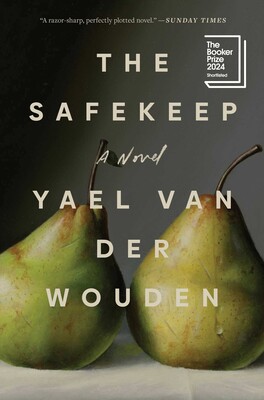
The Safekeep
In 1961, Isabel lives alone in her late mother’s house in the Dutch countryside, keeping its rooms and possessions under strict control.
About
Spoiler notice: Spoilers for the wartime history behind Isabel’s home and Eva’s connection to it; the ending is not described.
Yael van der Wouden sets The Safekeep in the Dutch countryside of Overijssel in 1961, sixteen years after the end of the Second World War. Isabel lives alone in the house where she grew up and where her mother died. She follows a strict domestic routine, cleaning and preserving the family’s possessions as if their careful arrangement could keep life settled. The house is not simply a comfortable inheritance: Isabel’s right to remain there is conditional, and her older brother Louis is expected to receive it when he marries. That uncertainty gives her attachment to its rooms and objects a practical edge. Plates, curtains and furniture become things to protect, while the household itself keeps the past close even as the surrounding country appears to have rebuilt and moved on.
Isabel’s controlled days change when Louis arrives with Eva, his new girlfriend, and leaves her to stay for the summer. Eva is noisy where Isabel is quiet, casual where Isabel is exacting, and unselfconscious about touching the things Isabel guards. A spoon or bowl goes missing, and Isabel’s attention narrows into suspicion: she counts, watches and interprets ordinary movements as signs of trespass. Her brother Hendrik provides another contrast. He visits from the city with a life and relationship of his own, while the family does not openly acknowledge his boyfriend, Sebastian. The siblings’ different ways of making room for themselves show how much the household’s rules depend on what can be said aloud. In that tightly managed setting, Eva’s presence makes Isabel’s resentment increasingly difficult to separate from fascination.
The novel’s early tension comes from this close domestic contest. Isabel knows the patterns of the house and believes that noticing every detail will protect what belongs to her. Eva, meanwhile, seems to treat those boundaries as invitations to ask questions. The summer heat and the repeated rituals make small disturbances feel consequential: an object displaced, a room entered, a memory unsettled. As Isabel becomes drawn toward Eva, her watchfulness shifts into desire, and the feelings she has kept outside her orderly life begin to press against the rules that have governed it. The change is not a simple escape into romance. Isabel remains bound to the property, to her mother’s memory and to a family structure that determines which futures are available to her. Intimacy makes those limits more visible rather than making them disappear.
The house’s history gives the conflict a wider reach. Its objects and rooms carry traces of people who lived there before Isabel’s family, while the postwar landscape encourages the comforting idea that reconstruction has put the violence behind everyone. Van der Wouden connects that public story of recovery to a quieter history of Jewish families in the Netherlands whose homes and possessions were taken during the Nazi occupation, and to the difficult return of those who survived. In the novel, ownership is therefore more than a matter of inheritance or household habit. The question of who may keep a home, and whose absence makes that keeping possible, turns Isabel’s attachment into a moral problem. The past does not arrive as a distant historical lesson; it is present in the way the characters speak about the house and in what they choose not to ask.
As the summer proceeds, Isabel and Eva’s relationship changes alongside the mystery of the missing belongings. The novel’s suspense depends on how those two strands affect each other: Isabel tries to understand Eva through the signs she sees, while Eva’s questions unsettle the version of family history Isabel has accepted. A later revelation connects Eva’s own family to the house’s earlier history and forces Isabel to reconsider what her family gained during the war and what it has since treated as its own. This turn recasts the domestic details that came before it. It also shifts the story’s centre of gravity toward Eva, whose presence is not merely an interruption in Isabel’s routine. The book asks what responsibility looks like when the facts behind a familiar home become impossible to ignore.
That reckoning does not erase the characters’ desires or the unequal circumstances in which they live. Isabel has to face both her attraction to Eva and the history that makes their relationship inseparable from questions of possession, loss and return. Hendrik’s quieter departure from the family’s expectations offers a parallel example of how a person might seek a life beyond the home’s inherited rules, though his path does not resolve Isabel’s choices for her. Van der Wouden keeps personal awakening and historical accountability in the same frame: an intimate bond can open a way forward, but it cannot undo the past or make its harms abstract. The novel’s final movement follows what Isabel and Eva do with that knowledge, bringing the question of who can call a place home into the present tense.
Book details
- Author
- Yael van der Wouden
- First published
- 2024
- Series
- No series listed
- Subgenre
- Literary historical fiction, Historical romance
- Primary genre
- Historical Fiction, Literary Fiction
- Tags
- No tags for this book.
Review
Editor profile
Baby Bat
Goodreads and social links will be added soon.
- Goodreads — link coming soon
- Social media — link coming soon