
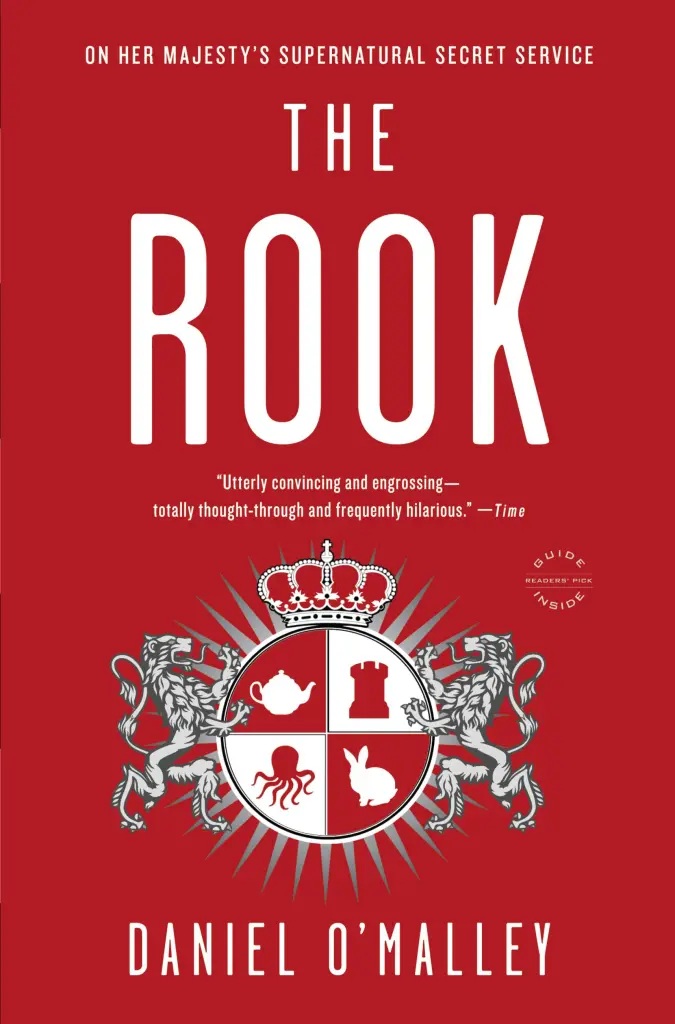
The Rook
Myfanwy Thomas wakes in a London park with amnesia and a ring of dead people wearing latex gloves.
About
Spoiler notice: Spoilers for the opening situation and the novel’s central premise; later revelations and the ending are not summarized.
The Rook opens with Myfanwy Thomas coming to herself in a London park, surrounded by dead people wearing latex gloves. She has no memory of her identity or of how she reached that scene, but she has a letter from the person she used to be. This device gives the story an immediate problem to solve while making its protagonist a stranger to her own life. Myfanwy has to use evidence left for her future self, assess the danger around her and choose what to do before she can reconstruct the past. The first-person voice in the letters and the present-tense practical demands create two versions of one character: the person who prepared instructions and the person who must decide whether to trust them.
Those instructions disclose a world organised around the Checquy, a secret British agency that protects the public from supernatural threats. Myfanwy learns that she is a Rook, a senior official rather than a newly recruited field agent. The title therefore carries both a chess-like institutional role and the weight of a job she did not knowingly accept. Its responsibilities include overseeing operatives, handling extraordinary cases and working within an established hierarchy. The premise turns an amnesia mystery into workplace orientation under extreme conditions: Myfanwy needs to understand procedures and colleagues while pretending to be the experienced official they expect. The gap between what she knows and what her office assumes she knows supplies both suspense and a source of awkward, dry comedy.
O’Malley’s supernatural inventions are presented through the agency’s administration. The Checquy has ranks, case files, meetings, facilities and a history of managing unusual people and events. Its structures give a recognisable bureaucratic frame to phenomena that would otherwise be treated as isolated wonders. In the sample chapters, Myfanwy consults a binder left by her earlier self, studies how the Rooks’ responsibilities changed over time, and tries to learn the layout and routines of the Rookery. The contrast between fantastical subject matter and practical office work helps define the book’s tone. Strange abilities and threats require logistics, judgment and coordination; the extraordinary becomes part of a working day, without losing its capacity to unsettle.
The letters are more than a convenient explanation of the setting. They let the former Myfanwy choose what the new one should know, and their voice can convey confidence, irritation or humour even though their author is absent. The present Myfanwy, meanwhile, has to interpret those instructions without sharing the assumptions behind them. That separation makes identity a question of action as well as memory. Is she obliged to continue the life and position prepared for her, or can she become someone distinct from the person whose body and office she inherits? The story’s central mystery concerns betrayal and survival, but its unusual structure also follows the slow formation of a self from incomplete records and new decisions.
The institutional setting makes suspicion unavoidable. Myfanwy’s former self believed that someone within the Checquy had caused her memory loss and intended to kill her. Yet she must depend on the same organisation for information, protection and a functioning role. Familiar colleagues may know the person she was, while she cannot reliably judge what they expect or conceal. The uncertainty applies to the organisation as a whole: its long history and extensive systems offer resources, but they also make it difficult for a newcomer in her own body to see how power is distributed. Rather than pursuing an investigator outside the system, Myfanwy has to work from inside the institution whose internal danger she is trying to identify.
The novel mixes thriller movement with fantasy and comic observation. The dead bodies and threat of assassination establish serious stakes, while the Checquy’s ranks and odd cases invite a wry response to official procedure. Kirkus describes the book as a fantasy debut marked by sly humour and social commentary, and notes the role of the letters in providing history and backstory. This blend is apparent in the premise itself: an endangered woman must learn the workings of an old secret service, while the service’s work involves supernatural powers and beings. Humour does not remove the danger; it changes the angle from which that danger is viewed, allowing institutional absurdity and genuine peril to occupy the same scene.
At its centre, The Rook asks how a person can act when memory, identity and trust have all become uncertain. Myfanwy has a practical guide written by her former self, but guidance cannot make decisions on her behalf. She must test what she has been told against people and events she encounters, build a working understanding of the Checquy, and decide how much of the previous life to inhabit. The agency’s secret work widens that personal problem into a conflict involving the safety of others and an unseen adversary. By joining a self-discovery story to supernatural espionage and an office-bound hierarchy, O’Malley gives the amnesia premise a distinctive engine: every attempt to learn who Myfanwy was also changes what she can choose to be.
Book details
- Author
- Daniel O’Malley
- First published
- 2012
- Series
- The Rook Files
- Subgenre
- Urban fantasy, Spy thriller, Conspiracy thriller
- Primary genre
- Fantasy, Mystery & Thriller
- Tags
- No tags for this book.
- Reading order
- This is the only The Rook Files title on the shelf right now.
Review
Editor profile
Baby Bat
Goodreads and social links will be added soon.
- Goodreads — link coming soon
- Social media — link coming soon