
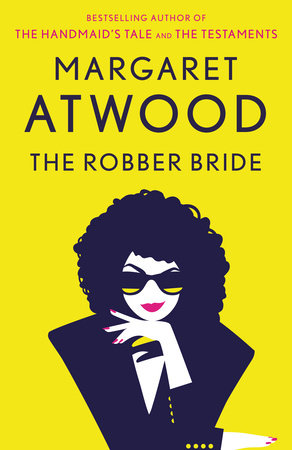
The Robber Bride
Roz, Charis and Tony have met for lunch every month since the funeral of their former university friend Zenia.
About
Spoiler notice: Spoilers below for Zenia’s return and the shape of the three women’s histories; the novel’s final outcome is not disclosed.
The Robber Bride opens at a Toronto restaurant, where Roz, Charis and Tony see Zenia walk in five years after attending her funeral. The three women were university classmates, and Zenia had once left each with a different reason to fear or resent her. Since the funeral, they have met for lunch every month, returning to the damage she caused and the questions it left behind. Her sudden appearance turns those recollections into an immediate problem. The friends must decide what to do with the person they had treated as part of the past, while confronting how much of their shared understanding rests on separate memories.
Zenia is the novel’s fairy-tale villainess, but Atwood gives that familiar role a modern social setting. The title echoes Grimm’s “The Robber Bridegroom,” and the story keeps the fable’s warning about a charming figure whose welcome conceals danger. Zenia is glamorous and persuasive, adept at discovering what someone wants to believe about a relationship. She uses confidence and intimacy to obtain money, sympathy, time and romantic partners. Her method depends on attention: she notices a need, offers herself as its answer, then leaves the other person to make sense of the loss. The result is a villain whose weapon is not force but her ability to make manipulation resemble closeness.
Each friend’s history gives Zenia a different shape. Tony is an ambidextrous military historian specialising in medieval siege techniques; Charis has psychic leanings and a complicated past; Roz is a businesswoman with gambling tendencies. The harms belong to different periods, stretching from the 1960s through the 1980s, and the narrative moves among those histories before returning to the present. The structure works through recurring motifs and nested recollections, so one woman’s account can echo or unsettle another’s. Zenia emerges cumulatively, through the effects she has had, rather than through a single explanation that would make her fully knowable. Repeated details work like musical motifs: a point that seems limited to one period can shift when another woman’s history comes into view. The memories also sit inside one another like nested stories, keeping each account in view of a larger pattern. This arrangement makes changes in perspective part of the suspense.
That shifting design keeps the friends at the centre even when Zenia commands attention. Tony, Charis and Roz have different work, habits and vulnerabilities; they do not respond to the same pressures in the same way. Their accounts describe Zenia, but also reveal what each woman hoped for and what she was prepared to overlook. The friendships that form around those histories are not simple alliances between blameless victims. Each woman has her own desires and compromises, and the monthly lunches give them a place to compare what happened without making their memories identical. Shared experience can offer recognition, while leaving room for disagreement.
Zenia’s return tests whether that companionship can become action. Before she reappears, the friends can revisit the past at a distance, turning old injuries over in conversation. Now the person they have discussed is present again, and their memories have consequences for what they choose to believe and how they approach her. The suspense comes partly from that shift: the women know enough to be wary, but their knowledge is still incomplete and shaped by personal histories. The book asks how trust survives when familiarity has been used as an opening, and whether recognising a pattern is enough to prevent it from recurring.
The fairy-tale frame sharpens the novel’s interest in moral choice. Zenia is allowed to be a woman who does harm, not a figure whose actions are excused by virtue or explained away as a lesson for someone else. At the same time, the three friends are not arranged as pure opposites to her. Their own judgments and appetites matter to the relationships she enters. This balance gives the book a lively, unsettled view of power among women: charm can be generous or strategic, care can carry expectation, and friendship does not guarantee that people see one another clearly. The danger lies in the space between what someone offers and what another person needs to believe.
First published in 1993, The Robber Bride joins a tale of a returning nemesis to a closely observed portrait of friendship over time. Its episodes circle back through the women’s lives like musical motifs, while the nested arrangement of their memories makes each new detail alter the pattern. That form suits a story in which no one has possessed the whole truth at once. The central question is not only what Zenia did, but how the friends understand themselves after years of telling and retelling it. Their effort to make a coherent account together becomes its own test of trust: they can recognise recurring harm and still differ over what it means.
Book details
- Author
- Margaret Atwood
- First published
- 1993
- Series
- No series listed
- Subgenre
- Literary fiction
- Primary genre
- Literary Fiction
- Tags
- No tags for this book.
Review
Editor profile
Baby Bat
Goodreads and social links will be added soon.
- Goodreads — link coming soon
- Social media — link coming soon