
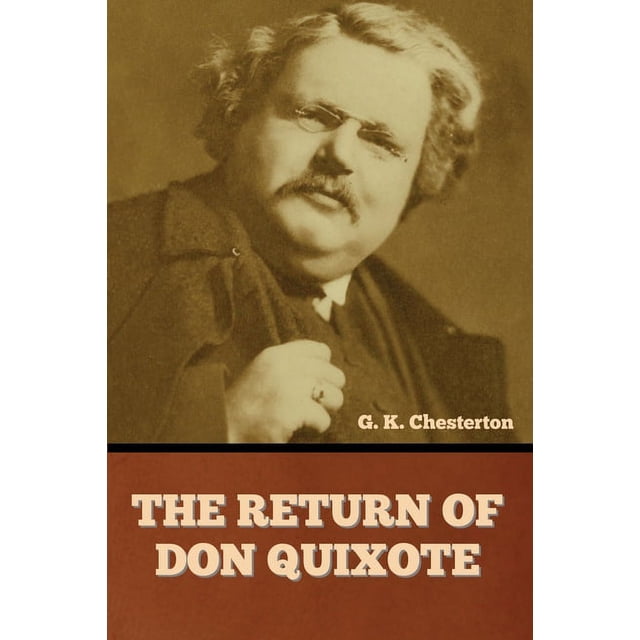
The Return of Don Quixote
An amateur medieval play at Seawood Abbey changes the life of its solitary librarian, Michael Herne.
About
Spoiler notice: This overview reveals the tribunal’s judgments, the collapse of Herne’s support and the final reunions.
The amateur play at Seawood Abbey needs scenery, costumes and people willing to perform, but nearly everyone involved has another concern. Olive Ashley, who wrote the medieval drama, is trying to recover a lost red pigment for her miniature painting. Her friend Douglas Murrel, usually called Monkey, helps with the scenery and moves comfortably between the household’s fashionable visitors and its political dissenters. Julian Archer brings the confidence of a successful amateur actor. John Braintree, an engineer and union secretary, has a strike to think about and refuses to join the performance. Published in 1927, G. K. Chesterton’s The Return of Don Quixote begins among these preparations before allowing the play’s ideas about kingship to escape into the country outside.
Michael Herne, the librarian, seems an unlikely person to cause that disturbance. His scholarly territory is the ancient Hittites, and when Rosamund Severne asks him to take a medieval part, he objects that the period lies outside his expertise. His seriousness makes him vulnerable to the people treating the production as a diversion. During a visit to the library, he climbs a ladder to consult books high above the floor; Archer removes the ladder while Murrel is away. Herne’s scholarship, solitude and literal answers initially make him a comic figure. Once he performs the Outlaw King, however, his commitment gives Olive’s dramatic verse a force that the more socially accomplished participants had not supplied.
Afterwards, Herne will not put away his green forester’s clothes and spear. The others assume that returning to ordinary dress should settle matters, but he begins asking why their clothes and customs count as ordinary in the first place. He argues that medieval society admitted its inequalities while modern society hides them behind comfortable names. That is Herne’s contentious explanation of the past, and the people around him do not all accept it. Rosamund nevertheless finds a purpose for her energy in his convictions. The League of the Lion turns the household’s historical enthusiasm into a movement, with old costumes, archery and followers prepared to take their pageant beyond Seawood’s grounds.
The movement attracts support for reasons Herne has little control over. One proclamation, delivered by arrow, nearly strikes the Prime Minister, Lord Eden, during a visit to Seawood. Eden recognises political uses for this strange new enthusiasm, particularly against Braintree and organised labour. Money and influential backing make the revival effective. England acquires a new arrangement of regional Kings-at-Arms, with provinces, courts and orders of chivalry, while the existing monarchy remains. Herne becomes one of these rulers. Archer adjusts readily to the new fashion, and Seawood’s aristocratic interests find fresh expression in heraldry. The old forms have returned with many of the same people who already possessed power standing conveniently inside them.
The industrial dispute brings that arrangement to a practical test. Braintree and the strikers reject the new tribunal, and Herne’s decision to compel his opponents to appear initially reassures supporters who want a firm hand. Murrel is disturbed by the prospect of violence and lasting division. The eventual hearing changes the direction of the conflict. Herne takes the craft principles behind his medieval language seriously: those who govern a trade should be qualified practitioners of it. Applied to the manufacture of dyes and paints, that principle supports Braintree’s claim. The wealthy owners cannot demonstrate the standing of master craftsmen. The historical authority they have helped establish is now examining the basis of their ownership.
Herne’s further judgments turn his allies against him. Evidence supplied by Murrel describes a skilled colourman whose work was suppressed while commercial rivals ruined him through their control of prices, materials and supplies. Herne regards the fortunes built through that injustice as illegitimate, despite his general defence of private property. His inquiry into hereditary status is just as unwelcome: Seawood’s family is actually Smith, and the Prime Minister’s ancestry also fails to support its pretensions. The great names in the room cannot meet the standards they welcomed when those standards appeared useful against someone else. Herne’s supporters start treating his conclusions as proof that he needs a doctor. Olive and Murrel stand by the verdict.
Herne sheds his judicial robes and leaves in his green clothes, returning to the position of an outlaw. Murrel offers to accompany him as Sancho Panza. Their travels turn the title’s reference to Cervantes into a friendship conducted through the peculiarly English vehicle of a hansom cab. They meet people in difficulty, help tramps and children, and continue arguing about what the modern world considers reasonable. Herne’s giant enemies include the machinery that, in his view, has become inhuman. He also comes to see Murrel’s practical help for the oppressed as a form of knightly action. Murrel’s jokes and sociability have never prevented him from taking another person’s trouble seriously.
When the travellers return to Seawood after years away, the estate has become an abbey in fact. Lord Seawood has died, and Rosamund has become a Catholic, given the property to monks and gone to work as a nurse in Limehouse under the name Miss Smith. Herne searches for more than three months before finding her. She corrects his assumption that she is a nun, and their reunion allows affection to survive their disagreement about her father’s guilt. Olive and Braintree are already married, as is Murrel to Dr. Hendry’s daughter. Herne and Rosamund embrace without an explicit account of a wedding. Their meeting takes place far from the heraldry and public ceremonies through which the movement once announced itself.
Book details
- Author
- G. K. Chesterton
- First published
- 1927
- Series
- No series listed
- Subgenre
- Literary fiction, Classic adventure
- Primary genre
- Literary Fiction
- Tags
- No tags for this book.
Review
Editor profile
Baby Bat
Goodreads and social links will be added soon.
- Goodreads — link coming soon
- Social media — link coming soon