
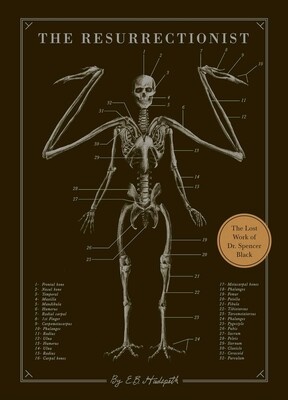
The Resurrectionist
In late nineteenth-century Philadelphia, surgeon Dr.
About
Spoiler notice: Premise and format details follow, including the broad outline of Dr. Spencer Black’s career and his disappearance. Specific late turns are withheld.
The Resurrectionist is built as a found archive from a life that never existed. E. B. Hudspeth presents Dr. Spencer Black as a nineteenth-century surgeon whose biography and scientific work have been recovered together, and the book asks the reader to enter that fiction as if handling a cabinet of medical curiosities. Its two-part construction is central to the experience: a narrative account establishes Black’s ambitions and decline, then The Codex Extinct Animalia gives those ambitions a visual form through anatomical studies of mythic animals. The title’s subtitle, The Lost Work of Dr. Spencer Black, signals the conceit before the story begins. This is gothic fantasy shaped like a medical document, with its invented evidence designed to make the fantastic feel organized and unsettling.
The biography places Black in Philadelphia in the late 1870s. He is introduced as the son of a grave robber, and his childhood encounters with the dead lead into formal medical training at the city’s Academy of Medicine. His life runs from corpse-exhuming childhood through study, carnival travel, experimentation and a final disappearance. These episodes give the book a recognizable biographical frame: a beginning rooted in family and education, a professional formation, a turning point, then a narrowing pursuit that takes him beyond conventional practice. Yet the account is explicitly fictional. Black is not offered as a forgotten historical physician whose papers have been authenticated; he is the invented subject through whom Hudspeth stages a speculative history of anatomy, collecting and belief.
Black’s central hypothesis supplies the story’s imaginative engine. He proposes that celebrated mythological beings, including mermaids, minotaurs and satyrs, might be evolutionary ancestors of humanity. That idea unsettles the border between natural history and folklore: if a creature can be classified, dissected and drawn, perhaps the myth has been mistaken for a story rather than a remnant of biology. The book does not turn this premise into a factual argument about evolution. Instead, it follows a fictional doctor whose effort to make the hypothesis persuasive becomes increasingly obsessive. A visit to a carnival and its anatomy museum becomes an important pivot in the narrative. There Black encounters a specimen he interprets as evidence, and his attention shifts away from conventional medicine toward the deformations that now dominate his work.
The carnival material also gives the premise a moral pressure that a bestiary alone would not have. Performers exposed to ridicule and specimens presented as public curiosities give the scene its social setting. Black interprets a deceased child with misshapen bones, extensive body hair and skull growths resembling young horns as a biological clue that supports his theory. The scene makes visible the danger in his method: he treats an ambiguous body as confirmation of a theory before he has reason to do so. The narrative’s macabre medical setting therefore concerns more than strange creatures. It asks how observation can become fixation, how classification can become a way of possessing what one studies, and what happens when a physician’s curiosity overwhelms his responsibility to the people and bodies around him.
After the life story, the Codex Extinct Animalia extends Black’s hypothesis into an illustrated reference work. Its subjects include dragons, centaurs, Pegasus and Cerberus, imagined through anatomical plates that resemble pages from a Victorian medical textbook. The shift from prose to diagrams changes the reader’s task. A biography can report what Black believed; a labelled anatomical image can make that belief appear systematic, as though each fantastic body had been examined and recorded. That appearance is part of the fiction’s craft. The plates give the mythic creatures physical structure and visual specificity, while their archival presentation raises questions about the authority usually associated with scientific illustration. The book’s horror emerges partly from this tension between precise-looking observation and an impossible premise.
Because text and image are paired, The Resurrectionist is not simply a short novel with decorative illustrations or a gallery of creature drawings with a thin narrative attached. The biography provides a reason for the codex to exist, and the codex acts as the most tangible expression of the doctor’s increasingly extreme worldview. Readers can approach the volume through its story, its invented science, or the relationship between the two. Each route returns to the same question: what does it mean to seek proof for an idea that has already taken control of the investigator? The format rewards attention to the transition between Black’s life and the illustrations, where a speculative premise becomes a system of visual evidence. It also makes the book suitable for browsing in sections, while its framing rewards reading the parts together.
The result sits at the meeting point of gothic fiction, Victorian medical imagery, mythology and dark fantasy. Hudspeth’s work is best understood as an invented archive rather than a history lesson: the fictional doctor, his career and the creatures in his codex belong to the book’s imaginative world. That distinction matters because the design borrows the visual language of scholarship and anatomy. The story can be approached as a portrait of ambition turning into obsession, while the plates invite close inspection of how a familiar myth might be recast as a body with bones, organs and structure. The Resurrectionist suits readers interested in illustrated speculative fiction, macabre curiosities and stories that let an object’s form carry part of the narrative. Its central pleasure is also its unease: the archive looks ready to be trusted even as its subject should prompt doubt.
Book details
- Author
- E. B. Hudspeth
- First published
- 2013
- Series
- No series listed
- Subgenre
- Dark fantasy, Gothic horror
- Tags
- No tags for this book.
Review
Editor profile
Baby Bat
Goodreads and social links will be added soon.
- Goodreads — link coming soon
- Social media — link coming soon