
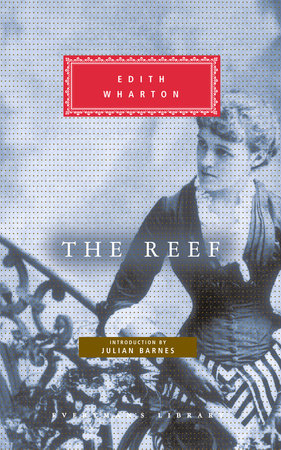
The Reef
George Darrow hopes to renew his relationship with the widowed Anna Leath, but a postponed visit leads to an encounter with Sophy Viner and a brief intimacy in Paris.
About
Spoiler notice: This overview discusses the broken engagement and the novel’s final scenes.
George Darrow is on his way to see the woman he hopes to marry when her telegram postpones the visit. The message is short, reasonable and, to his increasingly wounded pride, intolerable. He has recently met Anna Leath again after years apart, and their renewed closeness has encouraged him to imagine a future together. Now he reads rejection into a delay whose circumstances he does not fully know. Published in 1912, Edith Wharton’s The Reef begins inside this mixture of longing and self-importance. Darrow is an American diplomat accustomed to managing conversations and moving comfortably through society. Waiting at Dover in bad weather, however, he turns a disappointed expectation into an account of how badly he has been treated. The distinction between what happens and what he persuades himself it means will matter throughout the novel.
A wind-wrecked umbrella brings Sophy Viner into his path. Their subsequent time in Paris offers a temporary escape from his disappointment, but the two approach that escape from very different positions. Darrow can eventually return to his diplomatic duties; Sophy has to think about work, money and what she can afford to refuse. When he invites her to prolong their stay, she openly admits that money is the difficulty. He presents assistance as a service between friends, while his thoughts disclose the excitement of persuading her. Wharton leaves their intimacy largely between the lines, concentrating on its unequal emotional weight. Before leaving Paris, Darrow burns an unopened letter rather than allow its presence to disturb the situation around him. His ability to shut an unwelcome obligation out of sight proves much less effective later.
The story then moves to Givre, the French country house where Anna has lived through her marriage and widowhood. Its gardens, family rooms and established routines give her a settled existence without necessarily satisfying her. She cares for her daughter Effie and her stepson Owen; her late husband’s mother, Madame de Chantelle, belongs to the household’s older social order. Anna’s anticipation of Darrow changes how she sees this familiar place. A house that has sometimes felt monotonous suddenly seems full of possibilities. Wharton also looks back at Anna’s upbringing, in which strong feeling was easier to encounter in books than to acknowledge in respectable company. Her wish for a fuller life is therefore quite specific: she wants the emotional reality she has imagined, while still caring about the people and duties already surrounding her.
Darrow’s arrival brings the Paris episode into that household. Sophy is now Effie’s governess, and her relationship with Owen raises the possibility of marriage into the family. The role that offers her security also leaves her dependent on other people’s judgments. Madame de Chantelle can like a governess and still regard her as an unsuitable wife for her grandson; she asks Darrow to help oppose the match. Anna, meanwhile, connects the younger couple’s happiness with her own. Darrow is caught between requests that assume he can offer a disinterested opinion. He cannot. His earlier connection with Sophy gives him knowledge he wishes to conceal, and his instinctive opposition to her marrying Owen sits awkwardly beside his wish to protect her. Advice, loyalty and self-protection become difficult to separate whenever he enters a room.
Sophy understands the danger of this arrangement more immediately than Darrow does. During their private conversation, she asks for his help in remaining at Givre, while his offers to assist a theatrical career sound to her like attempts to make her leave. He gradually recognizes how little he has considered the episode from her position. Owen notices their confidential encounters and interprets the change in Sophy’s behaviour as evidence of Darrow’s influence. When she announces her departure, the dispute becomes a confrontation involving all four central characters. Anna initially treats Owen’s suspicions as an insult, then watches Darrow and Sophy with an attention she cannot switch off. Sophy confirms that her engagement is broken, but offers no explanation in that room. The lack of a tidy confession makes the scene more painful: everyone is struggling with a different portion of the same knowledge.
Once Anna’s confidence is shaken, affectionate gestures no longer carry a single meaning. Darrow’s ease can reassure her and, a moment later, seem like proof that he knows how to manage an awkward situation. Ordinary choices acquire a frightening second history. Suggesting a restaurant or a theatre sends her thoughts toward the places he may have visited with Sophy. She wants details, believing that knowing everything might allow her to forget, but Darrow refuses to recount them. Her bond with Owen is damaged too; she imagines an unspoken barrier between them that her usual kindness cannot remove. Yet the distress does not cancel her desire for Darrow. When he prepares to leave, she calls him back. Wharton allows that attachment its full force without presenting it as a solution to everything Anna now understands.
The final chapter gives Anna another plan: find Sophy, announce that she has relinquished Darrow, and make the decision impossible to retract. Even this intended act depends on reaching someone whose life has moved beyond Anna’s immediate view. At a shabby Paris hotel she instead meets Sophy’s sister, Mrs. McTarvie-Birch, whose surroundings unsettle her further. Sophy has left to travel to India with Mrs. Murrett, returning to an employment arrangement that had previously broken down. Anna never gets the conversation she came for. The novel ends without supplying a wedding that would settle her future with Darrow or bringing Sophy back for a reassuring reconciliation. Its closing distance between the women also preserves the material difference between their choices: Anna can struggle over the terms of a desired marriage, while Sophy must find somewhere to go and a way to live.
Book details
- Author
- Edith Wharton
- First published
- 1912
- Series
- No series listed
- Subgenre
- Literary fiction, Modern classics
- Primary genre
- Literary Fiction
- Tags
- No tags for this book.
Review
Editor profile
Baby Bat
Goodreads and social links will be added soon.
- Goodreads — link coming soon
- Social media — link coming soon